The Nigerian leader challenged the banking and financial services sector to move beyond traditional financial intermediation and play a greater role in financing businesses, production, and job creation, saying macroeconomic stability must now translate into broad-based prosperity.
President Bola Tinubu has challenged Nigerian banks to shift their focus from financing the government to providing affordable credit to businesses and productive sectors of the economy to drive investment, production and job creation.
The President said while the government’s economic reforms had restored macroeconomic stability and improved investor confidence, the next phase must focus on converting those gains into investment, production, jobs and improved living standards.
“The current phase of our reform journey is accelerating the conversion of stability into investment, investment into production, production into jobs, and growth into improved living standards,” he said.
He urged banks to move “from intermediation to transformation”, arguing that the performance of financial institutions should no longer be assessed only by balance-sheet growth, profitability and shareholder returns.
According to him, the critical question should be what the financial system is doing for the real economy.
“A resilient banking system cannot assist indefinitely where businesses cannot obtain affordable credit. Manufacturing that is struggling cannot expand, and millions of productive MSMEs remain outside the formal financial system,” Tinubu said.
He said the government was therefore expanding the architecture of guarantees, risk-sharing, blended finance and credit enhancements, with a National Credit Guarantee Company at its core, to crowd in private capital and support productive investment.
The Nigerian leader said success should increasingly be measured by how much productive capital government policies catalyse, rather than simply by how much the government spends.
The President also said the recently concluded bank recapitalisation must result in more than larger balance sheets, stressing that it should translate into increased capital formation in the real economy.
“It must translate into capital formation in the real economy, financing Nigerian businesses as they expand across Africa and pursue our ambition of a $1 trillion economy,” he said.
“A bigger bank that does not finance a more productive economy is a suboptimal outcome.”
He also called for broader financial inclusion, saying access to bank accounts does not automatically translate into access to finance.
He said the financial system should enable small businesses and entrepreneurs to obtain working capital based on viable cash flows rather than collateral they may not possess.
“We must build a system that finances potential and opportunities rather than quick gains for the privileged,” he said.
Mr Tinubu further called for a transition away from a financial system where attractive returns on government securities make lending to productive businesses less compelling.
He said that improving fiscal conditions would allow the government to create more space for private-sector credit progressively.
The President described the desired outcome as a “virtuous cycle” in which stronger fiscal discipline reduces pressure on government borrowing, lower inflation lowers interest rates, and cheaper capital stimulates investment and production.
He added that increased production would generate more jobs, incomes and tax revenues, further strengthening fiscal sustainability.
“That is how gains from reform begin to compound at scale, and the financial sector must be ready for that transition,” he said.
Tinubu also identified technology, long-term capital and trust as key pillars of a resilient financial system, warning that greater digitalisation would bring increased cybersecurity risks.
He said Nigeria would need to deepen its capital markets, insurance, pension, and asset management industries to mobilise domestic savings and foreign capital for long-term investment.
On the broader economy, the President said Nigeria’s GDP grew by 4.43 per cent in the second quarter of 2026, while headline inflation had eased to 15.43 per cent and external reserves had crossed $54 billion.
He said the improvements showed that “stability has returned” and “credibility is rising”, but cautioned that macroeconomic stability should not be mistaken for economic prosperity.
“Stability is a foundation; prosperity is a destination,” Mr Tinubu said.
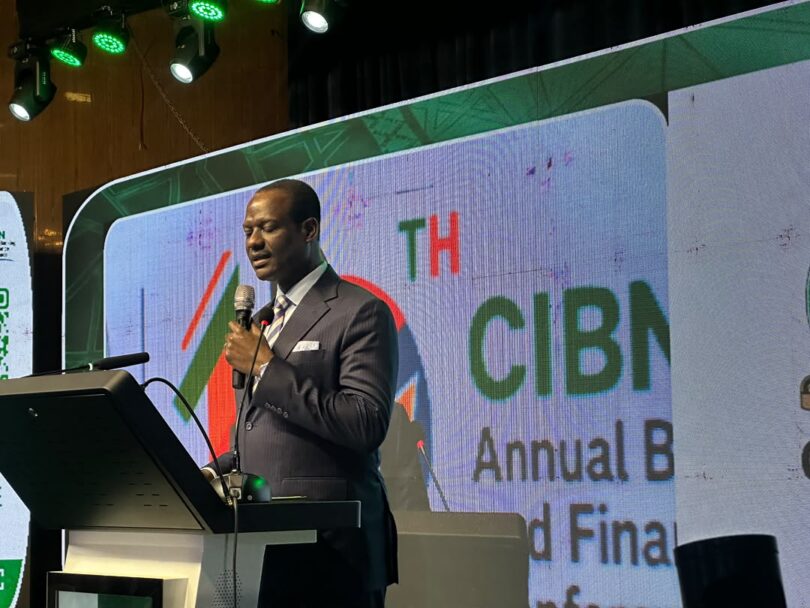
In his remarks, Dele Alabi, President/Chairman of Council, CIBN, said the good news is that certain policies implemented in the past couple of years are beginning to yield fruit.
For example, he argued that within Nigeria’s financial system, 33 banks met the revised minimum capital requirements, raising ₦4.65 trillion in new capital, providing a further buffer against domestic and external shocks.
“Likewise, recent indicators show that these efforts are beginning to rebuild confidence. As announced by Moody’s Ratings on 28 August 2026, Nigeria’s outlook was changed from stable to positive while the sovereign rating was affirmed at B3,” he said.
Additionally, the CIBN president explained that according to FTSE Russell’s March 2026 Semi-Annual Country Classification Review, Nigeria will be reclassified from Unclassified to Frontier market status, effective 21 September 2026.
“To top all this off, the icing on the cake is that according to the latest figures from the National Bureau of Statistics’ Q2 2026 Gross Domestic Product Report, real GDP grew by 4.43 per cent year-on-year in Q2 2026, up from 3.89 per cent in Q1 2026,” Mr Alabi said.