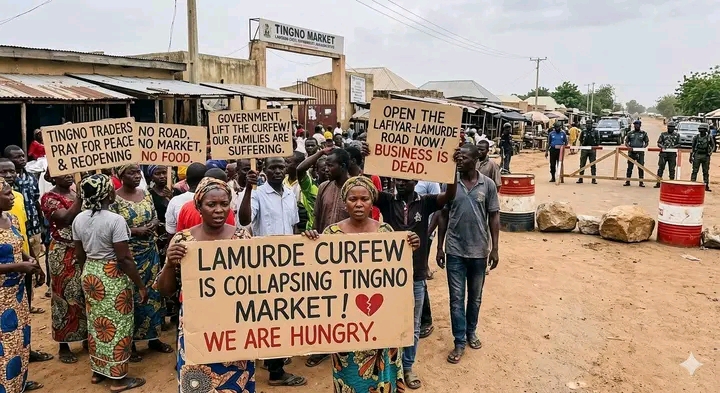
Speaking to PREMIUM TIMES, local merchants explained that the curfew has halted the movement of essential supply vehicles which led to the total closure of the popular Tingno market in the Lamurde Local Government Area.
Traders are lamenting a curfew imposed by the Adamawa State Government on 8 March following a resurgence of violence between the Bachama and Tsobo ethnic groups in Lamurde Local Government Area.
Traders told PREMIUM TIMES that the curfew has halted the movement of essential supply vehicles which led to the total closure of the popular Tingno market in Lamurde.
The brunt of this disruption is also being felt in the adjoining Karim Lamido LGA of Taraba State, where daily routines and rural economic stability have been affected.
A trader, Babangida Haruna, stated that the curfew has effectively severed a vital federal government road used to transport essential commodities.
“The curfew is killing economic activity,” Mr Haruna said. “It has affected the main artery that supplies residents in both Tingno in Adamawa and Karim Lamido in Taraba.”
“The closure of the Tingno weekly market has been particularly devastating. Typically, at least 50 trucks loaded with paddy rice depart Tingno weekly for large-scale milling factories in Kano and other industrial hubs.
“With the market shuttered and transport routes blocked, the price of paddy rice is plummeting as buyers from outside the state can no longer gain access,” he added.
Mr Haruna said the crisis is leading to financial losses, with several rice dealers crying that paddy rice, which has not been sufficiently dried, cannot remain in stranded vehicles for extended periods without getting spoiled.
He added that the situation is equally dire for traders in Karim Lamido, Taraba State, as assorted heavy-duty vehicles from Gombe State, which usually supply these markets, are currently blocked.
“Every week, we send at least not less than 10 trucks of goods from Gombe to Karim Lamido,” Mr Haruna lamented. “Now, not a single truck has left because of the curfew.”
He said only a few small vehicles are managing to manoeuvre through bush paths to deliver limited supplies for the Karim Lamido market in Taraba State.
Adamu Maikudi, a rice dealer at the Tingno market, said the violence and government-imposed curfew are crippling rural economies.
According to Mr Maikudi, these disruptions have forced dealers to operate at a loss due to escalating transportation overheads. He said traders are forced to pay an additional N2,000 per bag of paddy rice to move produce from Tingno to Lafiya Lamurde. This detour, he added, is a necessary precursor before the goods can be consolidated for long-haul transit to Kano.
“We are hiring trailer trucks for N1.6 million to transport paddy rice from Tingno town to milling factories in Kano, the same amount we are now paying at the Lafiya Lamurde despite bringing the goods closer to the main road”.
“While that long-distance rate remains fixed whether we load at Tingno or Lafiya Lamurde, the extra N2,000 per bag required just to reach the loading point in Lamurde is consuming the narrow profit margins we once relied on,” Mr Maikudi said.
The Adamawa State Government says it imposed the 24-hour curfew in Lamurde to restore order following a spike in violent attacks and breaches of peace in Lamurde Local Government Area.
Ahmad Lawan, the security aide to Governor Ahmadu Fintiri, stated that the curfew was implemented solely to safeguard lives and property, rather than to cause hardship for the citizens.
In an interview with the Hausa service of Radio France International (RFI), Mr Lawan explained that the state government is currently reviewing the situation.
He said the goal of this assessment is to determine how the curfew can be eased to allow business activities to flourish once again in the affected areas.
The conflict exists between the Bachama and Tsobo ethnic groups who are predominantly farmers and the traditional custodians of the land in the area. The conflict is a long-standing dispute centred primarily on land ownership, fishing rights, and administrative control.
The curfew was triggered by a renewed breach of peace which usually implies a retaliatory attack or a disagreement over land boundaries; a spark in one village often ignites a tit-for-tat cycle across the entire LGA.