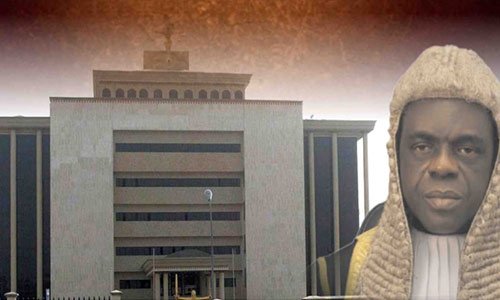
The Chief Judge of the Federal High Court of Nigeria, Hon. Justice John Terhemba Tsoho, OFR, has issued new Practice Directions governing the handling of pre-election matters across all divisions of the Federal High Court, repealing the 2022 Practice Directions and establishing a comprehensive procedural framework designed to ensure the fair, impartial, and expeditious determination of pre-election cases ahead of the 2027 general elections.
The Federal High Court (Pre-Election) Practice Directions, 2026, made at Abuja on June 26, 2026, comes into effect on Monday, June 29, 2026. It was issued pursuant to Sections 254, 285(9), (10), and (14) of the Constitution of the Federal Republic of Nigeria, 1999 (as amended), and Sections 29(5) and 88(2) of the Electoral Act, 2026.
The Practice Directions introduces significant innovations including the opening of court registries on weekends and public holidays exclusively for pre-election filings, the power of the Chief Judge to transfer pre-election cases across judicial divisions and nominate judges to sit in any division, the use of virtual hearings, strict page limits on written addresses, the suspension of preliminary objections until the stage of final judgment, and a maximum of two adjournments for any party.
Objectives and Guiding Principles
The Practice Directions sets out five objectives: to provide for a fair, impartial, and expeditious determination of pre-election cases; to ensure that in all election matters, the parties focus on matters which are genuinely in issue; to minimise the time spent in dealing with interlocutory matters; to ensure that the possibility of amicable settlement is explored before the parties go into hearing; and to minimise undue adjournments and delays in the conduct of matters.
Applicability
The Practice Directions applies to every pre-election matter brought pursuant to the Constitution and the Electoral Act, 2026. Pre-election matters are defined as matters falling within Section 285(14) of the Constitution (as amended). The provisions of the Federal High Court (Civil Procedure) Rules, 2019, continue to apply to any issue not provided for in the Practice Directions.
Parties
The Practice Directions requires that in every pre-election matter, the court shall pay particular attention to the provisions of Sections 29(5), (6), (7), 83(5) and (6), and 88(1-4) of the Electoral Act, 2026, as well as Section 285(14)(C) of the Constitution.
Significantly, a party challenging the conduct or outcome of a primary election must join as respondents in the suit all the relevant parties to enable the court to effectively determine the dispute. This provision addresses the recurring problem in pre-election litigation where cases are decided without all affected parties being heard, a concern that has featured prominently in recent judicial controversies.
Filing of Processes: Registries Open Seven Days a Week
In one of the most practically significant provisions, the Practice Directions recognises the time-sensitive nature of pre-election cases by directing that the Registry of the Federal High Court in all Judicial Divisions across the Federation shall be open on Saturdays, Sundays, and public holidays, between the hours of 10 AM and 2 PM, exclusively for the filing of pre-election matters.
This provision ensures that litigants and their counsel are not disadvantaged by statutory deadlines that may expire on weekends or public holidays, a problem that has generated litigation in previous electoral cycles.
Commencement and Mode of Filing
Every pre-election matter must be commenced by an Originating Summons as specified in the Federal High Court (Civil Procedure) Rules. However, the Practice Directions introduces an important proviso: where a party alleges fraud, forgery, or highly contentious facts, the parties shall, in addition to or in lieu of affidavits, set out the particulars of such alleged facts, which shall be examined by way of calling witnesses viva voce or receiving documents in evidence.
This provision addresses the tension between the originating summons procedure, which is designed for cases involving questions of law or construction of documents without substantial disputes of fact, and the reality that many pre-election disputes involve allegations of fraud, forgery, and manipulation that cannot be adequately resolved on affidavit evidence alone.
The parties and the court are also entitled to summon any person to attend, produce documents, or be examined or cross-examined before the court.
An Originating Summons must be accompanied by an affidavit setting out the facts relied upon, copies of exhibits, a written address, and an affidavit of non-multiplicity of action on the same subject matter.
Strict Timelines for Responses
The Practice Directions imposes tight deadlines for all procedural steps. A respondent served with an Originating Summons has seven days from the date of service to file a Memorandum of Appearance. Within ten days of service, the respondent must file a counter-affidavit and written address, which may include any Preliminary Objection raised to the action. An applicant who receives a defence has three days to serve a reply. Any amendment to the Originating Summons may be made with leave of court within seven days of service of the Respondent’s Reply.
Written addresses must be concise, typed in double spacing with font size of twelve, numbered consecutively, and shall not exceed fifteen pages.
Service of Process
The Practice Directions prohibits parties from serving a notice of an application on another party on the day fixed for hearing, a practice that has been criticised for ambushing opponents and undermining fair hearing.
To ensure speedy dispensation of justice, electronic mail and other electronic means may be employed by the court to inform counsel of urgent court events, provided that such notification is given at least forty-eight hours before the scheduled court date. Parties are expected to furnish the Court Registrar with functional telephone numbers and email addresses of themselves and their counsel.
Power to Transfer Cases Across Divisions
In a provision that carries significant implications for the administration of pre-election justice, the Practice Directions empowers the Chief Judge to nominate judges to sit in any Judicial Division for the hearing and determination of pre-election matters and to transfer pre-election matters from one Judicial Division to another.
This power could be used to address concerns about forum shopping, ensure that complex cases are assigned to experienced judges, balance caseloads across divisions, or respond to situations where the assignment of a particular case to a particular division raises concerns about impartiality. However, the breadth of the power also means that the Chief Judge has considerable discretion over which judges handle politically sensitive pre-election cases, a discretion that carries its own accountability implications.
Virtual Hearings
The Practice Directions expressly empowers judges handling pre-election matters to leverage technology in the conduct of proceedings, including virtual hearings. This provision reflects ..-COVID normalisation of remote court proceedings and provides flexibility for cases involving parties, counsel, or witnesses in different locations.
Where counsel is unable to appear due to ill health or unavoidable circumstances, the Practice Directions requires that a substitute counsel of requisite knowledge be present or that an application be made for the case to be heard virtually where practicable with the consent of parties.
Hearings: Seven-Day Rule and Maximum Two Adjournments
The Practice Directions establishes a seven-day rule: upon the close of exchange of processes between the parties, the court shall within seven days set down the matter for hearing. The court must continue to accord priority to all pre-election matters until judgment is delivered.
Where a matter comes up for hearing and either of the parties is absent, the court shall either suo motu or upon oral application by counsel for the party present, order that the address of the absent party be deemed adopted if it is satisfied that the parties had notice of proceedings.
The most striking anti-delay provision is the limitation on adjournments: not more than two adjournments shall be granted to any party to an action covered by the Practice Directions. No application for adjournment shall be entertained on a day fixed for hearing.
Counsel are required to ensure they are present in court and ready to proceed with their case at all times.