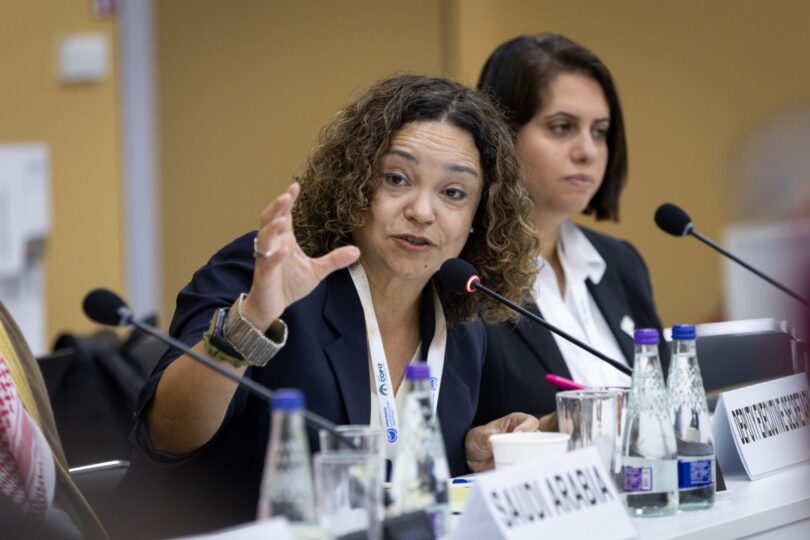
The Deputy Executive Secretary of the United Nations Convention to Combat Desertification (UNCCD), Andrea Meza, has expressed optimism that countries negotiating at COP17 in Mongolia will reach an agreement on drought management, despite differences among parties.
The Deputy Executive Secretary of the United Nations Convention to Combat Desertification (UNCCD), Andrea Meza, on Wednesday briefed journalists on key issues and developments shaping the ongoing COP17 negotiations in Ulaanbaatar, Mongolia.
She said drought should no longer be treated simply as an environmental issue but as a structural risk to economies, productivity systems, ecosystems, value chains and livelihoods.
“We really need to understand that we are not talking about an environmental issue when we talk about drought. We are talking about a structural risk to our economies, productivity systems, ecosystems and livelihoods.”
According to her, drought is a global phenomenon with effects cutting across multiple sectors and regions.
She cited drought-induced food insecurity in parts of Africa, disruptions to international commerce around the Panama Canal and significant agricultural losses in Europe.
Ms Meza also noted that drought was affecting regions not traditionally associated with severe water shortages.
“This morning, we were in a meeting with the Minister of Brazil, who said that even in the Amazon — a place we always associate with tropical forests and a lot of rain — we are seeing the effects of drought,” she said.
She added that the scientific evidence points to more frequent and intense droughts, making proactive planning increasingly urgent.
“What we are hearing from science is that we will have more frequent and intense droughts. This is the reality,” she said.
Ms Meza said governments, communities and businesses could no longer afford to wait until drought strikes before responding.
“This is why it is very important that countries, communities and companies move towards proactive drought management,” she said.
She identified access to information and investment in early-warning systems as essential components of such an approach.
However, she said early warning should go beyond generating scientific information to ensuring that it reaches those who need it and can act on it.
“We need to know when droughts are coming. But it is not only about generating this information. It is about what we do with it,” she said.
She said governments must develop drought plans and policies that identify vulnerable sectors in advance and guide investments in resilience.
“Countries need to have their drought plans and drought policies. They need to know which sectors will be most affected in advance, and they need to start investing in becoming more resilient.”
Ms Meza said this was one reason the ongoing negotiations were important, arguing that a COP decision could provide countries with clearer guidance on the elements and steps required for proactive drought management.
Beyond policy and early-warning systems, she said substantial financial resources were needed to implement drought resilience measures at scale.
She cited the International Drought Resilience Alliance and the Drought Investment Facility as initiatives that could help mobilise resources, including private capital, for vulnerable countries.
She also pointed to the Global Environment Facility’s ninth replenishment, GEF-9, which she said was opening new financing opportunities and recognising the need for increased investment in proactive drought management.
Ms Meza also highlighted the International Drought Resilience Observatory as an important tool for translating complex scientific information into accessible information for decision-makers.
“We need to know in advance that droughts are coming, but we also need to understand whether the actions we are implementing are generating more resilience,” she said.
According to her, measuring the impact of investments would also help governments and investors make a stronger economic case for drought-resilience spending.
Responding to a question from a Spanish journalist on whether politicians and businesses were taking drought seriously, Ms Meza said companies were increasingly recognising drought as a business risk.
She said businesses were already experiencing disruptions to production systems and supply chains, with agribusinesses in particular facing difficulties securing commodities needed for production.
“Just as we say that no country is immune to drought, we can say that no economic sector is immune to drought,” she said.
She urged businesses to incorporate drought into their risk-management strategies while also exploring opportunities presented by new technologies and innovations.
She cited precision agriculture, water-saving technologies, water reuse, drought-resistant crops and other innovations as areas where the private sector could contribute to solutions while creating new business opportunities.
But she stressed that the private sector’s responsibility went beyond developing new products and services.