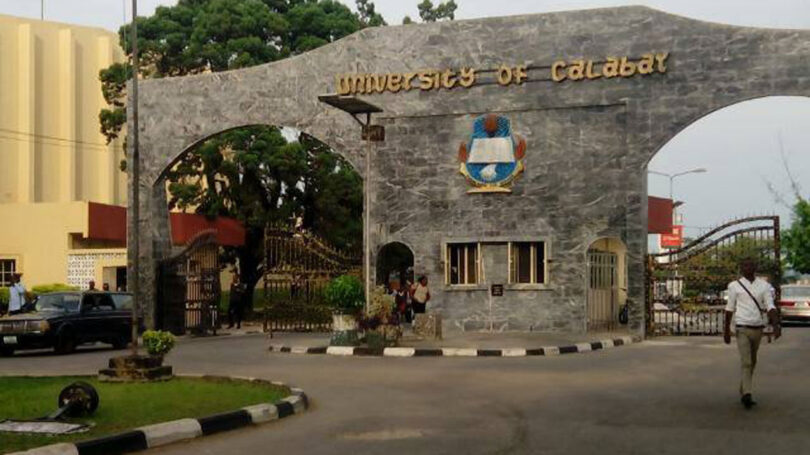
The controversy began this month after the University of Calabar had directed 214 second-year Law students to return to the departments where they were originally admitted into by the institution.
Over 200 students of the University of Calabar, Cross River State, have sued the university, its vice-chancellor, the registrar and President Bola Tinubu over their removal from the Faculty of Law and transfer to their former faculties and departments.
In the suit, they argued that their admission letters, payment of prescribed fees, course registration, examinations and JAMB regularisation created “valid, binding, and subsisting legal contracts” between them and the university.
They also argued that Vice-Chancellor Offiong Offiong, could not invalidate “the official acts, admissions, JAMB regularisation approvals, and institutional commitments made by his predecessor-in-office to the detriment of the Claimants.”
The controversy began this month after the University of Calabar had directed 214 second-year Law students to return to the departments where they were originally admitted into by the institution.
Vanguard reported that the decision followed a meeting between the university management, the Faculty of Law, the affected students and the Law Students’ Association of Nigeria, UNICAL chapter.
Mr Offiong said only 221 of the 435 students in the second year of the Bachelor of Laws (LL.B) programmes were officially admitted into Law. In comparison, the other 214 students had entered the faculty from other departments.
The university further explained that the affected students would not be eligible for the Nigerian Law School if they remained in Law under their current admission status.
It therefore temporarily locked their portals to facilitate their transfer back to their original departments. However, the university offered to refund their 2025/2026 school fees or provide free tuition for the 2026/2027 session in their original departments.
In an affidavit filed in support of the suit, Ogana Lawrence Lukpata, the second claimant, who said he was “personally affected by the administrative actions” stated that the university admitted him and 213 other students into its Faculty of Law between the 2023/2024 and 2024/2025 academic sessions.
After their admission, he said, the students accepted the offers, “paid acceptance fees, completed the required screening and paid school fees for almost three academic years.”
They subsequently registered for Law courses, “attended lectures, submitted continuous assessment assignments and sat for examinations conducted under the supervision of the university.”
According to the affidavit, the students passed their examinations and progressed from 100 Level to 200 Level, “with some reaching 300 Level.”
Mr Lukpata said the university later instructed the students to undergo JAMB regularisation, which they did after paying the required processing fees.
But he said problems arose after Mr Offiong, a professor of Chemistry, became vice-chancellor and “refused to sign” or complete the initial regularisation documents processed under his predecessor, Florence Obi, a professor of special education.
Mrs Obi served as vice-chancellor of the University of Calabar from December 2020 and handed over to Mr Offiong on 1 December 2025 after completing her five-year tenure.
The students said Mr Offiong claimed the forms did not bear his name and they consequently had to repeat the JAMB regularisation process and pay the required fees again, according to the affidavit.
But on 5 August, when the university management convened a meeting at the Senate Chamber with representatives of the Faculty of Law and the affected students, Mr Lukpata said Mr Offiong announced at the meeting that “214 of the 435 students in the LL. B II class would be removed from the Faculty of Law” and directed them to return to their former departments.
The affidavit said the university then locked the students’ academic result portals, cutting off their access to learning portals, academic transcripts and ongoing university activities.
“The Respondents gave no prior query, notice of allegation, administrative panel hearing, or opportunity for any of the Claimants to defend their status before taking this extreme measure,” the affidavit read. It also stated that none of the 214 students had been investigated, indicted or found guilty of examination malpractice, breach of university regulations or any act amounting to gross misconduct.
Therefore, the students questioned why university officials who handled the students’ admissions, fee payments and other administrative processes had not been investigated or sanctioned.
“Instead of holding its staff accountable for administrative lapses, the university management singled out innocent students who acted in good faith and spent years studying law courses,” they said in the affidavit.
Through the suit signed by a group of lawyers led by Okpi Bernard, the students raised some questions for determination to de
Among the questions was whether the vice-chancellor, can “arbitrarily and unilaterally” invalidate official acts, admissions and JAMB regularisation approvals made under his predecessor.
They also asked if the university can, under Section 18 of the University of Calabar Act, demote, eject or transfer students, or lock their academic portals, without first investigating them or finding them guilty of gross misconduct or academic dishonesty.
They also asked the court to resolve whether President Tinubu, as the appointing authority for the vice-chancellor, has a statutory responsibility to intervene and stop the university authorities from enforcing what the students describe as unlawful and oppressive decisions affecting their academic status and fundamental rights.
Urging the court to answer the questions in their favour, the students sought a declaration that their admission letters, acceptance of the offers, payment of fees, course registrations, examinations and compliance with JAMB regularisation requirements created valid contracts with the university.
They also urged the court to hold that the vice-chancellor is bound by “the doctrine of executive continuity and administrative estoppel” and cannot nullify official acts, admission approvals and academic standing granted under his predecessor.
They also want the court to declare that their removal from the Law faculty and the locking of their academic portals violated Section 18 of the University of Calabar Act and their constitutional right to fair hearing.
They asked the court for a permanent injunction restraining the university, its vice-chancellor and Registrar from “demoting, transferring, ejecting, restricting portal access, denying learning opportunities” or taking other adverse action against them as Law students.