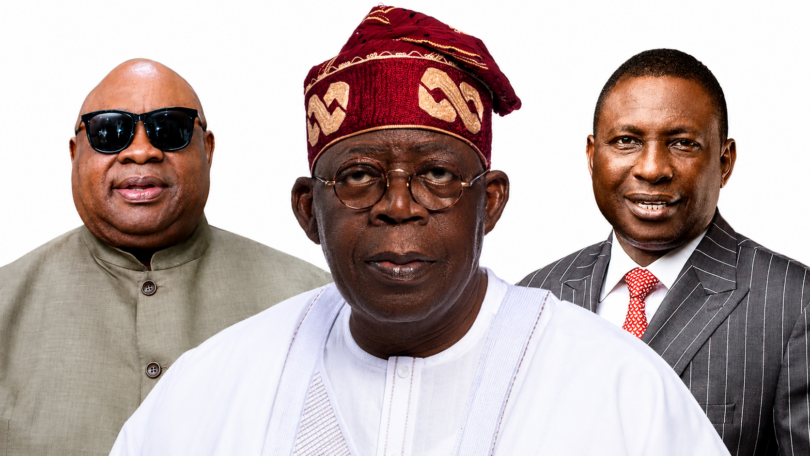
President Tinubu described the timing of the freezing of the Osun State Government’s account as deeply embarrassing to him.
President Bola Tinubu has ordered the Economic and Financial Crimes Commission (EFCC) to lift the freeze order it placed on a bank account of the Osun State Government.
The directive came amid growing criticisms of the anti-corruption agency’s action, which has increasingly drawn condemnation as a politically motivated step.
On Wednesday, the EFCC asked First Bank to freeze an account belonging to the Osun State Government, days before the 15 August governorship election in which Governor Ademola Adeleke of the Accord Party is running against Bola Oyebamiji, the candidate of the president’s party, the All Progressives Congress.
“I must state that I feel deeply embarrassed not by the EFCC’s exercise of its mandate backed by a court order, but by the timing of the agency’s action,” Mr Tinubu wrote.
“This is so because every action taken by an institution of State, especially at the Federal level, is always credited to me, as the President, even when I may not have had any prior knowledge of the action.”
The president said he learnt that the EFCC obtained a court order on 5 August (Wednesday) to freeze the Osun State Government’s account.
But that runs counter to EFCC’s framing of the sequence of events.
A viral 5 August from the EFCC, which triggered the freeze order, only requested First Bank, the state’s banker, to place a Post-No-Debit order on a particular account run by the state government without citing any court order.
Also, EFCC’s Director of Public Affairs, Wilson Uwujaren, appeared on Arise Television earlier on Thursday to justify the EFCC’s move to freeze the state government’s account without a court order.
However, the president reiterated in his statement on Thursday that the EFCC obtained a court order to freeze the account, a claim that had been part of the agency’s narrative regarding the case.
Mr Tinubu admitted that he had not been “fully apprised of the facts which informed the action of EFCC in approaching the court to obtain the said order freezing the Osun State Government account.”
Nevertheless, he said the anti-corruption agency’s action could undermine public confidence in the upcoming electoral process in Osun.
He said while he intentionally refrained from directing or interfering in the operational activities of the EFCC or any other investigative or prosecutorial agency, he felt compelled to intervene in the Osun State matter.
“Osun State is only a few days away from its gubernatorial election. Therefore, nothing ought to be done to give an impression that the EFCC or indeed any other agency of the federal government is being used to interfere with the election.
“Based on the foregoing premise, I am duty-bound to issue a directive on this issue in consonance with the overriding public interest in preserving public confidence and the integrity, credibility, and fairness of our democratic process,” Mr Tinubu stated.
“”Accordingly, I have directed the EFCC to immediately proceed to the court to vacate the order and discontinue whatever action it has instituted against the Osun State Government in this regard.”
The directive marks a dramatic intervention by the president in a controversy that has dominated political discourse in Osun State over the past 24 hours, after the anti-graft agency froze one of the state’s accounts over an ongoing investigation into the alleged diversion of about N11 billion in public funds.
The president’s directive came just hours after the EFCC defended its decision to place a restriction on an Osun State Government bank account without first obtaining a court order.
Speaking during an interview on Arise Television on Thursday, the EFCC’s Director of Public Affairs, Wilson Uwujaren, said the anti-graft agency acted after detecting what it described as suspicious movements of funds from the account.
According to him, the restriction was intended to preserve public funds while investigations continue.
“We observed in the past one week that activities on that account looked suspicious, and based on the mandate of the Commission, we took the step of placing a restriction on that account to preserve it,” Mr Uwujaren said.
He said the commission did not freeze all the accounts belonging to the Osun State Government but only imposed a restrictin on one account under investigation.
The commission’s defence comes amid growing criticisms of the enforcement action, which came less than two weeks before the governorship election.
Some lawyers, including the president of the Nigerian Bar Association (NBA), Afam Osigwe, have argued that the EFCC lacked the power to order a bank to restrict access to a government’s bank account, and that if it must do so, it must be based on a court order.
Rejecting the account restriction, the Osun State Government has also read political motivation into the EFCC’s action.
The state government described the action as unlawful and politically motivated.
Responding to criticism that the commission acted without judicial approval, Mr Uwujaren maintained that the EFCC possesses statutory powers to impose a temporary restriction on accounts suspected to be linked to financial crimes.
He cited Section 34 of the EFCC Act and Section 7(6) of the Money Laundering (Prevention and Prohibition) Act 2022 as empowering the commission to take such action.
According to him, the restriction can remain in place for up to 72 hours before the commission would be required to seek a court order if further restraint becomes necessary.