Onoja Baba
On the morning of 13 August 2026, the Ghana Police Service announced that it had foiled a planned armed robbery targeting three banks in the upscale Labone district of Accra. According to the official statement, intelligence received around 10:45 a.m. indicated that a gang was preparing to attack branches of GCB Bank, Ecobank and Zenith Bank.
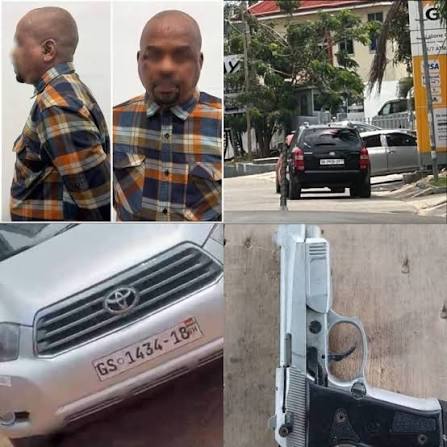
The police said officers deployed to the area spotted suspects in vehicles parked nearby. When the suspects noticed the police, one vehicle sped off, triggering a chase that led to the arrest of a Nigerian national identified as Augustine Okechuku Maazi (also referred to in some reports as Okechukwu Maazi).
The police explained that another occupant of that vehicle escaped. Occupants of a second vehicle allegedly opened fire while attempting to flee, resulting in a shootout in which two suspects were killed. Police recovered a Toyota Highlander with registration number GS-1434-18, a Hyundai Tucson with registration number GS 7915-17, and a blow pistol. Maazi was taken into custody and later remanded by an Accra Circuit Court, with further court appearances scheduled.
The plice account quickly went under scrutiny. Within hours, GCB Bank issued a firm public denial. The bank stated that no robbery or attempted robbery took place at its Labone Branch or on its premises. No breach occurred, and no customer, staff member, funds or property of the bank was affected. The Labone Branch remained secure and fully operational, the bank emphasised, urging customers to continue transactions with confidence. This direct contradiction of the police narrative, coming from a major Ghanaian financial institution that was named as a primary target, immediately raised doubts about the scale and nature of the alleged plot.
Even more troubling questions emerged about one of the recovered vehicles. Checks by SecretsReporters revealed that the Toyota Highlander bearing registration number GS-1434-18 had previously been listed by Ghanaian authorities as impounded in 2019 during a separate operation. How a vehicle that had been seized and placed under government agency’s custody years earlier could reappear in the hands of an alleged robbery syndicate in 2026 has not been explained. Parallel accounts circulating around the incident point to another recovered vehicle linked to plate GR 3588-23, described as a cloned or fake plate attached to a car with a longer history of government seizure.
That vehicle, according to these reports, formed part of earlier crackdowns by the Ghana Revenue Authority Customs Division and National Security on uncustomed luxury cars smuggled into the country, primarily through land borders with Togo. In 2017 alone, Customs reported impounding hundreds of such vehicles in operations targeting duty evasion. The path by which any vehicle from those secure government impound lots could leave custody, acquire cloned plates, and end up at a high-profile crime scene remains unanswered.
The Nigerian High Commission in Ghana formally raised concerns with the Ghana Police Service. Its media coordinator highlighted the conflicting accounts between the police and GCB Bank, the high-security character of the Labone area (near military and police installations), the recovery of only a single weapon despite claims of a multi-bank attack, and the use of registered vehicles, which is atypical for such operations in Ghana. The mission also sought clarity on the welfare of the arrested Nigerian suspect and the precise circumstances surrounding the deaths of the two others.
On social media, users amplified these doubts. One widely shared post summarised the High Commission’s points and questioned how a registered vehicle from prior police records could feature in the 2026 operation. Sahara Reporters, citing sources, asked pointedly how police could parade the same number plate in 2019 as an impounded exhibit and then present it again in 2026 as a tool of an armed gang. Commentators described the sequence as raising the possibility of a security breach at government storage facilities or worse.
Maazi remains the only named living suspect. The identities of the two men killed and the individual who escaped have not been publicly disclosed by the Ghana Police Service. No detailed explanation has been offered for how a vehicle previously under official custody left the system. The police have maintained that the operation was intelligence-driven and successful, praising their response team and thanking the public for information.
Yet the combination of the bank’s categorical denial, the unexplained reappearance of a previously impounded vehicle, the limited forensic details released, and the diplomatic questions from the Nigerian mission has left the official narrative under sustained pressure.
For many observers, particularly within Nigerian communities in Ghana and online, the episode risks reinforcing old stereotypes at a time when bilateral tensions over migration and crime periodically flare.
Whether the Labone operation represents a genuine disruption of a dangerous syndicate or a poorly explained incident that has been allowed to cast a shadow over an entire nationality depends on answers the Ghana Police Service has so far declined to provide. Until those answers emerge, particularly regarding the chain of custody of the vehicles and the full identities of all involved, the questions will continue to mount.