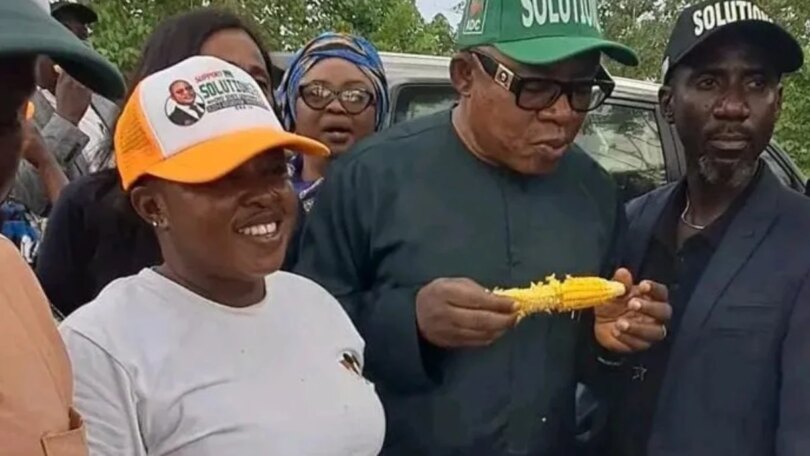
The governorship candidate of the African Democratic Congress (ADC) in Oyo State, Taofeek Adegoke, has come under public scrutiny after a video showing him sharing boiled corn with supporters surfaced online.
The clip, which has been circulating across social media platforms, captured the ADC candidate standing beside a pot of freshly boiled corn while handing portions directly to supporters gathered around him along a roadside.
In the video, several supporters crowded around Adegoke, stretching out their hands as they attempted to receive the corn personally from him.
Some repeatedly addressed him as “Mr Governor” while others chanted slogans in support of his governorship ambition.
The scene quickly attracted reactions online, with supporters describing the gesture as a demonstration of humility and accessibility.
Many argued that the politician’s willingness to interact closely with ordinary residents reflected a leadership style they could easily relate to.
Others, however, questioned whether such public displays by politicians should be viewed as genuine engagement or campaign symbolism.
This latest show by the Oyo ADC candidate has showed how more politicians are using quick roadside interactions and public appearances to win over voters before the election.
Adegoke has yet to publicly comment on the viral video, but the footage has continued to gain reactions in Oyo State and beyond.
Watch the video..
Recall in August 2019, billionaire businessman and philanthropist Tony Elumelu made headlines after a video emerged showing him stopping to buy roasted corn from a roadside vendor.
The clip showed Elumelu interacting with the seller before buying the roasted corn and taking a bite during the encounter.
After buying and eating the corn on camera, the video resurfaced in July 2026, getting Nigerians talking all over again.
Politics Nigeria earlier reported that the First Lady Senator Oluremi Tinubu, encouraged Nigerians facing economic difficulties to consider small businesses such as selling akara, roasted corn and kulikuli as a means of earning income.
Since then, roasted and boiled corn have unexpectedly become recurring symbols in public conversations surrounding politics, leadership and grassroots engagement.
Other Nigerian politicians have also used brief roadside encounters with street vendors and locals to project a humble, grassroots image.
However, the tactic has drawn sharp backlash from critics who view these stunts as insincere campaign ploys.
On February this year, the Minister of the Federal Capital Territory, Nyesom Wike, criticised politicians who engage in what he described as symbolic roadside displays during election campaigns.
Speaking at a public event, Wike dismissed the growing trend of politicians purchasing corn and other items in public as a campaign strategy.
According to him, electoral success should be based on performance rather than carefully staged public gestures.
“Winning an election is not by buying corn on the road. Winning of election is to show the people what you have done,” Wike said.
The comment by the minister came amid increasing appearances by politicians seeking to identify with ordinary citizens through roadside purchases, market visits and similar public interactions.
A few weeks later, Wike again revisited the issue while commenting on campaign activities linked to former Minister of Transportation, Rotimi Amaechi.
During the exchange, Wike described some politicians as “emergency corn chewer(s),” suggesting that certain public figures only engage in such displays when elections are approaching.
The issue itself is not new.
Over the years, politicians across the country have distributed food items ranging from rice and bread to noodles, chickens and other household commodities during campaigns and political outreach programmes.
Former Ekiti State Governor Ayodele Fayose famously defended what became known as “stomach infrastructure” politics, arguing that hunger remains a major concern for many Nigerians.
Speaking on the issue years ago, Fayose said, “When we banish hunger, we can talk of roads and other social infrastructure. A hungry man may not value a road that is tarred because his major concern is to have food to eat.”
The statement became one of the most referenced quotes in discussions surrounding food-based political campaign in Nigeria.