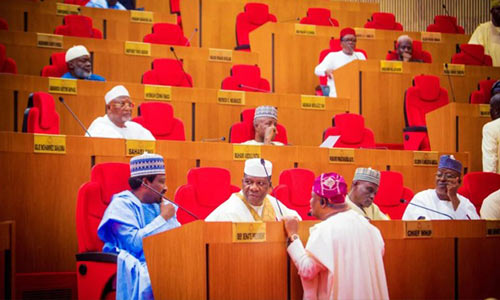
The Senate has clarified that the prohibition of preaching and hawking inside commercial vehicles was not newly introduced through the ongoing amendment of the Federal Road Safety Commission Establishment Act, insisting that the activities have been classified as road traffic offences since 2007.
The clarification followed widespread criticism of the Federal Road Safety Corps Amendment Bill, 2026, which prescribes a ₦50,000 fine for anyone convicted of trading, hawking or preaching inside a commercial vehicle.
In a statement issued on Monday by the Directorate of Media and Public Affairs in the Office of the Senate Leader, Senator Opeyemi Bamidele, the upper legislative chamber said reports suggesting that lawmakers had created a new restriction on religious activities were misleading.
According to the Senate, the controversial provision has long existed under Section 10(4) of the Federal Road Safety Commission Establishment Act, 2007, and Regulation 220 of the National Road Traffic Regulations, 2012.
“The Senate has duly noticed public concerns on the purported proscription of preaching and hawking in a commercial vehicle under the ongoing amendment to the Federal Road Safety Commission (Establishment) Act, No. 22, 2007,” the statement said.
It added that preaching and hawking inside commercial vehicles were already recognised as offences before the current legislative exercise began.
“Preaching and hawking in a commercial vehicle are offences. The offences have been part of the Act before the current amendment,” the Senate stated.
The upper chamber explained that the provision was previously listed as Item 36 in the Second Schedule to the 2007 Act but was renumbered as Item 49 in the proposed amendment.
It maintained that the change in numbering should not be interpreted as the creation of a new offence.
“Entrenched as Item 36 in the Second Schedule of the Act, preaching and hawking in a commercial vehicle are not new provisions in our legal system. The provisions have been part of the Act as far back as 2007. However, it is now listed as Item 49, Second Schedule of the Act,” the statement added.
The Senate also rejected claims that the bill would outlaw preaching on streets, in markets, at motor parks or in other public spaces.
It said the restriction relates specifically to activities conducted inside commercial passenger vehicles and was designed to protect commuters and other road users from distractions that could contribute to accidents.
“The Bill, therefore, does not outlaw preaching on the streets as some interests have claimed in different fora. It is about the safety of commuters and other road users and not intended to undermine any religious activity in the public space,” it said.
The clarification came after strong reactions from religious leaders, civil society organisations and members of the public who interpreted the proposed ₦50,000 fine as an attempt by the National Assembly to suppress religious expression.
The Senate maintained that the objective of the provision was road safety rather than the regulation of religion, stressing that street preaching and other lawful religious activities in public spaces were not affected by the bill.
It also distanced Senate Leader Opeyemi Bamidele from the initiation and sponsorship of the legislation.
According to the statement, Bamidele did not introduce the bill, as it was originally amended and passed by the House of Representatives before being transmitted to the Senate for concurrence.
“The Bill is not an initiative of Leader of the Senate, Senator Opeyemi Bamidele. Rather, it is a concurrence bill first amended by the House of Representatives,” the statement said.
The Senate explained that under the Constitution, a bill must be approved by both chambers of the National Assembly before it can be presented to the President for assent.
“As required by the 1999 Constitution, the Bill requires the concurrence of the Senate before it can become effective,” it added.
The upper chamber stressed that the legislative process had not been concluded and encouraged individuals and organisations concerned about any of the proposed provisions to formally present their objections to the appropriate institutions.
“The amendment process is still ongoing. In the spirit of democracy, stakeholders can channel their concerns to the appropriate institutions before the completion of the process,” the statement said.
Beyond preaching and hawking in commercial vehicles, the proposed amendment seeks to substantially increase penalties for several road traffic offences.
Under the bill, the fine for driving under the influence of alcohol, narcotics or other intoxicating substances would rise from ₦5,000 to ₦100,000.
A person convicted of driving while intoxicated could also face a prison sentence of up to two years or both the fine and imprisonment, depending on the circumstances and the court’s decision.
Reckless or dangerous driving would similarly attract a fine of up to ₦100,000, imprisonment or both penalties.
The proposed legislation also increases the fine for exceeding the prescribed speed limit from ₦5,000 to ₦100,000.
Motorists who disregard traffic lights, road signs, pavement markings or other authorised traffic-control devices could also face fines of up to ₦100,000.
The Senate said the increased sanctions were intended to strengthen compliance with road traffic regulations, reduce dangerous conduct and improve safety for passengers, pedestrians and motorists.
The bill will not take effect merely because it has been considered by the National Assembly. It must complete the legislative process and receive presidential assent before its amended provisions can become enforceable as a new Act.