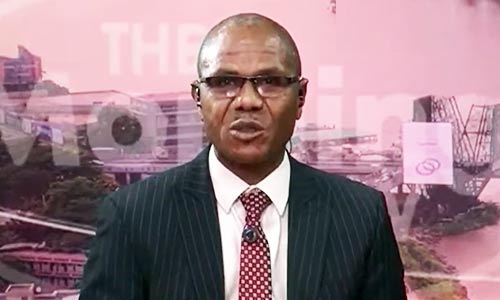
The Director of Public Affairs of the Economic and Financial Crimes Commission (EFCC), Wilson Uwujaren, has said the Commission restricted an account of the Osun State Government in order to preserve the resources of the state after it observed suspicious transfers on the account within one week, insisting that the measure is a targeted restriction on a single account and not a freeze of the state’s finances.
Uwujaren spoke on Arise Television on Thursday. The following is an account of his statements in the interview.
Explaining why the Commission acted, Uwujaren said: “As we indicated in the statement released by the Commission, we took that step to preserve the account of the Osun State government. We observed… In the past one week, activities on that account looked suspicious. And based on the mandate of the Commission, we took that step of placing a restriction order on that account to preserve that account.”
He said the measure was confined to one account. “That restriction order does not mean that all the accounts of Osun State have been frozen. No. It is just a targeted restriction on one account of Osun State government.”
On what triggered the decision, he said: “The essence, like I said, is just to preserve that account because we observed suspicious activities on that account in terms of transfer of funds to a number of entities within one week. We have to take that decision to place a restriction on that account, not minding the fact that there is an election process in place.”
He added: “We have the responsibility under the law to do so because if we don’t take that step and, for instance, funds are looted from the account of Osun State government… I’m sure the Nigerian public will also ask, where was the EFCC when those funds were being moved? So we have to take preventive action in placing that restriction order to preserve the money in the account.”
Uwujaren said the restriction does not impede governance in the state. “It does not stop Osun State government from running the government of the state because they have access to other funds in the other accounts that they have. In any case, the rolling out of the payment of salaries and other expenditure by state government happens just once in a month.”
He continued: “And what we have done is not a blanket freezing of the account; it’s just targeted freezing. And once we are satisfied that activities on that account are no longer suspicious, it will be lifted.”
Asked to state precisely what was covered, he said: “We didn’t freeze all the state government accounts. We only targeted one statutory account, which is restricted, temporary restriction on that account. And it does not stop the government from operating other accounts that they have. It’s only one account that is frozen for now.”
On the legal basis of the action, the spokesman said: “A number of people have asked the question whether the commission has power to do so under the law. I can assure you that we have the power to place temporary restriction on an account: Section 34 of the EFCC Act and Section 7, Subsection 6 of the Money Laundering Prohibition Act, 2002, give us that authority to take that step.”
He said the order is time-bound. “And the restriction order can last within 72 hours before we can come with a court order if we need to provide a court order.”
Asked directly whether what the Commission did was legal, he replied: “Absolutely. Those two provisions give us the power to place temporary restrictions on any account, not only limited to state government, on any account that we suspect that there are suspicious activities on those accounts. And we have 72 hours within which to produce a court order to continue to restrict those accounts or lift the restriction.”
He said the window had not been exhausted. “And we have a 72-hour window to obtain a court order, which the commission is at liberty to do. We have not exhausted that window, 72 hours, within which we either obtain a court order to continue to freeze it or lift the restriction on that account.”
On the prospect of the Osun State Government heading to court first, he said: “Well, it’s within their right to take that decision. We are also working on what we should do as an agency.”
Addressing the question of timing, Uwujaren said: “Let me address the issue of urgency. I mentioned the fact that we have noticed some suspicious activities in the last one week, especially beginning from August 2nd. A number of transactions that looked suspicious, and we had to act.”
He set the action against what happens after subnational polls. “If you look at the election cycle in Nigeria, you observe that once we have elections at the sub-national level and a new government comes in, the first thing that they talk about is that, look, my predecessor emptied the treasury and we have nothing to use to run the government. And some of them may not even be able to pay salaries. They go as far as going to banks to collect money to pay salaries.”
He continued: “Now we have a situation on our hands where the commission observed that the statutory account of this state government had suspicious activities, and we had a responsibility to act under the law. Somebody must — people like you rightly ask, why now? Because it’s just like nine days to the state election. If we say because of what people will say, because of the situation, we should fold our hands, we’ll be failing in our duty to Nigeria. We’ll also be failing in our duty to the people of Osun.”
He said neither he nor the Commission’s chairman had any personal stake in the state. “I’m not from Osun State, and the chairman of the commission is also not from Osun State, but we have a responsibility because the laws allow us to take preventive actions to preserve the resources of the state, or any accounts for that matter, if we observe that there are suspicious dealings on that account.”
Describing the decision as a difficult one, he said: “After the election, people will also raise the question: where was the EFCC? Why did they not take action? And as leaders, we should be able to take difficult decisions, difficult decisions in difficult moments. This, for us at EFCC, was a very difficult decision to take because we know that people will raise this situation. But we had to take that decision because it is our mandate to do so, and it is proper to do so because we need to preserve those resources for the people of Osun State.”
Uwujaren said the Osun action was not the first of its kind. “I understand where you are coming from. If you talk about what happened in Ekiti, we didn’t have any reason to intervene the way we are intervening now. And you don’t have access to the information that we have access to. But I can tell you that Osun State is not the first state where we’re taking this kind of action. During the Edo State election, before the coming of Governor Okpebholo, the EFCC also took actions to restrict the account of that state government when we saw that funds were being moved to suspicious accounts.”
He added: “And we were able to preserve 12 billion for them. That is why the current government was able to come on board and have resources to work. So this is not targeted at any particular government. We are simply doing our work under the law.”
When it was suggested to him that the Commission had a pattern of acting against opposition governors, he objected: “Rufai, don’t put words in my mouth. I didn’t say it’s a pattern for opposition governments. I said we have observed a pattern during the election cycle. That is the statement I made. So don’t misinterpret my position on that.”
He restated the point later in the interview: “The pattern that I agree with you is that there’s a pattern when it comes to the election cycle, that funds are usually… most times, there’s suspicious movement in terms of accounts, and we have a duty, where we have that information, to preserve those accounts from being dissipated. It’s within the mandate of the commission, and we acted within the ambit of the law.”
Asked how many days before the Edo poll that state’s account was restricted, he said: “No, I mentioned Edo State’s example just to give you an indication… No, I can’t tell you the number of days before the election. I can’t tell you offhand now. It’s not about knowing the number of days. What matters to the public was that there was a decision and order on the state account, and I told you that we were able to preserve 12 billion, which helped the new administration to take off.”
Responding to questions on Hajia Halima Shehu, who had said she wrote several letters to the Commission seeking to clear her name, Uwujaren said: “I’m coming to that… When you talk about Halima Shehu, who says she wants to clear her name — anybody that is accused of an offense that has an opportunity of clearing her name, she will be able to clear her name. But we have what we are doing within the commission, and it’s not everything that we respond to immediately. If we think it’s not auspicious for us to respond, we don’t respond.”
He said the matter remains open. “That investigation has not been concluded. It’s still ongoing, and I believe at an appropriate time, we will come out to the public to tell them the true position of things.”
On whether Osun was the only state under scrutiny, Uwujaren said: “Like we said in the statement, there are about 18 other states where we have ongoing investigations.”
He declined to name them. “I don’t want to start mentioning those states by name now… not to jeopardize the investigation that is currently ongoing.”
He emphasised that the Osun inquiry was not new. “But as it is now, I want to restate the fact that the Osun State case didn’t start today. It started way back in March. And a number of officials from that state have been interviewed in the course of this investigation. So it didn’t just begin now.”
Asked whether officials of the bank were arrested or complicit, he said: “I’m not aware that any official of the bank was arrested by the commission. That is strange to me, but it is not out of place if an official of the bank is interviewed in the course of the investigation but not arrested.”
Reacting to the suggestion that the Commission had blackmailed Osun State ahead of the election, Uwujaren said: “It’s okay, but I should also just say that we are not in the business of blackmailing anybody. Our duty is to enforce the law, and we are doing that. We are not blackmailing anybody.”