Following the incident, NRC recommended comprehensive inspections and safety audits of rolling stock, tracks, and railway infrastructure across its operational corridors before equipment is returned to service.
The Nigerian Railway Corporation (NRC) has said that a possible sudden wheel or bogie defect, along with the manner of brake application, may have contributed to the derailment of the Warri-Itakpe Train Service (WITS) in Delta State.
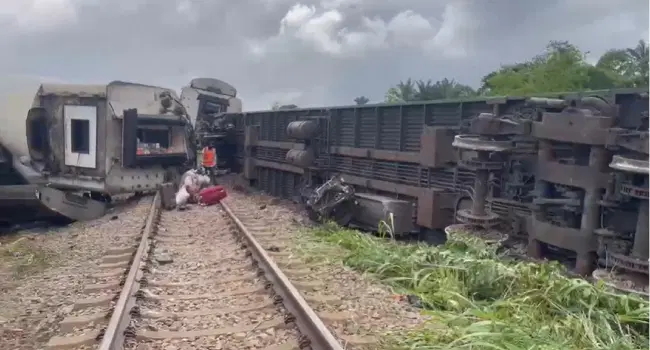
The train departed Itakpe at noon, carrying 482 people, comprising 442 passengers and 40 operational personnel, and derailed while approaching the Outer Home signal of the Goodluck Jonathan Railway Station (Kilometre 177), Owa-Oyibu, Agbor, Delta State.
The derailment affected five coaches, one locomotive and a power car, with three coaches and the power car overturning.
NRC said four people, three adults and one child, were confirmed dead, while 64 others were injured.
It said it adopted a structured methodology that included site inspections, evidence collection at the derailment location, and technical examinations of locomotives, rolling stock, and safety-critical components during the investigation.
It added that it conducted interviews with several witnesses on board, reviewed medical and casualty records, and analysed track infrastructure, turnout arrangements, and communication systems within the affected section.
The corporation said its internal investigation revealed that the possible sudden development of a bogie or wheel defect while the train was en route was a potential primary factor in the derailment.
It also said the possible manner of brake application may have contributed to the severity of the accident, stressing that both remained working hypotheses pending a definitive determination of the cause.
“Based on the internal investigation carried out by the NRC inquiry team, preliminary observations indicate the possible sudden development of a bogie/wheel defect while en route. This observation is being investigated further as a potential primary factor in the derailment.
“A wheel defect of this nature may have generated abnormal wheel-rail interaction, excessive impact loading, and loss of running stability,” the NRC preliminary report stated.
The railway body said its investigation found that the railway points were intact and that there was no evidence of track vandalism at the accident site.
This, NRC noted, differed from two previous WITS incidents on 1 November and 8 November 2025, which were attributed to track vandalism.
The corporation said the Nigerian Safety Investigation Bureau (NSIB) had commenced an independent investigation in line with statutory requirements and added that it was cooperating fully with the agency. The NSIB’s final report is still pending, according to NRC.
“It is important to note that site examination by the inquiry team observed that the points were intact and that no evidence of track vandalism was found,” NRC said.
Following the incident, NRC recommended comprehensive inspections and safety audits of rolling stock, tracks, and railway infrastructure across its operational corridors before equipment is returned to service.
It also recommended stronger maintenance and condition-monitoring programmes, timely replacement of defective components, and adequate availability of critical spare parts.
The corporation called for a review of operational procedures, including replacing obsolete practices with updated standard operating procedures and strengthening compliance monitoring and enforcement.
It advised that there should be improved emergency preparedness, regular rescue drills, stronger coordination among emergency agencies, and enhanced passenger emergency awareness.
NRC also recommended continuous professional development and competency assessments for staff, alongside sustainable funding for railway modernisation.
It advised that there should be adequate and sustainable funding to support the ongoing transformation of the railway sector, optimise existing railway assets, and facilitate the development of new infrastructure and services to sustain long-term operations.
The corporation said the railway track had been fully recovered and restored, while the locomotives were undergoing reconditioning.
However, it said the resumption of WITS operations would depend on the completion of a detailed track and equipment safety audit.
“Resumption of service will be dependent on the completion of a detailed track and equipment safety audit,” NRC said.