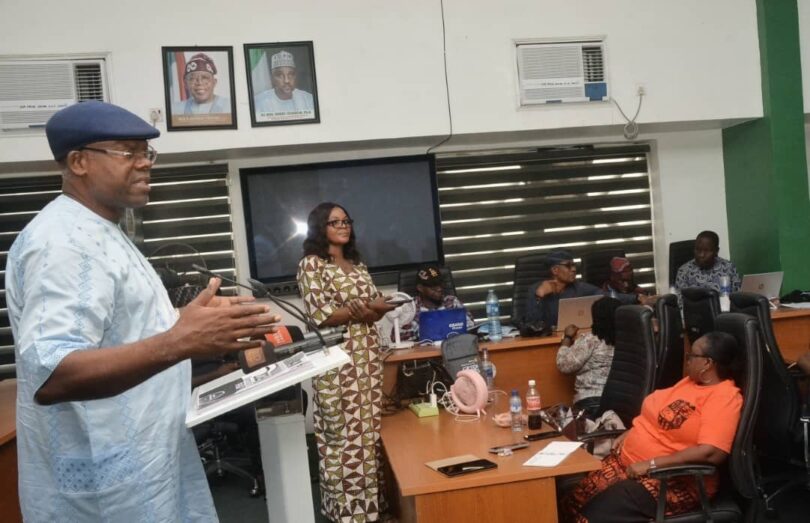
Mr Ossai says the decision of the APC to embrace direct mode of primaries would deepen democracy within the party.
A former member of the House of Representatives, Nicholas Ossai, has commended the leadership of the All Progressives Congress (APC) for adopting direct primaries as the mode for selecting candidates ahead of the 2027 general elections, describing the system as a major boost for participatory democracy and internal party inclusion.
He also spoke on why he wants to return to the lower chamber in 2027.
Mr Ossai said the decision of the APC National Working Committee (NWC) to embrace direct primaries would deepen democracy within the party by allowing ordinary members to directly determine who flies the party’s flag in elections.
He described the policy as one of the most democratic reforms associated with the current 10th National Assembly, arguing that aspirants who emerge through direct primaries usually enjoy wider legitimacy and acceptance among party members because of the transparent and participatory nature of the process.
“The most democratic aspect of the electoral process and one of the critical reforms supported by the current 10th Assembly is the direct primary system,” Mr Ossai told journalists.
“The APC National Working Committee has aligned itself with this process. As the national chairman stated a few days ago, the party has adopted direct primaries, and I believe this is a step in the right direction for democracy.”
He said direct primaries strengthen grassroots participation by giving party members a sense of belonging in the electoral process.
“I think direct primaries bring about what we call participatory democracy. Whoever emerges victorious through that process usually enjoys the confidence and goodwill of party members because they were part of the journey from the beginning.
“There is always that sense of joy, fulfilment, and acceptance when people freely vote for you. That is the role direct primaries will play in Delta State, and by the grace of God, I believe I am popular among my people,” he added.
Mr Ossai also defended the retention of consensus candidacy in Nigeria’s electoral framework, saying the National Assembly recognised consensus arrangements because there are situations where political stakeholders may collectively agree on a candidate in the interest of party unity.
“The 10th Assembly legislated for consensus because there are situations where party stakeholders and family members within a political structure may agree to support one individual for the collective interest of the party,” he said.
He, however, maintained that despite the legitimacy of consensus arrangements, direct primaries remain the most inclusive and democratic option for leadership selection within political parties.
Mr Ossai said his decision to seek a return to the House of Representatives was informed by what he described as unfinished developmental goals and his desire to continue providing effective representation for the people of Ndokwa East, Ndokwa West, and Ukwuani federal constituency.
“Today, I have the desire to return to the Green Chamber, not the Red Chamber, so that I can continue to address the pressing needs of my people,” he stated.
“When I joined the APC, I made it clear that the PDP structure in Delta State would eventually collapse because the people were yearning for change. The broom symbol of the APC represents that revolution and transformation.”
The former federal lawmaker recently defected from the Peoples Democratic Party (PDP) to the APC after spending over two decades in the opposition party.
Mr Ossai was first elected into the House of Representatives in 2011 on the platform of the PDP and subsequently won re-election in 2015 and 2019, serving three consecutive terms in the 7th, 8th, and 9th National Assemblies.
Before his stint in the National Assembly, he served in the Delta State House of Assembly, representing Ndokwa West State Constituency, and also held positions in state governance structures, including serving as Chairman of the Governing Council of the College of Education, Agbor.
His attempt to return to the National Assembly in the 2023 elections ended after he failed to secure the PDP ticket during the party’s primary election amid internal political realignments within the party in Delta State.
Reports at the time linked the development to the influence of powerful stakeholders within the PDP structure led by former Delta State Governor Ifeanyi Okowa.
The constituency seat was eventually won by Nnamdi Ezechi, who succeeded him in the House of Representatives.
Speaking on his political experience, Mr Ossai said his years in parliament provided him with deep legislative knowledge and oversight expertise which he intends to deploy again if elected.
“You can see that my submission documents are bulky because they contain records of achievements and experience accumulated over the years. My résumé speaks for me.
“I am not only grounded academically; I also have practical political and parliamentary experience. When it comes to oversight functions, accountability, and critical examination of issues affecting the people, I have distinguished myself,” he said.
The former lawmaker said he earned the nickname “Legislative Metro” because of what he described as his broad understanding of parliamentary activities and legislative procedures.
Reflecting on his previous committee assignments in the House of Representatives, Mr Ossai said he discharged his responsibilities diligently while serving as Chairman of the House Committee on Ethics and Privileges during the 8th Assembly and later as Chairman of the House Committee on Treaties, Protocols and Agreements in the 9th Assembly.
“When I served as Chairman of the House Committee on Ethics and Privileges, I handled issues responsibly and effectively. Also, as Chairman of the Committee on Treaties and Agreements, I carried out critical examinations of agreements entered into by the country in the national interest,” he said.