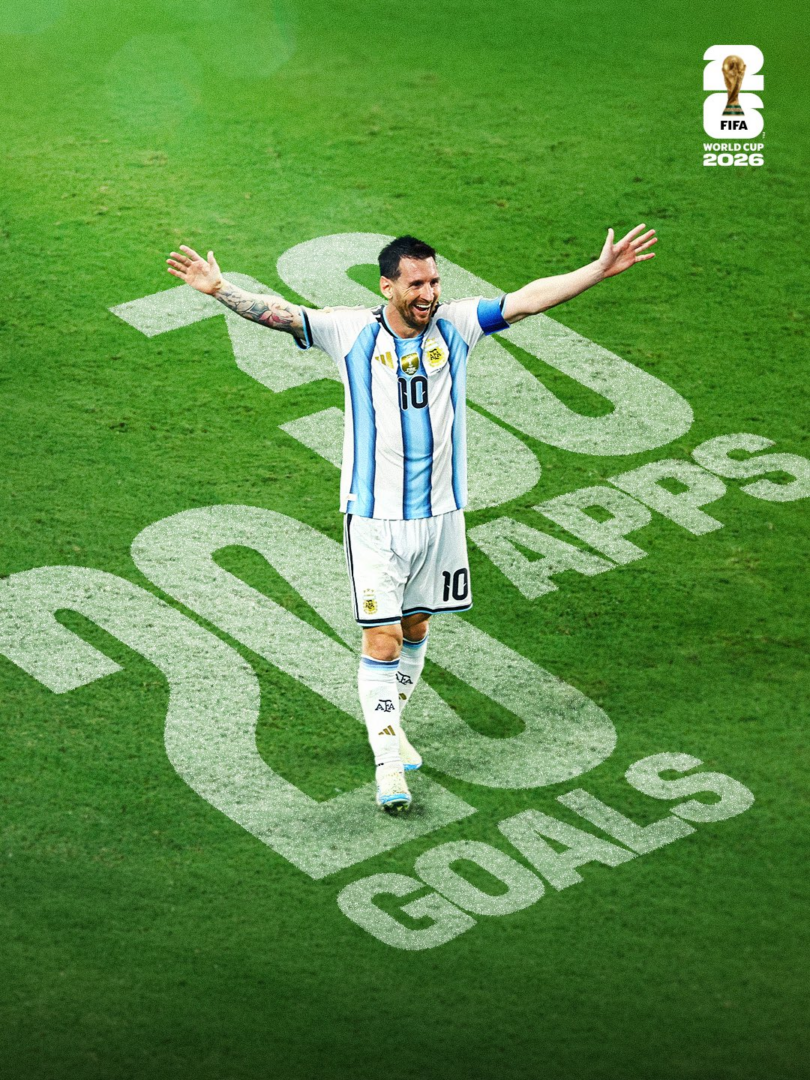
While Messi himself remains as beloved as any athlete on the planet, the team he captains has become the most distrusted side at the 2026 FIFA World Cup
While Lionel Messi himself remains as beloved as any athlete on the planet, the team he captains has become the most distrusted side at the 2026 FIFA World Cup.
It is a jarring duality: adore the man, resent the team.
Buried early in the tournament is the one incident that arguably worked in Argentina’s favour and yet receives the least attention. In the group stage against Algeria, Messi stepped on the calf of Algerian captain Aissa Mandi—a challenge that, under the laws governing serious foul play, could plausibly have been a red card. No card was shown, and Messi finished the match with a hat-trick.
According to Archivo VAR, a group that has tracked every major officiating decision of Argentina’s run, this was the only call across the tournament that genuinely broke their way, and even that was borderline. By their count, Argentina were actually on the wrong end of five of the six major decisions reviewed, three of which required VAR intervention to rectify an on-field mistake.
The controversy proper kicked off in the Round of 16 against Egypt. With 11 minutes remaining and Egypt leading 1-0—on the verge of their first-ever World Cup quarter-final—everything unravelled. Egyptian midfielder Mostafa Zico scored what should have been a goal. Still, VAR disallowed it for a marginal foul earlier in the buildup, with Marwan Attia penalised for clipping Lisandro Martínez’s foot. Egypt’s coach, Hossam Hassan, was furious, claiming he saw no fair play in the decision.
Matters worsened in the 91st and 92nd minutes. Just before Enzo Fernandez scored Argentina’s stoppage-time winner, Egypt had two separate penalty appeals waved away. First, Alexis Mac Allister appeared to pull down Hamdi Fathi in the box; moments later, Mohamed Salah went down after colliding with Julian Alvarez. Referee François Letexier waved play on, and VAR did not intervene.
Egypt’s federation lodged an official complaint, accusing officials of serious errors and double standards. Hassan suggested FIFA wanted to keep Messi and the champions in the tournament. FIFA pushed back firmly: refereeing chief Pierluigi Collina defended the Salah-Álvarez call point by point. Álvarez had already won the ball back before contact occurred, while FIFA president Gianni Infantino stated he had rewatched the footage more than ten times and found nothing untoward. Despite this, Argentina’s comeback story now carries an asterisk.
If Egypt lit the spark, the quarter-final against Switzerland is where the controversy caught fire. With the score level at 1-1 in the 67th minute, Leandro Paredes was booked for a tackle on Breel Embolo. VAR then stepped in under a new, untested rule known as “mistaken identity.” Instead of simply correcting the recipient of the card, the referee reversed the entire decision, booking Embolo for diving. Since Embolo had already received a yellow card, he was sent off, reducing the team to ten men. Switzerland lost 3-1 in extra time.
Swiss coach Murat Yakin was scathing, calling the rule that eliminated his team “unacceptable,” and captain Granit Xhaka said it altered the game’s complexion. Even neutral analysts were uneasy. Former FIFA referee Christina Unkel, working as a rules analyst for ITV, argued the protocol had been stretched well past its intended purpose, effectively re-refereeing the incident after the fact. She added that fan trust in officiating had taken a serious hit—a sentiment that captures the current mood.
That was the backdrop for the explosive semi-final against England. Just three minutes in, Enzo Fernández challenged Elliot Anderson for the ball and caught him with an elbow to the back of the head. Referee Ismail Elfath showed no card, appearing to read it as a natural collision rather than reckless play.
The inconsistency rankled: minutes earlier, Jude Bellingham had been shoved by an elbow from Paredes with no card shown, yet a comparative tangle between Anderson and Messi earned Anderson a yellow. Former English refereeing chief Keith Hackett stated that Elfath had to properly assert control over the match. To rub salt in the wound, Fernández scored Argentina’s equaliser with five minutes remaining, and Lautaro Martínez won it deep into stoppage time. For a wounded English press and public already primed to suspect bias, it was the moment frustration solidified into a full-blown theory.
Northeastern University’s sport analytics group crunched VAR intervention rates for every team in the tournament. Argentina emerged as the second-highest beneficiary of VAR calls overall and, strikingly, had not had a single VAR decision go against them through the Round of 16. Only Mexico, as co-host, ranked higher. Croatia and Iran sat at opposite extremes, absorbing poor decisions throughout their campaigns. Researchers cautioned that these measures capture fouls caught by VAR, not intentional bias, but the pattern is difficult to ignore.
Some of these trends stem from genuine rule changes for 2026, which expanded VAR to include mistaken-identity cases and wrongly awarded second yellows. The mistaken-identity rule, in particular, seems to have been implemented before its limits were fully understood.
Argentina now face a Spanish side that has been almost untouchable defensively, conceding barely anything across seven matches—a team built on structure rather than individual brilliance.
Messi’s Argentina represents the opposite: chaos, genius, and a trail of contested decisions. Much of what transpired may hold up under strict rulebook interpretation, but general perception rarely cares for technicalities. Some commentary has gone so far as to frame Sunday’s final in civilisational terms, pitting order against disorder.
Ultimately, it comes down to a simple, uncomfortable split: Messi is the artist people cannot help loving, and Argentina is the team many expect to have a clear, clear path. You can hold both feelings at once. On Sunday, as Argentina chases a repeat title—a feat no side has managed since Brazil in 1962—many neutral fans will simply be hoping their run of good fortune finally ends.