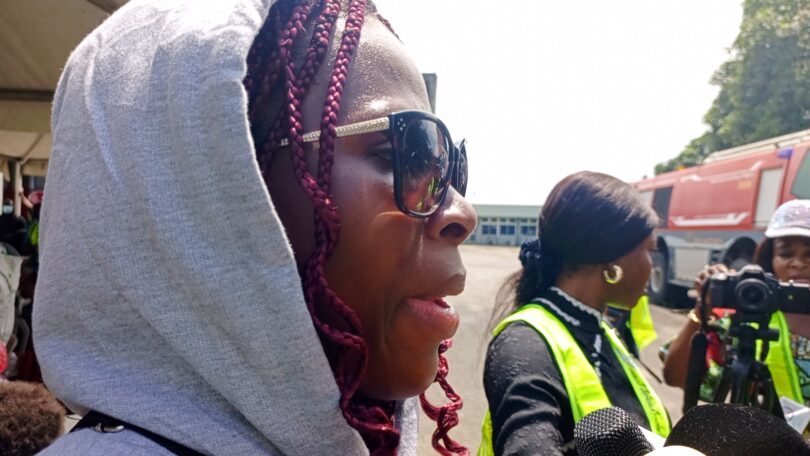
The South Africa returnee said she lived in the country for 22 years.
A Nigerian returnee from South Africa, Milly Abuh, has recounted how persistent discrimination against her family, particularly her children, forced her to return to Nigeria after spending 22 years in the country.
She said she worked as a teacher in South Africa and had integrated into the society, learning and speaking several local languages. Despite that, she and her family continued to face discrimination because of their nationality.
“I have been in South Africa since 2004 and I am happy to be back home. Most kids experience discrimination. Back then when I was in school, they used to call me different names and tell me to go back to my country.
“One of the things that made me decide to come back home is because of my kids, who are also facing the same thing. It’s even the teachers that actually influence this kind of behaviour because my child came home and told me that the teacher said we should stay away from Nigerians because they are kidnappers and killers. Many people also criticise my children because we are foreigners.
“Being here is actually a big relief for me and my children because I want to have a fresh start and see where life takes me,” she stated.
Ms Abuh also disclosed that she lost her spa business in South Africa after authorities allegedly took over the business because she did not possess the required permit.
Other returnees who spoke with PREMIUM TIMES said they lost their properties and livelihoods as a result of the hostile conditions they experienced in South Africa.
They also alleged that they had applied for residence permits more than three years ago and paid the required fees but neither received approval nor a formal rejection from the South African authorities.
Speaking on the returnees’ ordeal, Nigeria’s Acting High Commissioner to South Africa, Alexander Ajayi, described their experiences as traumatic but said they were relieved to finally return home.
“I want to start by thanking the Almighty God for bringing us this far and for bringing us here safely,” Mr Ajayi said.
“The people you see here today are our fellow Nigerians who have decided to come back home to escape the irresponsible violence that has been taking place in South Africa. They are in good spirits and have been looking forward to returning home since we started this process.”
Mr Ajayi said the 258 evacuees constitute the first batch in the ongoing repatriation exercise and commended President Bola Tinubu for personally driving the initiative.
According to him, shortly after the attacks began, the president established a direct communication channel involving the Presidency, the Ministry of Foreign Affairs and the Nigerian High Commission in Pretoria to monitor developments and coordinate the government’s response.
“From the very day the crisis started, Mr President established what we called a hotline communication between himself, the Ministry of Foreign Affairs and the mission in South Africa. Every day, he sought updates on developments and possible actions,” he said.
Mr Ajayi added that the Presidency also created a crisis monitoring unit to track developments across South Africa’s nine provinces, where anti-immigrant protests spread in recent weeks.
He further disclosed that President Tinubu had directed as far back as April that all Nigerians willing to return home should be evacuated, leading to the repatriation exercise that commenced with Thursday’s flight.
The minister said Nigeria would continue diplomatic engagement with South Africa to prevent a recurrence of attacks against Nigerians.
He said the countries already have institutional mechanisms, including the Nigeria-South Africa Binational Commission and an Early Warning Mechanism established through a memorandum of understanding, to address emerging tensions and protect the interests of their citizens.
According to him, the government intends to strengthen those frameworks to ensure quicker and more proactive responses to future crises.
Mr Enikanolaiye also argued that migration should not be criminalised, noting that many Nigerians living legally in South Africa make significant contributions to the country’s economy.
He further assured Nigerians in the diaspora that the Federal Government would continue improving consular services while urging citizens abroad to obey the laws of their host countries.
The arrival of the returnees marks the first phase of one of Africa’s largest coordinated repatriation exercises in recent years following renewed xenophobic attacks in South Africa.
The latest violence erupted in April after videos circulated online showing groups of South Africans assaulting Black foreign nationals and ordering them to leave the country, reviving concerns over recurring attacks that have strained diplomatic relations across the continent.
The unrest prompted Nigeria, Ghana, Kenya, Malawi, Zimbabwe and Mozambique to advise their citizens to avoid non-essential travel to South Africa, while several governments initiated evacuation programmes for nationals wishing to return home.
Nigeria announced plans to evacuate more than 1,000 citizens after two Nigerians, identified as Amaramiro Emmanuel and Ekpenyong Andrew, were allegedly killed in the country. Registration for voluntary evacuation was coordinated through the Nigerian High Commission in Pretoria in collaboration with South Africa’s Department of Home Affairs.