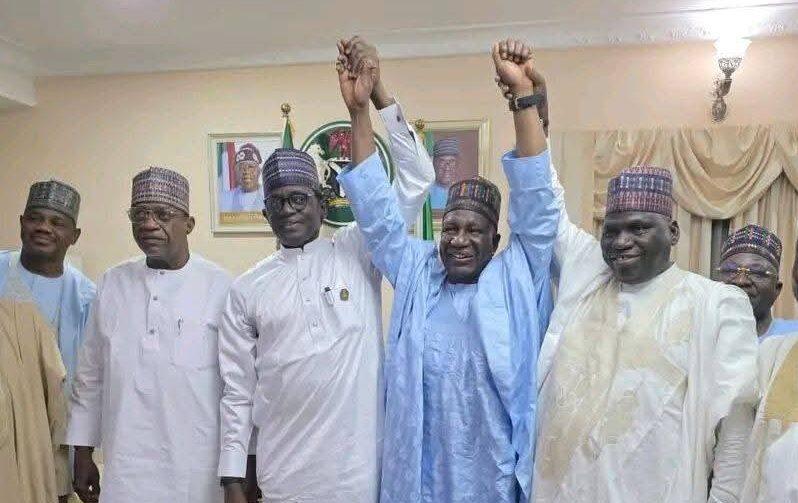
The endorsement of Mr Wali by the incumbent Governor Mai-Mala Buni, and the Minister of Police Affairs, Ibrahim Gaidam, has reshaped the contest. The alignment of the two figures effectively ditches Mr Lawan’s long-term governorship ambition.
The governorship aspirations of former Senate President Ahmad Lawan has ended following the endorsement of Baba Wali by key power brokers as the candidate of the All Progressives Congress (APC) in Yobe State.
The consensus between Messrs Buni and Gaidam, who are now the state’s power brokers, has also narrowed the path for other contenders like Mr Lawan whose supporters consider the right person with decades of experience to succeed Mr Buni.
Mr Wali’s endorsement was a strategic move, acknowledging that the Yobe North Senatorial District has not produced a governor since the Fourth Republic began in 1999.
While the district is now poised to claim the governorship, the chosen candidate lacks the mainstream political profile of figures like Mr Lawan.
Mr Lawan’s decades in active politics have made him a household name across the state, particularly in Yobe North’s six local government areas: Bade, Jakusko, Yusufari, Nguru, Machina, and Karasuwa.
Unlike his colleague from Yobe South, Ibrahim Bomai, Mr Lawan did not oppose the party’s adopted candidate. Observers attribute this stance to a combination of political influence and ethnic dynamics.
While Mr Lawan belongs to the Badawa tribe, which is predominantly concentrated in the Bade and Jakusko local government areas, he has historically enjoyed long-standing support from the Kanuri majority within his zone.
Consequently, political analysts suggest that Mr Lawan could not risk rejecting the governorship candidate, Mr Wali, who hails from the dominant Kanuri ethnic group.
Following the endorsement, Mr Lawan met with Mr Gaidam in Abuja. Shortly after, he announced his support for the party’s chosen candidate and withdrew from the race, urging his supporters to accept the decision in good faith.
He said the meeting with Mr Gaidam discussed the party’s governorship ticket, positioning Mr Wali as the APC’s preferred candidate.
“I requested to take time out to consult my supporters on the issue. Having consulted widely, it was clear to me that the majority of our supporters were of the view that we support the position of the leadership of the party. I informed him (Mr Gaidam) of my decision to support the declaration of Baba Malam Wali as the preferred candidate.
“I therefore, expressed my full support for the position of the party and the consensus candidate. I have willingly withdrawn from the race for the gubernatorial seat,” Mr Lawan stated.
The political lineage of the state continues to evolve through a legacy of strategic succession.
Mr Gaidam led the state for a decade, concluding his tenure in 2019. His path to the governorship began in 2009, when he served two years to complete the term of the late Mamman Ali, who passed away in office. Following that transition, Mr Gaidam went on to secure and serve two full elective terms.
He was succeeded by the incumbent Governor Buni, who subsequently became Mr Gaidam’s son-in-law.
While Mr Buni is completing his second consecutive term in 2027, he is heading for the Senate after the occupant of Yobe East Senatorial District, Mustapha Musa, a father-in-law to Mr Gaidam, stepped down for him, a development observers described as an evolution of a political marriage dynasty in the state.
The anointed gubernatorial candidate, Mr Wali, is a 70-year-old politician and seasoned administrator, who served as the Secretary to the State Government (SSG) under both the Gaidam and Buni administrations. He had held the position since 2015— that made him the longest-serving official in that capacity in the state’s history.
Both Messrs Wali and Gaidam served in the civil service of the old Borno State until the creation of Yobe State on 27 August, 1991. At that time, they returned to their home state, which had been carved out of Borno by the military regime of General Ibrahim Babangida.
However, the South senator, Mr Bomai, has rejected the adoption of the governorship candidate, citing a lack of fairness toward the people.
Mr Bomai said, “The reported anointment of the SSG by the former governor of Yobe State represents a clear assault on democratic principles.”
Mr Bomai said the decision to anoint the former SSG was not a collective one by APC stakeholders in the state. Rather, he said, it was the decision of a single individual against the will of millions.
“It is deeply troubling and highly irregular for a single individual, acting in isolation, to influence the leadership of millions without due process or respect for the will of the people,” he said.
“Such actions are unacceptable and undemocratic. They contradict the core values of fairness, representation, and collective decision-making. Yobe State belongs to its people—not to any individual or select group—and its leadership must reflect the genuine voice and choice of its citizens.
“We strongly reject any form of imposition, injustice, or oppression. We call on all relevant stakeholders to uphold democratic norms and ensure that governance remains transparent, inclusive, and accountable.”
Mr Bomai said that he remains committed to pursuing common democratic rights, undeterred by intimidation or discrimination.
“As citizens, I remain committed to lawful and peaceful means of expressing our concerns,” he said.
“I will continue to stand firm in defence of our rights and work collectively to safeguard the integrity of our democracy. No amount of intimidation, segregation, division, or exclusion will be accepted.”
The lawmaker described the anointment as “negative tendencies” which must be rejected “in the interest of unity, justice, and the progress of our dear state.”
Mr Bomai later declared his ambition to contest the governorship primary to challenge the adopted candidate, Mr Wali.