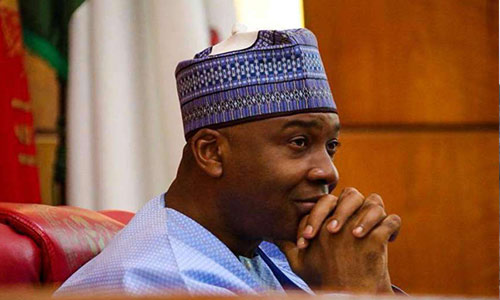
Former Senate President, Dr. Bukola Saraki, has warned that democracy is endangered when the legislature fails to exercise its constitutional oversight role and merely endorses executive decisions without scrutiny.
Saraki spoke on Friday at The Platform Nigeria Special June 12 Lecture held in Lagos as part of activities marking this year’s Democracy Day anniversary.
The event, themed “Governance, Democracy, National Security,” was organised by the Covenant Christian Centre, led by Pastor Poju Oyemade.
Speaking on lessons from his years in public office, Saraki said the strength of democratic governance depends largely on the independence of the legislature and the ability of parliament to question executive actions in the public interest.
According to him, a legislature that cannot say no to the executive cannot be regarded as a true legislature.
“What I learnt in those years in office is that a legislature that cannot say no is not a legislature at all,” Saraki said.
“A legislature which simply receives executive proposals, approves them without scrutiny and goes home has not fulfilled its constitutional mandate; it has merely performed a ceremonial function, an echo.”
He warned that a democracy made up of institutions that only echo executive preferences is fragile and vulnerable.
“A democracy made of echoes is only one election away from following something else entirely,” he added.
Saraki, however, said legislative independence should not be misunderstood as rebellion or hostility towards the government of the day.
He noted that lawmakers must be free to ask questions, scrutinise proposals and hold the executive accountable without being labelled as enemies of government.
“The independence of the National Assembly is not rebellion against the government of the day,” he said.
“Having been a victim, they said, ‘Ah, Saraki is bad, he’s against our government.’ I’m not just talking about myself. We’re talking about how those institutions can fulfil what they are meant to do in providing the mandate.”
The former Kwara State governor argued that an independent legislature strengthens, rather than weakens, the legitimacy of any administration.
According to him, government decisions become more credible when they are tested through debate, oversight and accountability.
“If the National Assembly is independent, it is the very reason that makes the government legitimate because a mandate that is never tested is a mandate no one can trust,” Saraki said.
“So how do we trust a government that was never subjected to questions?”
He described the legislature as the pressure valve of a democratic society, warning that suppressing its oversight function could push public frustration into more dangerous channels.
“The deepest service a legislature renders to society is to absorb the shock,” he said.
“The legislature is our pressure valve of the republic, of our democracy. Block it and the pressure may appear and find a far more dangerous way out.”
Reflecting on Nigeria’s democratic history, Saraki said the June 12, 1993 presidential election crisis was not caused by the failure of the Nigerian people, but by the weakness of institutions that ought to have defended the people’s mandate.
“We did not lose democracy in 1993 because the people failed. We lost it because the institutions that should have defended the people’s verdict were too weak to do so,” he said.
Saraki maintained that Nigeria’s democratic problems cannot be solved by weakening politics or silencing opposition voices, but by building stronger institutions capable of defending the public interest.
“The remedy is not less politics; it is stronger institutions,” he declared.
He urged Nigerians to pay closer attention to the role of institutions in protecting democracy, stressing that elections alone cannot sustain democratic governance where institutions are too weak to check abuse of power.