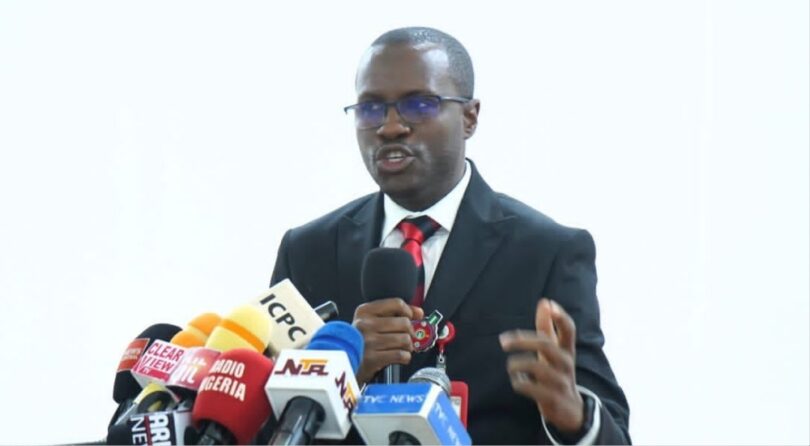
The Chairman of the Independent Corrupt Practices and Other Related Offences Commission (ICPC), Musa Aliyu, has disclosed how the embattled fake Director-General of the disowned Presidential Foreign Investment Promotion Council (PFIPC), Adeniyi Matthew allegedly exploited weaknesses in Nigeria’s public sector system to set up a fake agency and manipulate government processes.
The Commission Chairman, Musa Aliyu disclosed this on Thursday in Abuja at the 4th Economic Confidential Lecture/National Spokesperson Award.
Aliyu said the case was a clear illustration of how weak institutional controls could create opportunities for individuals to perpetrate corruption, stressing that strengthening systems was critical to preventing the diversion of public resources.
The ICPC chairman spoke on the need for stronger anti-corruption mechanisms, saying Nigeria’s corruption challenge was driven largely by two factors-weak public sector systems and a culture of tolerance for corrupt practices.
He said the Adeyemi case demonstrated how an individual could exploit gaps in the system, obtain documents and move them through different government agencies without adequate verification.
“Recently, we have seen what happened on the issue of the vacancy. The system is very, very big. That was why an individual, allegedly, was able to build the system and to get documents to pass through various agencies, and for the agencies to act without due diligence,” Aliyu said.
According to him, some documents should immediately raise questions when presented to government officials, but inadequate scrutiny often allows suspicious transactions and records to pass through the system.
“Sometimes, we get all these documents. There is a document when you see it, you don’t need anybody to tell you that, ‘Look, I need to do further’,” he said.
Aliyu said the ability of individuals to exploit institutional loopholes posed a significant threat to Nigeria’s economy, particularly its capacity to attract foreign direct investment.
He cited the example of a foreign investor who could purchase land legally, only to discover that another person had obtained another title document for the same property.
“How can people not believe you? Why is the system not working?” he asked, warning that such weaknesses could undermine confidence in the country’s institutions.
The chairman said the problem extended beyond land administration to public payrolls, where the ICPC had uncovered several instances of fraudulent employment records.
He disclosed that one individual enrolled 14 members of his family as public workers even though they were not working in the offices where they were purportedly employed.
“He even enrolled his hotel, a hotel as a public officer receiving salary,” Aliyu said.
In another case, he said an individual enrolled his wife, daughter, son and in-law on the government payroll and was found to be receiving 13 salaries.
“Thirteen salaries,” he stressed, describing the case as an indication of the extent to which weak controls could be manipulated to divert public funds.
Aliyu said such fraudulent payroll practices had consequences beyond the salaries being paid to ghost workers, as they could also generate fraudulent pension, housing and health insurance deductions.
The ICPC chairman disclosed that the Commission recovered more than N24bn in ghost workers’ pension-related funds in 2024.
He also said the agency secured interim orders involving about 900 suspected ghost workers and recovered more than N100m from accounts linked to the suspects.
According to him, some payroll records contained the name of a supposed female worker while the account number was linked to a man, highlighting the sophisticated nature of the manipulation.
Aliyu said the ICPC had also identified weaknesses in the budgeting and project implementation processes.
He disclosed that the Commission had found instances where projects were inserted into the budgets of agencies that had no connection with them.
“You will see a stadium building inserted into an agency in the agricultural sector. I have seen where training of local barbers was put under empowerment in one of the agencies under the justice sector,” he said.
The chairman said the ICPC had consequently strengthened its system study and project monitoring interventions to ensure that appropriated funds were used for their intended purposes.
He said the Commission had intervened in projects involving trillions of naira and forced contractors to return to sites to execute projects according to their original designs or refund government funds.
“Because it is better for us to do that than to engage in filing criminal charges. How many charges can we file?” Aliyu asked.
He disclosed that the value of funds recovered or saved through such interventions was close to N900bn within the period under review.
Aliyu said prevention was more effective than waiting for public money to be stolen before pursuing recovery.
“It is better to make the system strong and people will not be able to siphon the money than to allow the money to disappear, then we go after those who diverted the money,” he said.
He identified weak public sector systems and Nigeria’s tolerance of corruption as the two major factors sustaining the problem.
“We have a culture of corruption tolerance in this country. Two major problems — one, weak system in the public sector; secondly, tolerance to corruption culture,” Aliyu said.
He said the ICPC would therefore focus increasingly on prevention, ethical rehabilitation, public engagement, recovery of proceeds of crime and law enforcement.
The chairman also stressed the importance of educating young Nigerians on integrity, saying sustainable anti-corruption efforts must begin early.
Aliyu said Nigeria could learn from countries such as Singapore and Hong Kong, which strengthened institutions and cultivated a culture of integrity among younger generations.