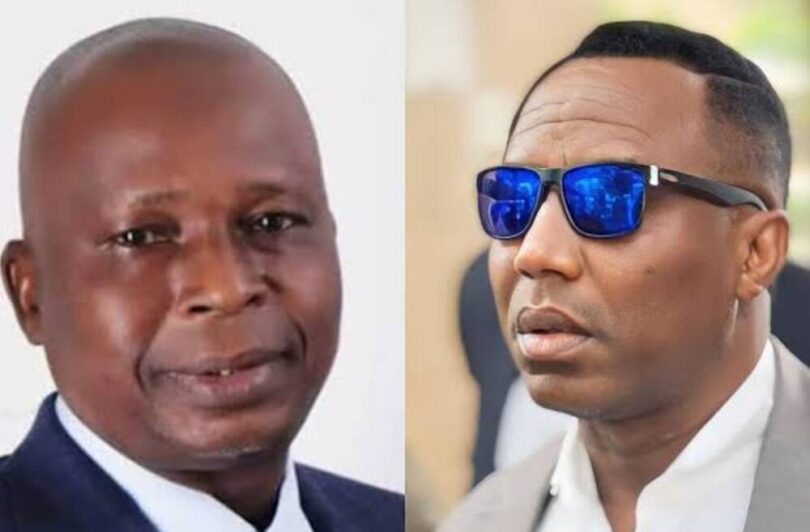
The Attorney-General of the Federation (AGF) and Minister of Justice, Lateef Fagbemi (SAN), and counsel to human rights activist and African Action Congress (AAC) presidential candidate, Omoyele Sowore, on Tuesday disagreed over the Attorney-General’s appearance in the ongoing alleged cyberbullying trial before the Federal High Court in Abuja.
Lead defence counsel, Adeyinka Olumide-Fusika (SAN), objected to what he described as the Attorney-General’s sudden entry into the proceedings without prior notice to either the court or the defence.
The matter, before Justice Umar Mohammed, had been slated for the appearance of the Director-General of the Department of State Services (DSS), Tosin Ajayi, who was subpoenaed as a defence witness.
However, Fagbemi informed the court that the prosecution had no proof that the subpoena had been served on the DSS Director-General.
When the court drew his attention to its records confirming that the subpoena had indeed been served, the Attorney-General, after examining the document, argued that no specific time had been indicated for Ajayi’s appearance. He also maintained that the DSS boss was summoned in his official capacity.
Responding to questions over his appearance in the case, Fagbemi said he was acting pursuant to Section 174(3) of the 1999 Constitution (as amended), which empowers the Attorney-General to institute, take over or discontinue criminal proceedings.
Fusika, however, argued that although the Attorney-General possesses such constitutional powers, they must be exercised in the public interest, in the interest of justice and in a manner that does not amount to an abuse of court process.
He contended that Fagbemi was not part of the prosecution team when the trial commenced but entered the courtroom and immediately made applications on behalf of the subpoenaed DSS Director-General without filing any formal notice.
The senior lawyer further argued that the Attorney-General’s application to assume control of the prosecution denied the defence adequate opportunity to respond, especially after citing more than 20 judicial authorities in support of his position.
“How do you expect me to respond immediately to over 20 authorities cited from the Bar without prior notice?” Fusika asked the court.
He insisted that if the Attorney-General intended to take over the prosecution, the appropriate notices and supporting documents ought to have been filed before the application was made.
“The Attorney-General should file the appropriate notice and place the necessary information before the court.
In the absence of that, the application is procedurally defective,” he submitted.
Fusika also argued that any authority exercised by counsel appearing on behalf of the Attorney-General must be backed by the appropriate legal process, warning that failure to follow established criminal procedure could set a dangerous precedent.
He urged the court to reject the application until due process had been complied with.
In his response, Fagbemi stated that lead prosecuting counsel, Kehinde Akinlolu, had been granted a fiat to prosecute the matter and that, as Attorney-General, he retained the constitutional authority to assume control of the case at any stage.
The defence, however, maintained that neither the court nor the defence had been served with any document showing that Akinlolu was prosecuting the case by virtue of such a fiat.
Fagbemi further argued that the subpoena ought to have been served personally on the DSS Director-General and maintained that no specific time had been fixed for his appearance.
He described the subpoena as an abuse of court process, noting that the document the defence intended to question Ajayi about had already been admitted in evidence as Exhibits D and DWC on July 22, 2026.
According to him, insisting on compelling the DSS Director-General to testify after the document had already been tendered served no legitimate purpose.
The Attorney-General added that Ajayi was being summoned solely in his official capacity regarding a document authored and signed by another prosecution witness, insisting that the subpoena was being used for an improper purpose.
He therefore urged the court to set aside the subpoena and direct the defence to proceed with its case.
Following consultations between both parties, the defence and the Attorney-General agreed that a representative of the DSS Director-General would appear before the court instead of Ajayi.
Justice Mohammed subsequently adjourned the matter until August 3, 2026, for continuation of the defence.