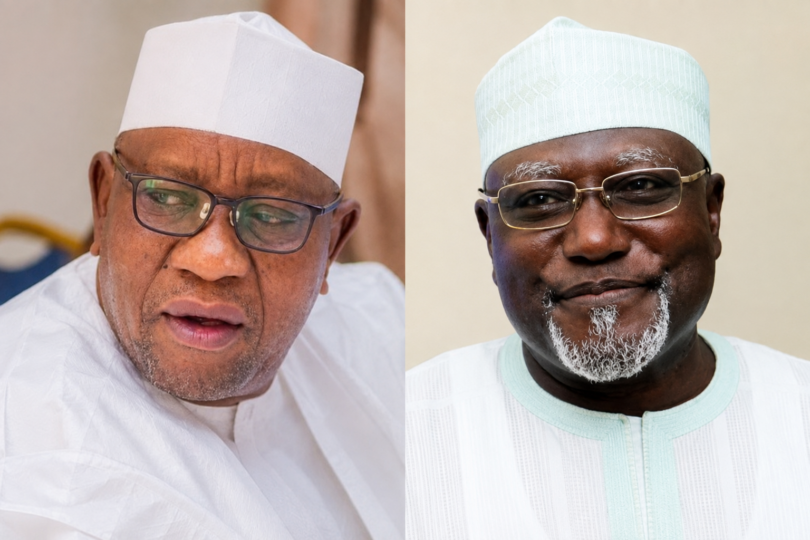
The two former ADC governorship aspirants cite similar grievances over the party’s candidate-selection process but have chosen sharply different paths ahead of the 2027 elections.
Earlier this year, Mustapha Inuwa and Lawal Daura were among the political heavyweights attempting to build a formidable opposition platform to challenge the ruling All Progressives Congress (APC) in Katsina State.
Mr Inuwa, a former secretary to the Katsina State Government and the first APC chairman in Katsina, announced that he and his supporters were returning to the ruling party.
Mr Daura, a former Director-General of the State Security Service (SSS), chose a different destination, moving to the Allied Peoples Movement (APM).
The two politicians left the African Democratic Congress (ADC) with essentially the same complaint: allegations that the party failed to guarantee a credible, fair and internally democratic candidate-selection process.
But they have arrived at sharply different conclusions about where Katsina’s political alternative now lies.
Mr Inuwa argued that despite insecurity, economic hardship and internal disagreements within the APC, returning to the ruling party offers the most practical political route for his supporters.
Mr Daura took almost the opposite position. He portrayed the APC itself as politically impaired and said the APM provides a healthier platform for pursuing his political objectives.
Both men cited essentially the same grievance over alleged failures of internal democracy in the ADC. Yet Mr Inuwa has returned to the ruling party he once helped build, while Mr Daura has moved to a smaller opposition platform after dismissing both the ADC and APC as defective political vehicles.
At the beginning of the year, the political movement that eventually coalesced around the ADC brought together several prominent politicians opposed to Governor Dikko Radda’s administration and the APC.
Among them were Mr Inuwa, Mr Daura, former senators and other political actors with structures across Katsina’s 34 local government areas.
PREMIUM TIMES reported in January that the gathering of political heavyweights was emerging as a potentially significant opposition force ahead of the 2027 elections.
Mr Inuwa had travelled a particularly long political route to get there. He was the first APC chairman in Katsina and later spent seven years as secretary to the state government under former Governor Aminu Masari.
His relationship with the party deteriorated after he lost the 2022 APC governorship primary to Mr Radda. He later moved into the opposition, first through the Peoples Democratic Party (PDP), before participating in efforts to build another political platform in Katsina.
Speaking to supporters at his office in Katsina on Sunday, Mr Inuwa recalled how his political group initially considered the Social Democratic Party before moving to the ADC.
He said members opened offices, mobilised supporters and financed political activities themselves in the expectation that the ADC would provide a fairer political process.
That expectation, he said, ultimately collapsed.
The dispute centred largely on rival claims over party structures and candidate selection, and on allegations that acceptable primaries or consensus arrangements were not conducted.
PREMIUM TIMES had earlier documented two layers of crisis within the Katsina ADC: rival structures competing for legitimacy and a separate dispute within the Muhammad Rimi-led camp over how candidates emerged.
That camp included Messrs Inuwa and Daura, as well as former Senator Ahmad Kaita.
Same grievance, different exits
In his Sunday speech, Mr Inuwa repeatedly returned to what he described as injustice in the selection of candidates.
He said members joined and helped to build the ADC because they expected the party to conduct its affairs differently from the political establishments they had criticised.
According to him, that expectation was betrayed.
Mr Inuwa alleged that there was neither a proper primary election nor a valid consensus process for several elective positions.
He claimed that 154 people had sought State House of Assembly tickets across different constituencies, but that the eventual choices were made without giving many of them a fair opportunity to participate.
He also cited a senatorial contest in which, according to him, five aspirants were bypassed, and another person who had not participated in the original contest was selected.
These remain Mr Inuwa’s allegations against his former party.
He said he and his supporters had demanded corrective action since 27 May but received no satisfactory resolution.
Mr Inuwa also alleged that a senior figure in the political movement had promised him on five occasions that they would meet to discuss the dispute, but none of the proposed meetings took place. He did not name the official.
Mr Daura’s diagnosis of the crisis is substantially similar.