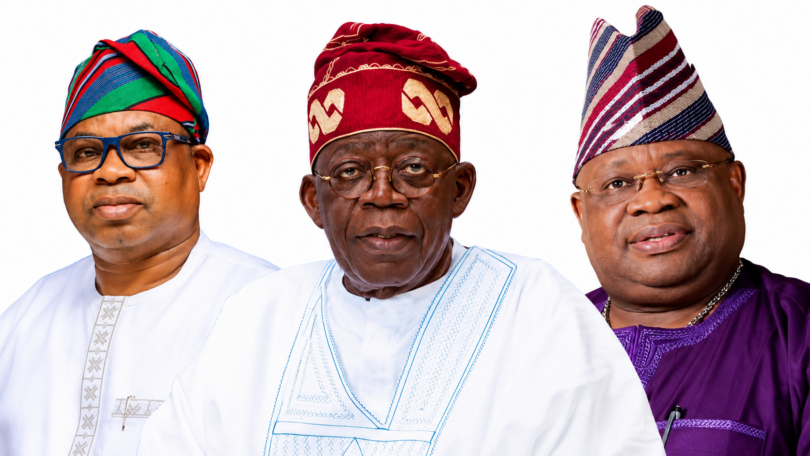
The election has become a test of President Bola Tinubu’s authority within the APC, his personal relations hindering his ability to manage competing interests inside the party.
A few days to Saturday’s governorship election, one question keeps circling back in Osun’s political conversations: where does President Bola Tinubu actually stand?
In reality, it has become something larger. The election has become a test of President Tinubu’s authority within the APC, his personal relationships, and his ability to manage competing interests within the ruling party.
Unlike previous off-cycle elections, Osun presents the president with an unusually delicate political equation.
Mr Tinubu’s ancestral roots are widely traced to Iragbiji in Boripe Local Government Area of Osun State, the hometown of former governor Gboyega Oyetola, his cousin and one of his closest political allies. Mr Oyetola remains a key figure in the APC and now serves as Minister of Marine and Blue Economy.
Ordinarily, there would be little doubt about where the president stands. The APC has nominated former Commissioner for Finance Bola Oyebamiji to reclaim the state after Governor Adeleke defeated Mr Oyetola in 2022. Party members expect the president to deploy the full weight of the federal government behind the APC candidate.
However, politics in Osun has become more complicated.
Governor Adeleke has maintained cordial relations with President Tinubu despite belonging to the opposition.
The relationship drew greater attention last year when members of the Adeleke family met the president in Lagos after the governor explored joining the APC.
The move generated intense debate before collapsing amid resistance from influential APC leaders in Osun, who argued that admitting a sitting opposition governor would disadvantage loyal party members who had remained in opposition since 2022.
APC chieftains in Osun, at various points led by former Speaker Timothy Owoeye and state chairman Tajudeen Lawal, publicly said that the governor was trying to defect and that the party would not have him.
Mr Lawal called him a Trojan horse, adding that there was no space for him in the APC. By April this year, the Osun APC campaign organisation was claiming Mr Tinubu himself had rejected efforts to “smuggle” Mr Adeleke into the party. It had reaffirmed Mr Oyebamiji as Tinubu’s man.
In June, Mr Oyebamiji felt the need to go on record again, telling supporters in Ifedayo, Ila, and Boluwaduro that he remained Mr Tinubu’s only anointed candidate, and that claims of a presidential endorsement for the governor were false.
Mr Adeleke is contesting a second term under the Accord Party, having left the PDP after months of speculation about his political future and amid the PDP’s national leadership crisis.
Campaign billboards have paired President Tinubu with the governor, despite the APC fielding its own candidate. The images have fuelled political debate and invited different interpretations.
Governor Adeleke has never claimed the president’s endorsement. The presidency has also never suggested that Mr Tinubu is backing the Accord Party candidate.
Still, the ambiguity has become part of the political conversation.
“Adeleke is not just dancing; he is organising. He connects emotionally with people, and that is something APC has failed to match,” said political analyst Olaniyi Oyekanmi.
Political watchers close to the contest, including journalist Babafemi Ojudu, have also argued that Mr Tinubu’s public posture toward Mr Adeleke has softened in recent weeks, not hardened.
Mr Ojudu, a former senator and presidential aide, pointed to a reported phone call between the two men and to security agencies apparently easing off the governor as the vote nears, reading into it a coded signal rather than an open one.
EFCC intervention shifted attention
Any lingering questions about the relationship between the president and the Osun governor took a new turn last week.
The Economic and Financial Crimes Commission (EFCC) had frozen the Osun State Government’s bank accounts as part of an ongoing investigation into the state’s handling of public funds. The opposition immediately accused federal authorities of using state institutions to weaken Governor Adeleke’s administration on the eve of the election.
“I have endorsed you. That should be enough. Stop the bloodshed in Osun State and call your brother, Oyetola, to order,” Governor Adeleke said in a speech addressing the president.
President Tinubu responded to the freezing of the Osun State government’s account within hours.
In a personally signed statement, he directed the EFCC to return to court and vacate the freezing order.
The president did not challenge the commission’s legal authority. Instead, he questioned the timing.
“I must state that I feel deeply embarrassed not by the EFCC’s exercise of its mandate backed by a court order, but by the timing of the agency’s action,” Mr Tinubu said.
He added, “Osun State is only a few days away from its gubernatorial election. Therefore, nothing ought to be done to give an impression that the EFCC or indeed any other agency of the federal government is being used to interfere with the election.”
Presidents rarely publicly question investigative actions already backed by a court order.
Mr Tinubu also acknowledged that although anti-corruption agencies are expected to operate independently, actions taken close to elections can easily be interpreted as reflecting the wishes of the presidency.