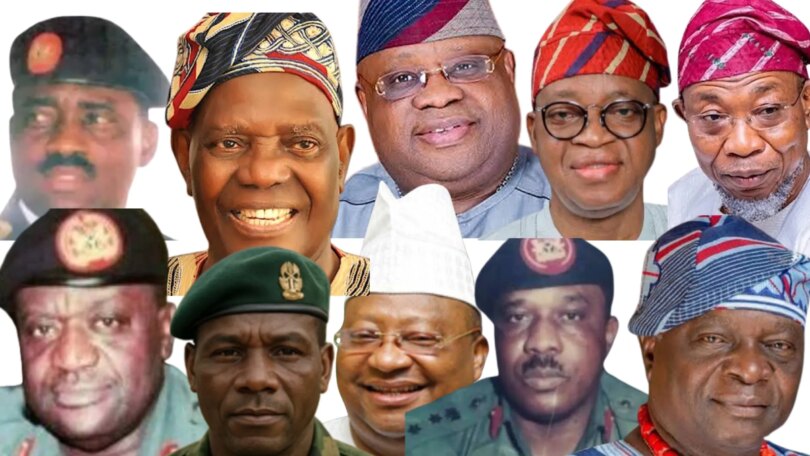
Since its creation in 1991, Osun State has been governed by a succession of military administrators and elected civilian governors whose policies have shaped the state’s political, economic and social development.
Osun State was created from the old Oyo State in August 1991 by the military government of General Ibrahim Babangida. Since then, the state has been ruled by appointed military administrators and elected civilian governors, each leaving a distinct imprint on its political and developmental trajectory.
The return to civilian rule in 1999 ushered in a succession of elected administrations led by Bisi Akande, Olagunsoye Oyinlola, Rauf Aregbesola and Gboyega Oyetola. The incumbent governor, Ademola Adeleke, was elected in 2022 amidst several political controversies.
Over the past three decades, these administrations have pursued different approaches to governance. Some have been celebrated for fiscal discipline, social welfare programmes, institutional development, and infrastructure, while others have been criticised for debt accumulation, labour disputes, political infighting, electoral controversies, and allegations of financial impropriety.
This analysis examines the major achievements and low moments associated with each administration and what they reveal about the evolution of governance in Osun State, as the state prepares for another gubernatorial election on Saturday.
Leo Ajiborisha, a military officer, was appointed the first administrator of Osun State upon its creation in 1991.
His administration largely focused on establishing the basic institutional framework of the new state and preparing it for the transition to civilian rule.
Among the notable steps taken during his tenure was the establishment of the Osun State Civil Service Commission in September 1991. His administration also established the Osun State Broadcasting Corporation, with its radio station in Ile-Ife, which commenced operations in November 1991.
Mr Ajiborisha handed over power to Isiaka Adeleke in January 1992, marking the beginning of elected civilian administration in the new state.
Mr Ajiborisha’s tenure was brief, reflecting the transitional nature of the military administration.
He later held senior military positions, including Director of Operations at the Defence Headquarters and Principal Staff Officer to former Head of State Abdulsalami Abubakar.
Isiaka Adeleke became Osun State’s first elected governor in January 1992 under the defunct Social Democratic Party (SDP).
As the pioneer civilian governor, he faced the task of consolidating the institutional structures established during the state’s formative period.
One of the notable initiatives of his administration was the establishment of the Osun State Polytechnic, Iree, which is now part of the state’s tertiary education infrastructure.
Mr Adeleke’s administration was abruptly terminated following the military takeover of November 1993, which aborted Nigeria’s Third Republic.
His tenure, therefore, lasted only about two years and did not provide sufficient time for many of his administration’s programmes to mature and manifest.
He eventually served as a two-term senator, representing Osun West from 2007 to 2011 as a PDP member. He was later reelected under the APC in 2015 but died in April 2017.
Following the 1993 military takeover, Nigeria and Osun returned to military administration.
Anthony Udofia became the second military administrator of the state under the regime of Sani Abacha, Nigeria’s late head of state. His administration focused largely on maintaining government operations and pursuing social and developmental programmes.
Mr Udofia was replaced by Anthony Obi, who served as military administrator from August 1996 to August 1998. Mr Obi’s tenure coincided with one of the most politically uncertain periods in Nigeria’s history.
Mr Obi was later redeployed to Abia State, where he remained until the return to civilian rule in May 1999.
Theophilus Bamgboye became the fourth military administrator of Osun State under General Abdulsalami Abubakar’s transitional government.
His administration operated during the final phase of military rule and was primarily concerned with maintaining government institutions while preparing the state for the return to democratic governance in 1999.
Mr Bamgboye, an indigene of Omu-Aran in Kwara State, handed over to Bisi Akande, the first elected governor of Osun State under the Fourth Republic.
Mr Akande, who was elected on the platform of the Alliance for Democracy, governed the state from 1999 to 2003.
His administration was strongly associated with fiscal discipline, institutional reforms and an emphasis on reducing government waste.
Mr Akande’s government also pursued free education and healthcare initiatives, reflecting the social-democratic orientation of the Alliance for Democracy administrations that controlled all the South-west states at the time.
His administration’s attempt to rationalise and downsize the state civil service generated significant opposition from organised labour.
The reforms, which were presented as necessary, were opposed by workers and contributed to the political difficulties the governor faced in the 2003 election.
Mr Akande eventually lost the governorship to Olagunsoye Oyinlola, thus spending only one term of four years in office. He had served as the secretary to the defunct Oyo State Government and later deputy governor of the state under late Governor Bola Ige.