The NSIB disclosed the development 65 days after the 10 June incident, saying the aircraft’s return to Lagos before investigators arrived resulted in the overwriting of critical flight data that could have helped establish what happened during the wrong-surface landing in Asaba.
The Nigerian Safety Investigation Bureau (NSIB) has said critical data from the flight recorder of the private jet that landed on a road near Asaba Airport was overwritten after the aircraft was flown back to Lagos before investigators could take custody of it.
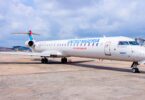
The incident involved a US-registered Bombardier Challenger 601-3A operated by VMO Aero Limited, which landed on a paved road near Asaba Airport in Delta State on 10 June instead of the designated runway.
The aircraft, which was flying from Lagos to Asaba under Instrument Flight Rules, was carrying four crew members and three passengers. No injuries were reported.
The crew later flew the aircraft back to Lagos before investigators arrived at the scene.
Mr Badeh said the return flight resulted in the flight recorder overwriting data that could have assisted the investigation.
He said the recorder was expected to have a longer recording capacity but, in this case, investigators recovered only about two hours of low-quality data.
“The rule allows them to have a 26-hour electric recorder but we discovered that it only recorded for about two hours of low quality,” he said.
He explained that because the aircraft had flown from Lagos to Asaba and then back to Lagos, the recorder had overwritten information from the period investigators were most interested in.
That has left investigators with less flight data from the aircraft’s movement around the time of the wrong-surface landing.
Mr Badeh, however, said the loss of the data would not end the investigation, adding that the bureau was using other methods to establish what happened.
The incident had earlier raised questions about how the aircraft ended up on a road despite having been cleared to land at Asaba Airport.
PREMIUM TIMES had reported that the preliminary investigation showed the crew discontinued its initial approach before attempting a second approach to Runway 11.
The crew believed it was correctly aligned with the published Required Navigation Performance procedure before landing on a paved road under construction near the airport instead of the runway.
The aircraft subsequently departed the roadway and returned to Lagos.
Following its arrival in Lagos, the Nigeria Civil Aviation Authority (NCAA) grounded the aircraft and suspended VMO Aero Limited’s Permit for Non-Commercial Flight pending investigations.
The development also attracted the attention of the Minister of Aviation and Aerospace Development, Festus Keyamo, who described the incident as a serious security breach.
Mr Keyamo had said the aircraft had been cleared by air traffic control to land on the runway but instead landed on a concrete road outside the secured airport environment.
He also raised concerns about the crew’s decision to leave the scene before investigators could examine the aircraft.
The crew was subsequently arrested on arrival in Lagos and handed over to the State Security Services (SSS) for further investigation.
Mr Badeh said the decision to return the aircraft to Lagos before investigators arrived created a major challenge for the safety investigation.
He said the pilot flew the aircraft back to Lagos without clearance from Air Traffic Control (ATC).
The additional flight, according to the NSIB boss, caused the recorder to overwrite some of the data from the original journey.
Flight recorders use continuous recording systems in which newer information can replace older data once the available storage capacity is reached.
As a result, the additional flight can affect the availability of information investigators need when reconstructing an occurrence.
Mr Badeh said the NSIB was still working to recover as much information as possible through other investigative methods.
He also said another flight recorder-related issue had been identified, but cautioned against drawing conclusions about what caused it.
“Although the FTR of the airplane did not work as well, I am not sure what happened but I think it was part of the cleaning, I’m not sure and I am not going to blame the operators yet.”
He added that the bureau would wait for the outcome of the investigation before reaching conclusions.
“So, for me I don’t think the airlines are going out of their way to destroy evidence,” he noted.