The works of the three women honourees make the same argument from three different domains: that the continent’s most enduring excellence is institutional, not incidental, and that talent only compounds when it is built into structures that outlast the individual
The Africa Soft Power Summit 2026 closed in Nairobi with a Gala honouring three women whose lives’ work makes the same argument from three different domains: that the continent’s most enduring excellence is institutional, not incidental, and that talent only compounds when it is built into structures that outlast the individual.
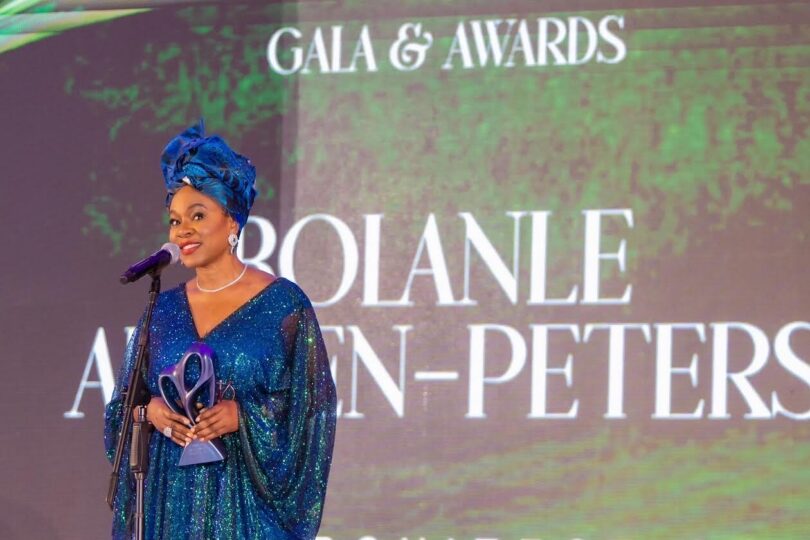
Bolanle Austen-Peters, the Nigerian theatre, film and cultural-enterprise founder, was presented with the ASP Architect of Culture Award by H.E. Zainab Hawa Bangura, Under-Secretary General and Director-General of the United Nations Office at Nairobi, in recognition of more than two decades of work building the institutional foundations of modern Nigerian theatre.
Austen-Peters’s path did not begin in performance. Trained as a lawyer, she worked in Nigeria and internationally before founding Terra Kulture in Lagos in 2003, originally conceived as a cultural home for Nigerian art, language, literature, food and heritage. With Saro the Musical, she helped usher in a new era of modern Nigerian theatre by demonstrating that local stories could be produced with ambition, precision and commercial viability. Through BAP Productions, she followed with Wakaa! The Musical, Fela and the Kalakuta Queens and Moremi the Musical, productions that created jobs, trained crews, built audiences and showed brands, investors and cultural institutions that African theatre could command scale and sustain demand.
That work expanded into film, including 93 Days, The Bling Lagosians, Collision Course, Man of God, Funmilayo Ransome-Kuti and House of Ga’a, and into training infrastructure through Terra Kulture and the Terra Academy for the Arts, which has developed actors, writers, producers, designers and technical crew across the wider Nigerian creative industry.
The recognition at ASP 2026 reflected the Summit’s broader argument that culture becomes influence when it is supported by institutions, and that talent becomes industry when it is paired with training systems, production capacity and long-term capital. Austen-Peters, who appeared earlier in the Summit on the Creators as Economic Power panel, has spent two decades building the infrastructure beneath the spotlight, and the award positioned her as one of the architects of the creative economy ASP 2026 spent its second conference day examining.
Faith Kipyegon, the Kenyan middle-distance runner whose Olympic and world record achievements have redefined women’s 1,500 metres, was presented with the ASP Gold Standard Award by George Odhiambo, Managing Director of National Bank of Kenya. The award was received on her behalf by Patrick Sang, her long-time coach.
Kipyegon’s record is one that historians of athletics will study for decades. Three consecutive Olympic gold medals in the 1,500 metres, in Rio, Tokyo and Paris, a feat no woman had previously achieved. World titles in 2017, 2022, 2023 and 2025. Three world records broken inside a single fifty-day stretch in 2023, across the 1,500 metres in Florence, the 5,000 metres in Paris and the mile in Monaco. In June 2025, she attempted what no woman had ever done: a sub-four minute mile. She finished in 4:06.42, faster than her own world record, and short of the four-minute mark by a margin that has already begun to look provisional.
The trajectory has its origins in the red dust of the Rift Valley. Kipyegon grew up in a small village near Keringet, in Nakuru County, the eighth of nine children on a family farm. Her father had been a 400 and 800 metres runner; her mother knew the sport. From preschool onwards, she ran four kilometres to school and four back, twice a day, barefoot. She was fourteen when a teacher organised a one-kilometre race in PE class. She won it by twenty metres. Two years later, at sixteen and still barefoot, she ran her international debut at the World Cross Country Championships in Poland, finishing fourth in the junior race and as the youngest finisher in the top twenty-one.
In 2018, she stepped off the track to have her daughter, Alyn. Many assumed that would be the end of her competitive arc. The three Olympic golds that followed reframed what was possible for African women in the sport, and reframed the relationship between motherhood and elite athletics for a generation of athletes coming behind her.
The ASP Creative Legacy Award was conferred posthumously on Koyo Kouoh, the Cameroonian-born curator and institution builder whose work reshaped how African contemporary art is convened, exhibited and understood globally. The award was presented by David Kinyua, Chairman of Renaissance Capital, and received on her behalf by Neneh Diallo, Founder of NDG Agency and former Chief Diversity Officer at USAID.
Kouoh was born in Douala in 1967, raised in Switzerland from the age of thirteen and trained in business and banking. None of it predicted the institution builder she became. In 2008, she founded RAW Material Company in Dakar as a residency, academy, library and gallery designed to give artists, writers and curators the space to sit with ideas long enough for them to mature. She did so, in her own words, because Africa’s cultural future required its own house to be built, rather than admission to someone else’s.
In 2019, she took over Zeitz MOCAA in Cape Town, then a struggling museum, and turned it into one of the most serious centres for contemporary African art in the world. Her landmark survey When We See Us, charting a century of Black figuration in painting, travelled from Cape Town to Basel, Brussels and Stockholm.
In December 2024, she was appointed Artistic Director of the 61st International Art Exhibition at the Venice Biennale, the first African woman ever appointed to lead it. She titled her exhibition In Minor Keys, submitted her curatorial text on 8 April 2025, and died in Basel on 10 May 2025. The team she had chosen herself carried the work to its opening, exactly as she had imagined it.
Her work continues to operate. RAW Material Company continues to convene. Zeitz MOCAA continues to set the standard for African contemporary art curation on the continent. Her Venice exhibition continues to travel. The questions she asked of African art, about who tells the story, on whose terms and in whose room, remain the questions the continent’s cultural institutions are working to answer.
Across the three honourees, the Gala anchored the Summit’s central thesis, that Africa’s next decade will depend less on the abundance of its talent than on the systems, institutions and infrastructure that allow that talent to compound into lasting value for the continent. Austen-Peters, Kipyegon and Kouoh have each built that compounding in different domains. The recognition at ASP 2026 reflected the work done; the institutions, audiences and athletes they have shaped continue the work still ahead.
The Africa Soft Power Group is the umbrella platform for three organisations with shared objectives: The Africa Soft Power Project, ASP Global and African Women on Board. Its mission is to mainstream African perspectives as a fundamental part of the global conversation across every aspect of life and economy. Learn more at www.africasoftpower.co