Special Reports
ASUU renews demand for unpaid 2022 salaries

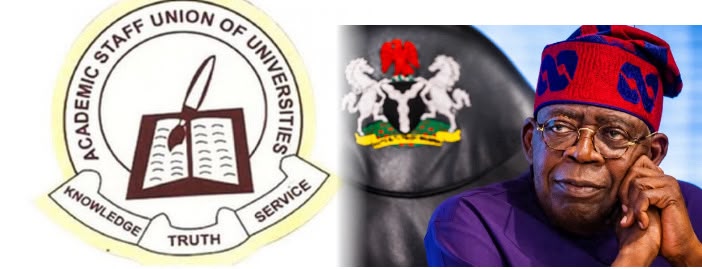
ASUU accused Mr Tinubu of reneging on a promise he made to academics before he became president.
The Academic Staff Union of Universities (ASUU) has renewed calls for President Bola Tinubu to release the three-and-a-half months’ salaries withheld from its members during the 2022 nationwide strike.
In a statement issued by its president, Chris Piwuna, on Wednesday, ASUU accused Mr Tinubu of reneging on a promise he made to the academics before he became president.
The statement noted that the union agreed, at its National Executive Council (NEC) meeting held at the University of Abuja on 13 and 14 November, to appeal to Mr Tinubu to “resist the temptation of punishing ASUU members for honouring him with the suspension of the 2022 nationwide strike over which about half of the unpaid salaries are still withheld under his watch.”
The union said the continued withholding of the salaries was unfair and could trigger another crisis in the Nigerian university system.
ASUU also described the non-payment of the withheld salaries as a ‘criminalisation’ of strike action through the enforcement of the ‘No Work, No Pay’ policy.
“When government ‘went on strike’ by withholding what is due to our members, we took our losses with equanimity and did declare No Pay, No Work,” Mr Piwuna, a professor, said.
“Why then should government criminalise strike action through slavish enforcement of the so-called No Work, No Pay rule?”
The union argued that its members had also suffered financial losses from delayed salaries, promotion arrears and unremitted third-party deductions under successive administrations, without receiving compensation.
The union also said its members had made sacrifices to restore the academic calendar after the 2022 strike, including forfeiting their annual and research leave and working harder to enable affected students to graduate.
ASUU said the lecturers had done their part to restore stability to public universities and should not be denied their outstanding entitlements.
ASUU embarked on an eight-month strike in 2022 over the non-implementation and renegotiation of the 2009 agreement. The Buhari administration had applied the ‘No Work, No Pay’ policy to the striking lecturers and withheld their salaries for the period of the industrial action.
ASUU said Mr Tinubu, then a presidential candidate, had intervened in the dispute, promising to prevent a recurrence of such industrial crises if elected.
According to the union, Mr Tinubu agreed with ASUU that the crisis could have been averted if steps had been taken early enough to address the union’s grievances.
ASUU said Mr Tinubu had also supported the principle of clemency in resolving the issue of withheld salaries during his pre-election engagement with the union.
“ASUU members heaved a sigh of relief when Asiwaju Tinubu won the presidential election with the expectation of a full release of the seven-and-a-half months’ salaries seized under President Muhammadu Buhari,” Mr Piwuna said.
“However, the hope raised through his pre-election intervention now seems to have been dashed. Three-and-a-half years down the line, only the arrears of four months have been paid.”
According to ASUU, Mr Tinubu’s Chief of Staff, Femi Gbajabiamila, later told the academics that the government was not ready to pay the withheld salaries in full.
“Surprisingly, the Hon. Minister of Education, Tunji Alausa, has continued to echo the Chief of Staff’s position on the matter, and all ASUU’s entreaties to have a direct audience with President Tinubu have been rebuffed,” the ASUU president said.
In October 2023, Mr Tinubu approved a partial waiver of the policy, directing the release of four months’ salaries to affected lecturers. The president described the waiver as an exceptional and final concession to ASUU and other education sector unions.
The payment left three-and-a-half months of salaries outstanding, which has remained a major point of disagreement between the union and the federal government.


₦5trn Agricultural Loss Claim Is False And Misleading —Kyari

ASUU renews demand for unpaid 2022 salaries

Pipeline Billions: Akwai Ibom demands economic justice, federal inclusion

2 in 5 Nigerians pay twice for medical tests over missing records-Report

Fountain of Life crisis: Court restrains Jimmy Odukoya as senior pastor

President Tinubu Confers GCON Honour On Legal Luminary, Wole Olanipekun

COP31: Africa draws red line against reopening Paris Agreement as climate finance row persists

Court Stops Jimmy Odukoya From Running Fountain Of Life Church
“The Task Force Is On Top Of It, NCDC Is On Top Of It” — FG Assures Nigerians Of Capacity To Contain Ebola
18-Year Old Arraigned In Court For Allegedly Stealing N30m Jewelries In Popular Lagos Estate
Dangote To Nigerian Creatives: Africa Must Build Its Own Prosperity
AGN President Abubakar Yakubu Bags Bebuzee Ambassadorial Deal
Abia Tertiary Sports Fiesta Begins November As Otti Receives Unity Torch
Glovo, Verve Partner To Deliver Greater Value To Nigerian Customers
Otti Flags Off Reconstruction Of Two Aba Roads
Kenya confirms ninth Ebola case, says all patients improving

 News7 days ago
“Autonomy Brings Responsibility” — ICPC Recovers ₦5.3bn From LG Accounts In Seven States, FCT, Moves To Publish 774 Councils’ Finances Online
- News7 days ago
“EFCC Recruitment Is Absolutely Free” — Commission Warns Nigerians Against Fake Employment Emails Demanding ₦3,354
- Top Stories7 days ago
“States, Not FIRS, Collect Itinerant Workers’ Income Tax” — Supreme Court Rules For Bayelsa In Offshore PAYE Dispute
- Business7 days ago
“Fixes Are Not Taking As Expected” — Microsoft Struggles To Restore Outlook, Teams, Copilot As Global Outage Hits 74 Countries
- Politics7 days ago
Details Emerge as Police, Reps Probe Attack on Obi’s Supporters in Lagos
- Special Reports7 days ago
EFCC Docks Music Star, Felix Duke For Alleged N21.2m Fraud
- Investigations3 days ago
OPay in Trouble as CBN and Others Slam Fintech With ₦946m in Fines Over Money Laundering and Other Breaches
- Special Reports6 days ago
Young Nigerians pledge to become responsible digital citizens in Lagos