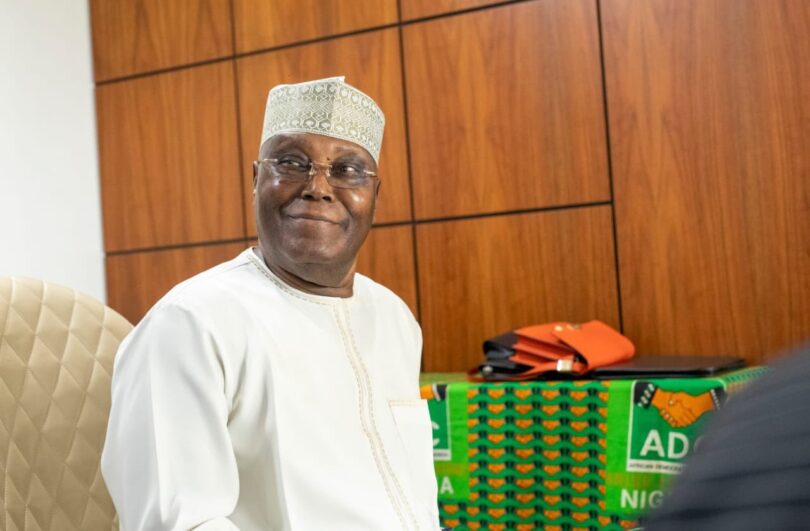
The candidates in the ADC direct primaries are Atiku, former Transportation Minister Rotimi Amaechi and economist Mohammed Hayatu-Deen.
Former Vice President Atiku Abubakar has taken an early lead in the African Democratic Congress (ADC) presidential primary as collation of results from Tuesday’s nationwide exercise continues, amid reports of irregularities and factional tensions that complicated the process.
Preliminary results from several states, according to party officials and state-level tallies, indicated that Atiku was winning with wide margins.
In Sokoto State, Atiku polled 68,824 votes, Hayatu-Deen 319 and Amaechi 292, according to the returning officer.
In Zamfara State, Atiku scored 60,500 votes, Hayatu-Deen 446 votes, and Amaechi 191 votes.
In Yobe State, Atiku polled 44,841 votes, Amaechi 300 and Hayatu-Deen 365.
In Gombe State, Atiku recorded 139,334 votes, Amaechi 1,150 and Hayatu-Deen 465.
In Ebonyi State, Atiku scored 15,300 votes, Amaechi 2,200 and Hayatu-Deen 200, according to the state primary election committee.
The former vice president has also been reported to be ahead in Adamawa, according to party officials.
False reports circulated on Monday claiming that Mohammed Hayatu-Deen had withdrawn from the race. The aspirant rejected the claims after casting his vote in Jare, Borno State.
Reports of organisational challenges and conflicting tallies also emerged from some states. Observers have noted that such issues can create uncertainty during direct primaries that depend on broad grassroots participation.
A separate faction of the ADC, led by Dumebi Kachikwu, the party’s 2023 presidential candidate, held a national convention on Sunday. The group adopted Mr Kachikwu as its presidential candidate and elected a new leadership structure. The faction also announced the dissolution of the David Mark-led National Working Committee.
This development has added to questions about party unity. It remains unclear how the Independent National Electoral Commission (INEC) will recognise the competing structures.
Peter Obi and Rabiu Kwankwaso recently left the ADC to join the Nigeria Democratic Congress (NDC).
A senator, Victor Umeh, had earlier described consultations involving Mr Obi and other opposition figures as routine. Political observers have noted that movements between parties could influence coalition-building efforts ahead of the 2027 general election.
As more results are expected throughout the day, attention is turning to how the eventual candidate will address the party’s internal divisions. Legal questions over legitimacy could arise.
A fragmented opposition landscape — involving structures linked to the ADC, NDC and PDP- could shape the challenge to the advantage of the ruling All Progressives Congress (APC) in 2027, according to political watchers.
The ADC primary is seen as a test of the opposition’s ability to consolidate ahead of the elections. The outcome is expected to influence realignment efforts within the broader opposition space.