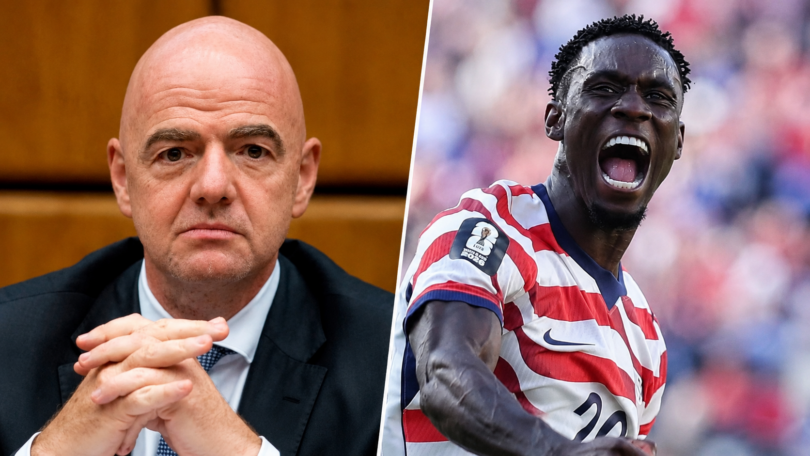
FIFA’s decision to suspend the automatic one-match ban handed to United States striker Folarin Balogun has triggered one of the biggest controversies of the 2026 World Cup
Until last week, Folarin Balogun had been making headlines for all the right reasons.
Today, however, Balogun is making headlines for a very different reason.
Instead of talking about his goals, football is talking about FIFA’s decision to allow him to play in the Round of 16 despite receiving a red card in the previous match.
The decision has sparked one of the biggest disciplinary debates in World Cup history.
By suspending the implementation of Balogun’s automatic one-match ban, FIFA has not only cleared one of the tournament’s biggest stars to play against Belgium, but also opened a wider debate about fairness, consistency and trust in football’s rules.
Criticism has come from several quarters.
UEFA has accused FIFA of undermining the game’s regulations, Belgium has questioned the decision’s legality, while former FIFA president Sepp Blatter has warned against any form of political influence in football.
International media, including the BBC Sport, Associated Press, CBS News and many others, have also intensified scrutiny after revealing details surrounding the events that preceded FIFA’s ruling.
The controversy has gone far beyond Balogun himself.
It has become a test of whether football’s governing body can still convince players, coaches and supporters that the same rules apply to everyone.
Balogun was sent off during the United States’ victory over Bosnia and Herzegovina in the Round of 32.
Normally, that would have been the end of the story.
Under FIFA’s World Cup regulations, any player shown a straight red card automatically misses the team’s next match. It is one of football’s clearest disciplinary rules and has rarely been questioned.
Instead, FIFA announced that although Balogun’s red card would remain on his record, the one-match suspension would not take effect immediately.
The world football governing body relied on Article 27 of the FIFA Disciplinary Code, which allows a disciplinary sanction to be suspended under certain circumstances.
In a short statement, FIFA cited Article 27 but did not explain why Balogun’s case deserved special treatment or what factors influenced the decision.
That lack of explanation has become one of the biggest issues in the controversy.
The questions quickly followed.
Why was Article 27 used in this case?
Why was Balogun allowed to play while every other player sent off at this World Cup served a suspension?
And what made his situation different?
Without clear answers from FIFA, the discussion has shifted from Balogun’s red card to the decision-making process.
According to BBC Sport, Article 27 has never before been used to suspend the implementation of an automatic red-card ban during a FIFA World Cup. That has made Balogun’s case unlike any other in the competition’s modern era.
For generations, players, coaches and supporters have accepted one simple fact about the World Cup.
If a player receives a straight red card, he misses the next game.
There has never been room for negotiation or appeal during the tournament.
That certainty has helped protect the credibility of the competition because every team has expected the same rule to apply equally.
According to BBC Sport, there have been 189 red cards in World Cup history, yet only one player has previously escaped serving the usual suspension.
That player was Brazil legend Garrincha during the 1962 World Cup in Chile.