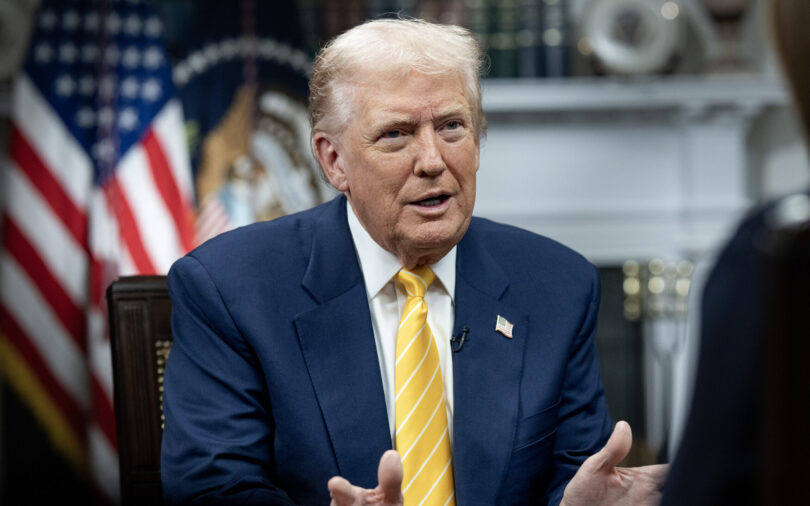
United States President Donald Trump has admitted to asking FIFA to review Folarin Balogun’s red card at the World Cup.
United States President Donald Trump has explained why he asked FIFA to review the red card shown to American striker Folarin Balogun, saying the decision would have unfairly denied one of the team’s best players the chance to feature in a crucial World Cup knockout match.
“I saw the play,” Mr Trump said. “I’m a person who loves sports and was a good athlete. I understand sports really well. That wasn’t a foul. That wasn’t even an infraction. That was two guys running full speed that happened to crash into each other.”
Balogun was sent off during the United States’ Round of 32 victory over Bosnia and Herzegovina after a challenge that referee Antonio Mateu Lahoz judged to be serious foul play.
Under FIFA’s World Cup regulations, players shown a straight red card automatically miss their country’s next match.
However, FIFA later suspended the implementation of Balogun’s one-match ban under Article 27 of its Disciplinary Code, clearing him to play against Belgium in the Round of 16.
The decision has since become one of the biggest controversies of the 2026 FIFA World Cup.
“It was very unfair”
Mr Trump said he initially did not realise the consequences of a red card until he was informed that Balogun would also miss the United States’ next match.
“And he gave him a red card. I didn’t know what that meant,” the president said. “I didn’t think it meant much. Then I started hearing that that means he can’t play in the next game, at least in the next game.”
According to Mr Trump, that punishment was excessive.
“I said, boy, that’s a big penalty. If it had happened to another player, it would have been unfair. But when they take your best player—or just about; they have some great players—and they say you can’t play, that’s very unfair.”
He questioned why a dismissal during one match should automatically affect another game.
“It’s one thing to penalise somebody for the game. But how do you penalise them for a game that hasn’t been played yet? It’s very unfair. You can’t do that.”
Mr Trump then confirmed, for the first time publicly, that he personally contacted FIFA.
“So yes, I asked for a review by FIFA. I spoke to a man who’s highly respected and, by the way, whose level of respect has gone up tenfold.”
Although Mr Trump did not mention him by name, his comments appeared to refer to FIFA president Gianni Infantino.
The U.S. president also questioned the referee’s decision, claiming many people believed the dismissal was incorrect.
“These were two great athletes that got tangled up,” he said. “And this referee, who is a little bit suspect… He made a call that nobody could believe”.
Without providing evidence, Mr Trump suggested even supporters of the opposing team believed the United States had been unfortunate.
“Even people on the other side, they said, ‘Oh, we got lucky’.”
He also criticised football’s officiating protocols, saying he was surprised that certain reviews are not assessed in slow motion because they can create a misleading impression of an incident.
FIFA has not publicly linked Mr Trump’s intervention to its disciplinary ruling.
Instead, the world football governing body cited Article 27 of its Disciplinary Code, which allows a disciplinary sanction to be suspended.
The organisation, however, did not explain why the provision was applied in Balogun’s case or what exceptional circumstances justified the decision.
Article 27 has never been invoked to suspend the automatic World Cup red-card ban, making Balogun’s case unprecedented in the tournament’s modern era.
Mr Trump’s comments are likely to fuel further debate over FIFA’s decision.
Earlier, UEFA accused FIFA of having “crossed a red line,” arguing that the automatic suspension following a red card is one of football’s fundamental rules and should not be subject to exceptions during a World Cup.
Former FIFA president Sepp Blatter also questioned the circumstances surrounding Balogun’s reinstatement, writing on X that “red cards are not overturned by political phone calls” and warning that “football must never become a playground for political power.”
Belgium, the United States’ Round of 16 opponents, described FIFA’s decision as “astonishing”, while coach Rudi Garcia said his team was “defending football” by questioning the ruling.