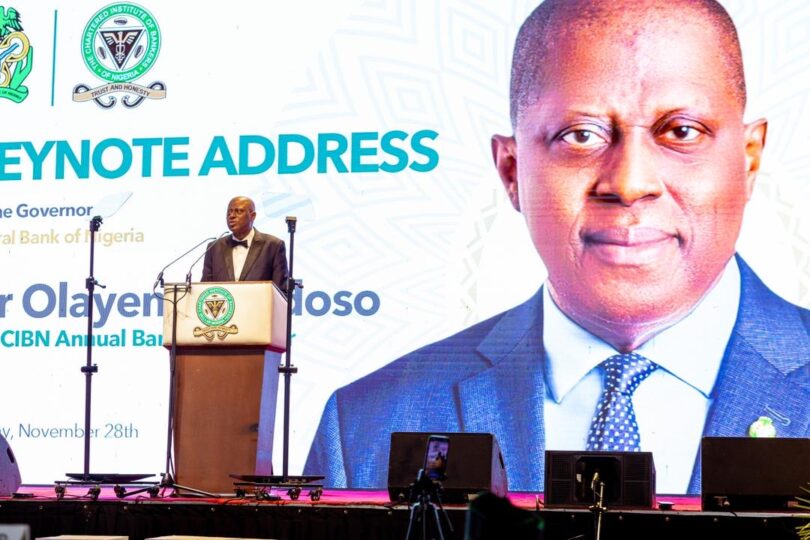
The CBN’s reform record over the past two years is, by any serious comparative measure, extraordinary.
On 22 April 2026, the Central Bank of Nigeria offered ₦750 billion in treasury bills at its primary market auction. By the time bidding closed, subscriptions had reached ₦2.36 trillion, more than three times the offer size. That is not a routine market result. It is a verdict. Investors, domestic and foreign, surveyed two years of monetary policy reform under Governor Olayemi Cardoso and decided, with their capital, that they believed in the direction of the Nigerian economy. It was one of the most unambiguous confidence signals the CBN has received in a generation.
To understand what was taken, one must first appreciate what was accomplished. The CBN’s reform record over the past two years is, by any serious comparative measure, extraordinary.
The architecture securing this digital financial ecosystem is being reinforced on multiple fronts simultaneously. On April 20, 2026, the CBN and the Nigerian Communications Commission formalised a landmark MoU establishing two joint operational committees – one on payment systems and consumer protection, and one governing the Telecom Identity Risk Management System (TIRMS) portal, which will give financial institutions real-time visibility into recycled and flagged phone numbers, directly targeting the SIM-swap fraud vectors that have drained Nigerian bank accounts at scale.
The MoU is backed by a harder regulatory layer: from May 1, 2026, the CBN’s revised BVN framework enforces ten mandatory controls across the banking system, including single-device restriction for mobile banking apps, a once-in-a-lifetime limit on BVN-linked phone number changes, a ₦20,000 transaction ceiling on newly activated devices within the first 24 hours, and a real-time 24-hour watchlist for BVNs flagged for suspicious activity.
On the market infrastructure side, the CBN and the Financial Markets Dealers Association jointly launched the Nigerian Overnight Financing Rate (NOFR), a standardised overnight benchmark that positions Nigeria alongside SOFR, SONIA, and €STR, and is designed to sharpen monetary policy transmission, deepen price discovery, and strengthen investor confidence in Nigerian fixed income markets.
On the fiscal side, Taiwo Oyedele and the Presidential Committee on Fiscal Policy and Tax Reforms delivered what the country had been promised for decades and never received: a genuine consolidation of Nigeria’s fragmented tax architecture. Four landmark laws enacted in June 2025 rationalised more than 50 federal levies, exempted small companies from corporate income tax entirely, raised the PAYE exemption threshold to ₦800,000, and mandated e-invoicing for large taxpayers –replacing a paper-based, leakage-prone system with real-time transaction reporting.
Every one of these milestones was delivered through a misinformation siege that would have broken less resolute institutions. The FX unification, by far the most politically exposed reform on the agenda, was immediately repackaged by the misinformation ecosystem as a CBN-engineered conspiracy against the naira. The distinction between a structural correction of artificially suppressed rates and a malicious devaluation was deliberately and systematically collapsed. The consequence: dollar hoarding persisted in the parallel market weeks beyond the point at which the fundamental case for it had vanished. Capital that should have re-entered formal channels held back. Confidence that should have returned waited.
The treasury bills auction that recorded ₦2.36 trillion in subscriptions in April 2026 is the kind of number that, in a cleaner information environment, might have arrived six months earlier. The remittance flows rising from $3.3 billion to $4.73 billion through official channels is a trajectory that fabricated narratives about CBN policy reversals were actively working to suppress.
The e-invoicing rollout, which had to navigate a legislative environment poisoned by fabricated revenue-impact figures before the tax reform bills had cleared committee, was delayed not by technical failure but by manufactured political noise.
This is the precise definition of the misinformation tax: not that the reforms failed to deliver, but that their benefits were deferred, diluted, and made to arrive on a schedule set not by policy logic, but by the speed at which falsehood could be outrun. What by now would have counted as accomplished milestones are instead presented as promising outlooks. What should have compounded into the next phase of reform is still being consolidated.
The CBN and FIRS were not alone in this siege. The FCCPC faced a coordinated disinformation campaign in April 2026 through viral posts and newspaper reports falsely claiming it had banned airtime borrowing and data advance services, which the Commission attributed directly to “vested interests and their foreign collaborators” sabotaging its DEON consumer lending reforms.
The NUPRC had its own fabricated smear in April 2025, when anonymous online reports alleged underhand dealings in the 2024 oil licensing bid round, timed precisely to poison investor confidence mid-process.
NERC was hit on January 1, 2024, when false rumours of an immediate electricity tariff hike forced the regulator into emergency denial mode on New Year’s Day. And the list goes on – Same playbook. Different sectors. One economy paying the bill.
Every reform announcement triggered a fabrication cycle. Every policy communication had to navigate an environment in which a fake press release could reach more Nigerians faster than the official statement it counterfeited. Weekends disappeared into crisis management. Technical teams that should have been stress-testing the next reform iteration spent their hours drafting emergency denials for documents that never existed. The psychological cost of operating at this pitch is real, even when it is invisible – of watching carefully constructed policy be publicly misrepresented as conspiracy, of rebuilding credibility that misinformation had eroded, again and again.
The cascading effect reaches every household, though most of those affected cannot identify its origin: the trader who made the wrong inventory decision; the SME owner who delayed a capital commitment; the rural applicant who handed over biometric data to a scam platform impersonating a government scheme and the everyday buyer who is forced to part with more for hoarded products.
Many do not know that misinformation was the proximate cause of their loss. That invisibility is not incidental. It is the mechanism by which the misinformation tax is most efficiently collected – from pockets that were never meant to pay it, in amounts too small to litigate, at a scale that aggregates into something the economy cannot afford to keep absorbing.
The results, achieved against this headwind, are by any honest standard remarkable. But a Nigeria serious about compounding those results would treat the eradication of its misinformation ecosystem as an economic priority of the first order. The technocrats have held the line. The question is whether the country will finally hold it with them.