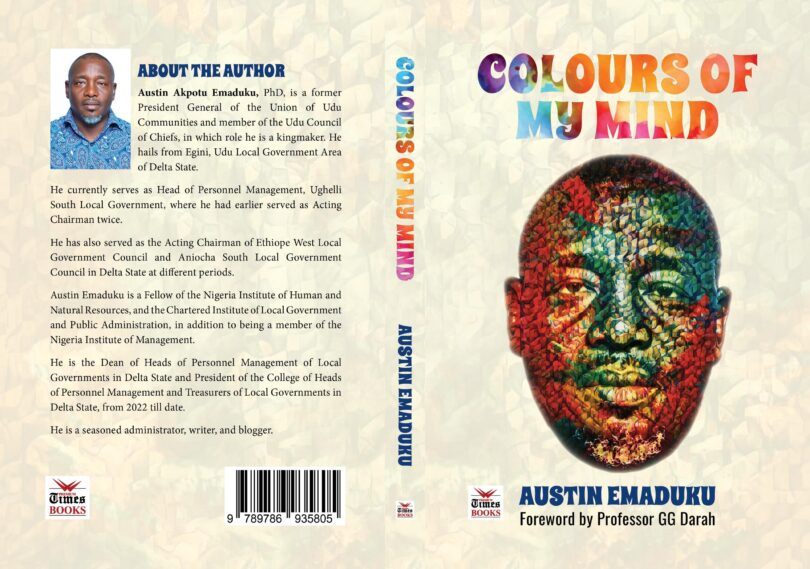
Its value lies in the fact that Emaduku has preserved something that disappears easily in the digital age: the record of sustained civic engagement.
In the foreword to Colours of My Mind, Professor Godini G. Darah places Austin Emaduku within a distinguished lineage of Nigerian public intellectuals, from Nnamdi Azikiwe and Anthony Enahoro to Dele Giwa and Tunji Dare, who used the written word to interrogate power and hold public authority to account.
Colours of My Mind is something perhaps more modest, but in some respects more interesting: a record of how an engaged Nigerian citizen thought through his country in real time, from the particular vantage point of the Niger Delta. Its value lies less in the comprehensiveness of its political analysis than in the immediacy of its observations, the force of its convictions and its willingness to turn the critical gaze upon the author’s own community.
The pieces, written predominantly between 2016 and 2017, with some extending to 2023, cover politics, governance, religion, ethnicity, culture, social values and local affairs. They originated largely as social media commentaries, and the book retains much of the immediacy of that form.
This is not a conventional work of political philosophy. It is part political commentary, part local history, part moral argument and, above all, an archive.
What Kind of Book Is This?
Emaduku himself provides the key to understanding the collection. In his introduction, he explains that “a bulk of these articles were written between 2016 and 2017, a trying period in my life that turned out to be my most productive and creative years thus far.” He says he put the collection together “to record my thoughts for posterity.”
Fair enough. That is an important declaration of intent.
The reader should therefore resist the temptation to judge every piece as though it were written as part of a single, carefully constructed political thesis. These are interventions made at particular moments, responding to particular events and controversies. Some are angry. Some are reflective. Some are deliberately provocative. Some are much stronger than others.
Taken together, however, they create a portrait of a Nigerian citizen trying to make sense of his country during a difficult period.
That is the book’s real organising principle.
The Niger Delta Vantage Point
Emaduku’s most distinctive contribution is his rootedness.
He writes from Udu Kingdom in Delta State, from a region that produces a substantial portion of Nigeria’s wealth while bearing many of the environmental, economic and social consequences of oil extraction. His commentary, therefore, comes with a perspective that is often missing from national political writing.
In a keynote address on youth restiveness and militancy delivered in October 2016, he recalls the Warri of his youth:
“I can recall the mid-80s to the early 90s when Warri, the economic hub of Delta State was home to hundreds of oil companies. Oil production was at its peak and many of our young men and women were engaged in one form of employment or the other. Technicians, fitters, welders, caterers, security guards, etc.”
The passage is valuable because it is not simply nostalgia. It becomes an indictment of what happened afterwards. Emaduku writes:
“We created the state of insecurity that chased away the companies that would have provided employment for our teeming unemployed youths.”
The significance lies partly in where the criticism is directed. He acknowledges the failures of government and the injustices suffered by the Niger Delta, but he is equally prepared to confront destructive choices made within the region itself.
That willingness to look inward recurs throughout the book.
His description of the social consequences of the collapse of the local economy, including the uncomfortable account of “club girls” who once rejected African customers because of their lack of “dollar power”, is hardly polished sociological analysis. But it is vivid social observation, recording the mentality that developed around oil wealth, foreign workers, local deprivation and the distorted expectations created by a boom economy.
He does not merely describe the Niger Delta as a victim. He tries to understand how victimhood, grievance, opportunism, militancy and communal responsibility became entangled.
The Community Intellectual
The book also introduces us to Emaduku as a community intellectual.
His interventions in Udu politics, the affairs of the Union of Udu Communities, the BEDC electricity crisis and the Aladja-Ogbe-Ijoh conflict may appear specifically local to readers outside Delta State. Yet they reveal something important about citizenship.
For Emaduku, politics is not an abstraction taking place in Abuja. It is electricity that does not reach communities, institutions that fail, traditional authorities that are contested, neighbours who become enemies and local leaders whose conduct affects ordinary people.
His letter to the Aladja and Ogbe-Ijoh communities in August 2017 is particularly striking because it draws upon memory as a form of moral argument. Recalling a period when the two communities enjoyed close relations, he writes:
“I recall with clarity and fond memories the peaceful brotherly relationship that existed between your two communities. I recall my first visit as a student of Aladja Grammar School to the then sleepy community of Ogbe-Ijoh.”
Then comes the question:
“What or who brought this calamity upon you?”