Special Reports
Court reserves judgement in N3.1bn fraud case against Suswam

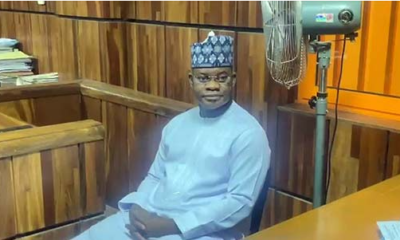
The trial judge, Peter Lifu, announced on Friday that the date for judgement would be communicated to the parties after their lawyers adopted their final written addresses.
The Federal High Court in Abuja has reserved judgement in the alleged N3.1 billion money laundering case involving former Benue State Governor Gabriel Suswam and a former Commissioner for Finance in the state, Omodachi Okolobia.
Mr Suswam and Mr Okolobia, through their respective lawyers, urged the court to acquit them, while the Economic and Financial Crimes Commission (EFCC) asked the judge to find that the prosecution had proved its case against them.
Mr Suswam’s lawyer, Chinelo Ogbozor, told the court that the defence filed its final written address in December 2025. She added that the defence submitted a reply on points of law in April after receiving the commission’s final address.
Adopting the submissions, Ms Ogbozor urged the court to discharge and acquit Mr Suswam on counts one to seven of the 11-count amended charge, which contain allegations against the former governor.
The counts centre on the alleged misappropriation of N3.1 billion, said to have come from the sale of shares owned by the Benue State Government through the Benue Investment and Property Company Limited.
Mr Okolobia’s lawyer, Paul Erokoro, a Senior Advocate of Nigeria (SAN), also asked the court to acquit his client. He said the defence filed its final written address in January and later submitted a reply on points of law in June, following receipt of the prosecution’s address.
“I adopt these two processes as our final address in urging your lordship to discharge and acquit the second defendant of all the counts in the amended charge,” Mr Erokoro told the court.
He argued that the prosecution had failed to prove the allegations against Mr Okolobia in counts eight to 11, which concern the former commissioner alone.
The commission’s lawyer, Rotimi Jacobs, SAN, urged the judge to uphold the prosecution’s case. He adopted the commission’s final written address, filed in March.
Mr Jacobs described the case as “a straightforward case” and outlined the prosecution’s allegations that the defendants diverted funds belonging to Benue State.
Mr Suswam is a lawyer and politician who represented Katsina-Ala/Ukum/Logo Federal Constituency of Benue State in the House of Representatives between 1999 and 2007. He was elected governor in 2007 and served two terms until 2015. He later represented Benue North-East Senatorial District in the Senate from 2019 to 2023.
The allegations in the case relate to transactions carried out during his second term as governor. The EFCC accused him and his then Commissioner for Finance, Mr Okolobia, of diverting N3.1 billion from proceeds of the sale of shares owned by the state government.
The shares were held through the Benue Investment and Property Company Limited (BIPC). According to the prosecution, part of the proceeds from their sale through Elixir Securities Limited and Elixir Investment Partners Limited was diverted between August and October 2014.
Abubakar Umar, a bureau de change operator who operated Fanffash Resources Limited, testified that he converted the money into $15.8 million and delivered the dollars to Mr Suswam. His account of where he delivered the money changed during the trial.
The commission also accused Mr Okolobia of conducting transactions totalling N578 million in four tranches between December 2014 and January 2015, in breach of the cash transaction limit under the money laundering law. Both defendants denied the allegations.
The commission first arraigned the duo before the Federal High Court in November 2015. They pleaded not guilty to the charges, which were later amended to 11 counts. The case passed through three judges before it was reassigned to Mr Lifu in 2023. The defendants were re-arraigned before him in March 2024 and again pleaded not guilty.
During the trial, Junaidu Sa’id, an EFCC investigator, testified about the investigation and the alleged transfer of the money. Brigid Shiedu, then managing director of BIPC, gave evidence about the sale of the shares and the governor’s authorisation.
Mr Umar, the fourth prosecution witness, described how he converted the money into dollars. In January 2018, he told the court that his earlier evidence about delivering the money to Mr Suswam’s Maitama residence was wrong. He also alleged that people close to the former governor had pressured him to change his account.
The prosecution called nine witnesses and tendered documentary evidence before closing its case. One of the witnesses, Adewale Agunbiade, a compliance officer with Guaranty Trust Bank, testified about Mr Suswam’s naira and dollar accounts.
He told the court that more than $200,000 entered the dollar account in installments between August 2014 and July 2015, while Mr Suswam personally paid $175,000 in cash.
During cross-examination, however, Mr Agunbiade said the inflows were not unusual and that he had not noticed any breach of banking regulations. Appea Sunday, an EFCC investigator, also testified for the prosecution.
The defendants then asked the court to dismiss the charges without requiring them to present a defence, arguing that the prosecution had failed to establish a case against them. Their lawyers, Ms Ogbozor and Mr Erokoro, said the evidence was insufficient to sustain the charges, but the prosecution opposed the application, insisting that the evidence linked the defendants to the alleged offences.
In July 2025, Mr Lifu dismissed the application and directed the defendants to present their defence. He held that the prosecution had presented enough evidence to require them to respond to the allegations.
Mr Suswam subsequently testified as the sole defence witness, while Mr Okolobia did not testify or call any witness. They concluded their defence in November 2025, after which the judge directed the parties to file and exchange their final written addresses.
Although he gave the prosecution 14 days to file its address and allowed the defendants 14 days to respond after receiving it, the adoption took almost a year.
The court initially fixed a day in January this year for the adoption of the addresses, but the proceedings were postponed several times. The matter was later moved to May and then to July before another adjournment to September.
At the July proceedings, the judge adjourned the case after the prosecution informed the court that Mr Suswam and his lawyer, Mr Erokoro, were indisposed.
The matter suffered another delay in October when Mr Suswam’s lead lawyer, Joseph Daudu, was absent. The prosecution told the court that Mr Daudu had written to say he would be travelling to Denmark for the International Bar Association’s annual conference.
The prosecution described that request as a deliberate attempt to frustrate the trial but agreed to the adjournment to avoid any question of denying the defence a fair hearing, while the judge subsequently adjourned the case to November.


Presidency hails Rarara’s new Tinubu campaign song, says APC has ‘support’ across north

“Nganjiwa Should Not Be Sitting As A Judge” — Odinkalu Faults 167-Page Judgment Disqualifying Omo-Agege From 2027 Senate Race

Court reserves judgement in N3.1bn fraud case against Suswam

Tompolo Movement To Release Book On Tinubu’s Reforms

Isa Ashiru asks Gov. Sani to resign over rising insecurity in Kaduna

AI must not replace teachers, students, humanity, NOUN VC warns

When History Speaks, Diplomacy Must Listen: Fani-Kayode And The Question Of African Solidarity

Asharami Synergy Advances Digital Innovation and Operational Resilience in Aviation Fuel Supply
Jumia Nigeria Unveils ‘No Manage Am’ Black Friday 2026 Campaign With Up To 60% Off
ADC Postpones Presidential Campaign Flagoff, Fixes New Date
“User Funds Are Completely Safe” — Binance Investigates Suspected $6.3 Billion Hack, Suspends Deposits And Withdrawals
Abuja court to rule on joinder application in Pantami-PDP suit
Davido features Chioma in ‘Already Falling’ video, recreates proposal scene
IAEA can’t verify location of Iran’s nuclear material – Rafael Grossi

“Airlines Increase Seat Availability But Do Not Necessarily Reduce Airfare” — Christmas Return Tickets Hit ₦822,000 As Carriers Expand Flights Across Nigeria
Troops Neutralise 44 Terrorists In Borno, Disrupt IED Attack

 Business4 days ago
“Airlines Increase Seat Availability But Do Not Necessarily Reduce Airfare” — Christmas Return Tickets Hit ₦822,000 As Carriers Expand Flights Across Nigeria
- Special Reports3 days ago
Zamfara Govt Suspends Campaign In Maru LGA Following Fatal Accident In Gummi
- Top Stories5 days ago
“1,571 Tractors Deployed To 23 States” — APC PCC Lists Agriculture Interventions As Tinubu Approves ₦1.5tn BOA Recapitalisation
- News3 days ago
NAFDAC Threatens Prosecution Over Illegal Pharmacy Raids In Edo
- Top Stories5 days ago
“We Are Examining The Video” — Daura Emirate Launches Probe Into Tourist’s Sexual Assault Allegations Against Emir Faruk Umar Faruk
- News5 days ago
One Dead As Fire Guts Lagos Filling Station
 Politics3 days ago
ADC Demands Tinubu’s Impeachment Over Gov Yusuf’s S’Court Revelation
- Special Reports3 days ago
Alleged ₦110.4b Kogi Fraud: Witness Narrates How Kogi LGs Repaid N2.1bn Loan for Bello’s Children School Fees