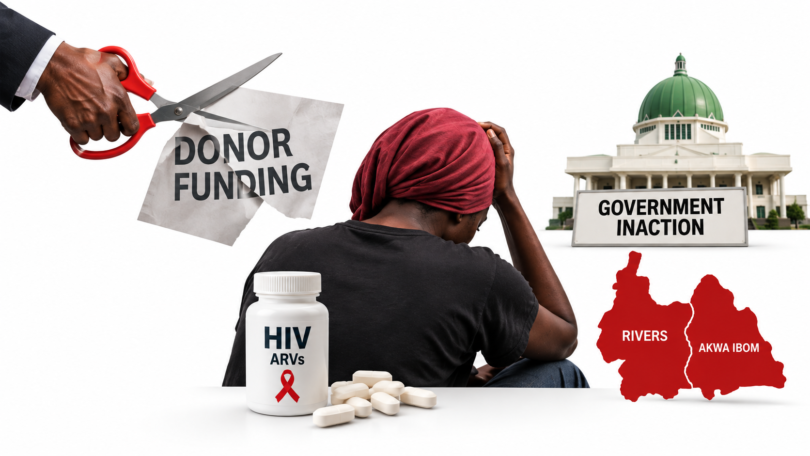
Conclusion of PREMIUM TIMES’ three-part series: As donor support declines, laws meant to guarantee political leadership, funding and protection for people living with HIV remain weakly implemented, raising critical questions about accountability in Rivers and Akwa Ibom states.
Long before the gradual withdrawal of international HIV funding exposed the fragility of Nigeria’s HIV response, Akwa Ibom and Rivers states had enacted laws intended to prevent such a crisis.
On paper, the laws offered a blueprint for sustainability. However, a PREMIUM TIMES investigation found little publicly available evidence that several of the statutory mechanisms operated as intended during the period under review, even as donor-supported community services began disappearing in both states.
The findings raise a critical question: if institutions specifically created to sustain the HIV response are not fully functional before donors leave, what happens when external funding eventually disappears?
In Akwa Ibom, the HIV/AIDS Control Agency Law establishes the State Council on HIV/AIDS as the highest policy-making body responsible for coordinating the state’s HIV response.
Its composition reflects the importance attached to the epidemic. The governor chairs the council, while the deputy governor serves as vice-chairperson. Other members include the Secretary to the State Government, the Head of Service, commissioners from key ministries and the Director-General of the State Agency for the Control of AIDS (SACA).
Under the law, the council is responsible for providing political leadership, mobilising funding, coordinating partnerships, reviewing implementation of the state’s HIV strategic plan and ensuring that the response remains effective.
The law requires the council to meet at least once every quarter.
Yet, despite repeated requests, the Akwa Ibom government did not provide PREMIUM TIMES with records showing how many statutory meetings were held between January 2023 and June 2026, the resolutions reached at those meetings, or actions taken to prepare the state for declining international donor support.
PREMIUM TIMES also reviewed official government websites, social media pages, publications, press releases and other publicly available records but found no evidence of quarterly council meetings on HIV during the period.
When asked whether the statutory meetings had taken place, Commissioner for Health Ekem Emmanuel said Governor Umo Eno “holds meetings on HIV/AIDS” but referred questions about the number of meetings and records of deliberations to the State Agency for the Control of AIDS.
The commissioner later said he could not be expected to keep track of such meetings.
“You honestly think I will be keeping count of the meetings? I was not the Commissioner for Health in 2023,” he said.
On 7 July, PREMIUM TIMES sent a detailed 12-point enquiry to the agency’s Programme Manager, Enobong Akpan, seeking records of council meetings, budget releases, implementation of the HIV law and the state’s preparedness for shrinking donor support.
Mr Akpan acknowledged receiving the enquiry and initially promised to respond after returning to Akwa Ibom from an official meeting. Despite repeated reminders, he did not respond to the questions.
Akwa Ibom’s HIV law extends beyond state-level governance. It establishes Local Action Committees on HIV/AIDS across all 31 local government areas, with council chairpersons expected to lead HIV coordination at the local level.
The committees are designed to mobilise communities, coordinate prevention and treatment activities, strengthen awareness campaigns and receive financial support through local government budgets.
Effectively, they are intended to ensure that the HIV response reaches communities long before patients arrive at hospitals or clinics.
However, interviews conducted by PREMIUM TIMES with officials of the Network of People Living with HIV/AIDS in Nigeria (NEPWHAN) in Akwa Ibom, community advocates and local government stakeholders found no evidence that the committees were actively performing those statutory roles.
“We have tried engaging local governments, particularly in areas with high HIV prevalence, but the response has been poor,” Elizabeth Udo, Akwa Ibom State Coordinator of NEPWHAN, told PREMIUM TIMES.
PREMIUM TIMES also could not independently identify recent HIV interventions directly implemented by any of the state’s 31 local governments under the framework created by the law.
Scrutiny of local government spending is further complicated by the 31 councils’ failure to publish their budgets and other fiscal documents, a practice PREMIUM TIMES previously reported to violate the state’s fiscal responsibility law.
The situation in Rivers is similarly unclear.
The Rivers State Agency for the Control of AIDS Law establishes governance structures intended to sustain political commitment, mobilise domestic financing and coordinate the HIV response through a Governor’s Committee on AIDS, a State Council on HIV/AIDS and Local Government Action Committees.
Those institutions were expected to become increasingly important as donor support declined.
However, when PREMIUM TIMES requested records on 7 July showing whether the statutory structures remained functional during the donor transition period, the Rivers State Agency for the Control of AIDS did not respond.
Its Programme Manager, Naaziga Francis, initially indicated that he preferred an in-person interview. But when a PREMIUM TIMES reporter travelled to the agency’s office in Port Harcourt, Mr Francis declined to answer the questions.
“I am just a civil servant. Those questions you have asked will have political consequences,” he said.
PREMIUM TIMES also visited the Rivers State Ministry of Health. Officials explained that the prolonged political crisis in the state meant no commissioner had been appointed, while the permanent secretary had retired.
Repeated telephone calls, text messages and WhatsApp messages sent to the state’s Commissioner for Information, Honour Sirawoo, were not answered before publication.