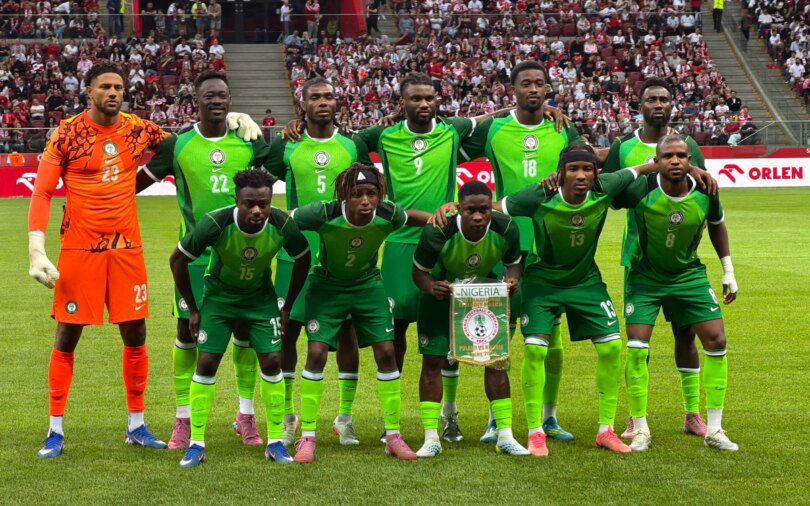
This is the Super Eagles’ second failure, in a row, to participate in the global football tournament.
For the next six weeks, millions of football fans across the globe would be glued to their television sets at home and in sports bars, etc., and to streaming devices to watch another quadrennial contest of the beautiful game, organised by FIFA. The present spectacle kicked off in Mexico last Thursday, which co-hosts the tournament with the United States of America (USA) and Canada. In the opening game, Mexico thrashed South Africa 2-0.
Apparently, missing in the competition and sadly so is the Super Eagles of Nigeria. It could not qualify from the Africa Group C, which comprised five other national teams from South Africa, Benin, Lesotho, Rwanda and Zimbabwe. South Africa picked the group’s ticket with 18 points, just a point above Nigeria’s 17. Nine other African countries in the Mundial are Egypt, Ghana, Senegal, Cape Verde, Morocco, Ivory Coast, Algeria, Tunisia and the Democratic Republic of Congo, which qualified through the intercontinental play-offs.
It is “the beautiful game” as the great Pele of Brazil described it; the global unifier, the melting pot of cultures and friendships. Why Nigeria is not in this football galaxy, out of 10 representations from Africa, should be a crucial talking point for a considerable length of time.
Ironically, President Donald Trump had robbed the football fiesta of its redolent spirit even before the kick-off, with his government’s denial of Somalian referee Omar Artan, officials from a number of teams, and supporters from across the world, entry into the US. Equally, soaring ticket prices would deny many fans the right to be at the different stadia to cheer their teams.
Unable to qualify, the Super Eagles have lent themselves to Poland, Portugal, Jordan and Iran, which are participating in the tournament, in friendly games, to perfect their tactics. The last game in the series was played on Wednesday, and the Portuguese team, led by Cristiano Ronaldo, beat them 2-1.
This is the Super Eagles’ second failure, in a row, to participate in the global football tournament. It is, indeed, a true and poignant reflection of the abysmal depths our football has plumbed, and the incompetence of those entrusted with its administration.
When the Super Eagles debuted in the USA in 1994, they reached the group of 16; they dazzled the world, such that they were the toast of all. They ended up being ranked the fifth best globally. In 1998, the team also surpassed the group stage. Since then, the slippery slope began as they were bundled out in four other subsequent editions at the group level. We had thought that Nigeria’s football administrators and the players had learned their lessons by missing the 2022 edition. Regrettably, they chose to become “Those that fail to learn from history (and who) are doomed to repeat it,” which Winston Churchill warned about.
Trouble for Nigeria began with Jesse Peseiro’s resignation as coach after the 2023 AFCON finals in Abidjan, Côte d’Ivoire, which it lost, without immediate steps taken to replace him. Finidi George, who was his assistant, was drafted in, in an acting capacity. And when he finally got the job, Daniel Amokachi was designated as his assistant. But Amokachi rebuffed the offer without offering reasons.
The consequences were quite telling in the Group C qualifiers that Finidi managed, with a score line of: Nigeria 1: South Africa 1; and Benin 2: Nigeria 1. At that point, he resigned as the gaffer in June 2024, seeing as it were the irredeemable fate that awaited the country. Austin Eguaveon replaced him on a temporary basis until the incumbent, Eric Chelle, took over in January 2025. By this time, the ticket had been lost. Qualification was no longer in Nigeria’s hands, but in the envisioned misfortune of South Africa, which never happened.
We bemoan the situation because the ongoing World Cup miss for Nigeria is a lost opportunity for national solidarity, amid the ethnic, sectarian and regional divides that constantly negate our quest for nationhood. Those in charge of our football and the political authorities should always be aware of the potential of this game as a symbolic vehicle of our nation-building aspirations, which offers insight into how a binding nationalism can be forged in the country. It needs to be constantly approached with the seriousness it deserves.
Football breeds talents, lifts the youth out of poverty, and creates wealth, as the swelling international purse of the game testifies to – from player income to media rights and other forms of merchandising. Nigeria has lost multiple levels of fortune due to the Super Eagles not featuring in the tournament. But this negative tide can be turned around with the right attitude and vision, if we can put our acts right in football administration, and work towards making certain our participation in the 2030 Mundial.
Quite unfortunately, for the majority of humanity, anticipating the unique experiences and entertainment of the World Cup, Trump has significantly muddied this up with the exasperating border barriers he has set up to restrict participation. Among instances of this was the situation of Somalian referee Artan, who was subjected to 11 hours of border interrogation at Miami airport, before being denied entry, despite a valid diplomatic visa and intact travel documents.
Equally, the Senegalese and Uzbekistan national teams were put through ill-tempered entry checks, while the US government has ensured that the Iranian team never spends a night on US soil, as they have to return to Mexico after each game, due to the continued war between both countries. Iranian fans have had their stadium tickets withdrawn. The Trump administration’s misanthropic immigration policy has barred nationals of 12 countries from entry into the US since June 2025.
The dissonance from all this is so crippling that the Dutch football great, Ruud Gullit, called out FIFA President Gianni Infantino for watching so much discredit being brought to bear on the game. Hence, he wants him to step down and take responsibility for the mess. Guillit lamented that, “A World Cup should unite people. Instead, this tournament is becoming a symbol of division, political disputes, travel restrictions, and administrative failures.” He couldn’t be more right!
Infantino has mired the tournament in a miasma, with the indelible footprints of a FIFA boss who chose to subject the tournament to an inhospitable host. More disturbing is that he has never defended any of the footballing victims whose rights President Trump has violated so far. Rather, he keeps appealing to the incredulous and unacceptable argument that FIFA has no control over national borders or the power to admit participants into any country.
But we could as well say that FIFA had the responsibility of choosing a host who would not be as disagreeable and detesting of those whose participation brings joy and beauty to a game that entertains and unifies humanity. Infantino has set a dangerous precedent that should never be allowed to stand, going forward.