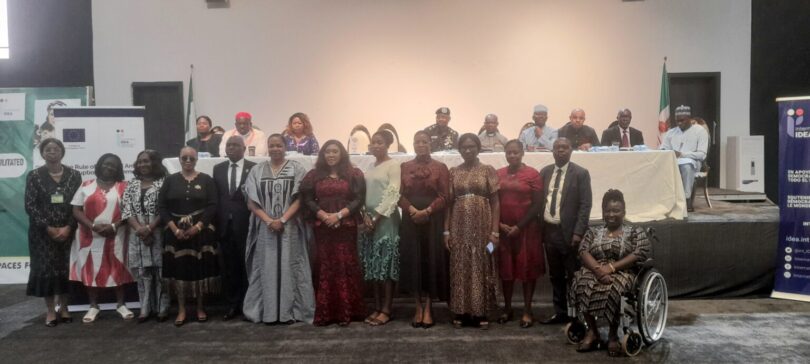
The policy was unveiled on Monday at the 17th Quarterly Meeting of the Edo Gender-Based Violence Management Committee in Benin.
The Edo State Government has introduced a Policy Framework on Technology-Facilitated Gender-Based Violence (TFGBV) to enhance prevention, reporting, protection, response, and accountability against digital abuse.
The meeting was organised by the Edo State Ministry of Women Affairs and Social Development in collaboration with the Rule of Law and Anti-Corruption (RoLAC) programme.
It brought together government officials, security agencies, the judiciary, health workers, development partners, civil society organisations and youth representatives to review GBV interventions and emerging digital violence.
Edesili Okpebholo-Anani, chairwoman of the committee and coordinator of the Office of the Wife of the Governor, reaffirmed the government’s commitment to creating a safer society free from violence, abuse, exploitation, and discrimination.
Okpebholo-Anani said the state’s GBV clubs in secondary schools were designed to equip young people with knowledge of their rights, healthy relationships, violence prevention, reporting mechanisms and support services.
She said educating young people early would help raise a generation that rejects violence and advocates for positive social change.
Okpebholo-Anani said technology had transformed communication and interaction but had also created new avenues through which women, girls and vulnerable persons could experience harassment, threats, stalking, cyberbullying and other forms of abuse.
She said the TFGBV policy provided a framework for strengthening prevention, protection, reporting, referrals, survivor-centred services, response and accountability.
Okpebholo-Anani announced the formation of an implementation sub-committee to coordinate policy implementation, monitor progress, identify gaps, and report regularly to the GBV Management Committee.
She urged members to strengthen referral pathways, survivor-centred services, data systems, prevention programmes, community engagement and accountability mechanisms.
The chairwoman appreciated RoLAC for its technical and strategic support, saying the partnership had helped strengthen policies, institutions, and coordination mechanisms to address GBV.
Eugenia Abdallah, commissioner for women’s affairs and social development, said technology had transformed communication, learning, work and interaction, but also created new avenues for gender-based violence.
Abdallah identified emerging forms as cyberstalking, online sexual harassment, cyberbullying, threats, impersonation, identity abuse, non-consensual sharing of intimate images, sextortion and technology-enabled exploitation.
She described the policy as a timely response to digital violence, saying it would promote digital literacy, public awareness, school-based learning and community engagement.
The commissioner said the framework would establish survivor-friendly reporting, referral, evidence preservation, and support systems, while improving digital investigation, prosecution, and victim-protection procedures.
She added that the policy clarified the roles of justice, social development, health, law enforcement and other institutions while encouraging cooperation with digital platforms and service providers.
Abdallah said the inauguration was only the beginning of implementation and urged stakeholders to ensure technology remained a tool for empowerment, inclusion and development, rather than violence and exploitation.
The newly deployed Commissioner of Police in Edo, Patrick Daor, pledged the command’s support for the state’s GBV response and efforts to tackle technology-facilitated crimes.
Mr Daor said the police command received numerous complaints involving cyberbullying, blackmail and intimidation, emphasising the need for stronger collaboration among stakeholders.
“The use of technology should be in a way that benefits everyone. But now you have people out there using it for bullying, blackmail and intimidation. As commissioner of police, I get a lot of these complaints,” he said.
The Edo State Commissioner for Health, Cyril Oshiomhole, emphasised that survivors of GBV should not be blamed for violence perpetrated against them.
Oshiomhole urged health facilities across the state to attend to survivors promptly and ensure they received appropriate medical care, psychosocial support and other necessary services.
Representing the Commissioner for Justice, Roland Otaru, the Director of Public Prosecution, Charity Ebosele, described GBV as a human rights violation that should not be tolerated.
Ebosele said the policy was an important step towards strengthening institutional responses to technology-enabled crimes and ensuring the effective prosecution of offenders.
She said the judiciary remained committed to ensuring justice for survivors and appropriate sanctions for offenders while emphasising the need to handle cases sensitively.
A UNICEF youth representative, Isabel Anani, called for greater attention to cyberbullying among young people, particularly in schools and tertiary institutions.
Anani said peer bullying could be difficult to detect because perpetrators and victims often interact within the same social circles, making it harder for adults to identify the abuse.
She called for youth-friendly reporting mechanisms and safer institutional environments where young people could report digital abuse without fear.
She also emphasised the importance of ensuring that students were aware of available online reporting channels and the confidentiality associated with such reports.