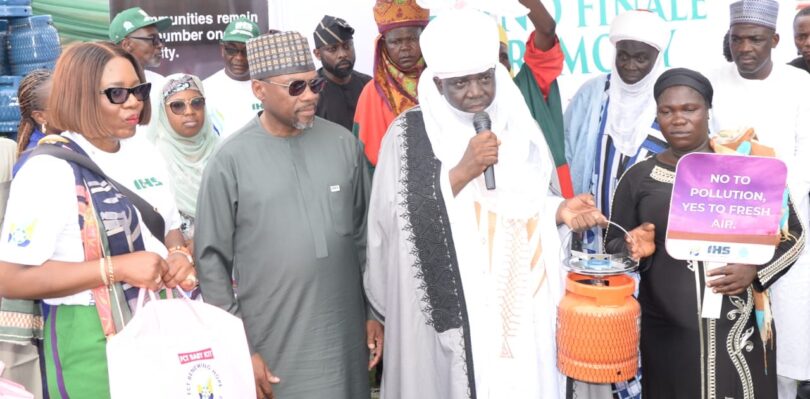
This was announced on Thursday during the programme’s final rollout in Bwari Area Council, where beneficiaries received gas cylinders, burners and refill vouchers through a partnership between the FCTA and IHS Nigeria.
The Federal Capital Territory Administration (FCTA) says its Abuja Breathe Clean Air Initiative, supported by IHS Nigeria, has reached about 10,000 households across the six Area Councils, replacing firewood and charcoal with cleaner cooking gas as part of efforts to improve maternal and child health, reduce indoor air pollution and lower household energy costs.
Officials at the event said the initiative, introduced under the administration of the FCT Minister, Nyesom Wike, was designed to encourage households to adopt cleaner cooking energy while addressing the health and environmental hazards associated with the widespread use of firewood and charcoal.
Speaking at the event, the FCT Minister of State, Mariya Mahmoud, said that indoor air pollution remains a significant public health concern, particularly for women and children, who spend more time in cooking areas.
Ms Mahmoud, who her Special Adviser, Majeed Adamu, represented, said indoor air pollution remains a major public health challenge in many communities, with women and children disproportionately affected because they are more frequently exposed to smoke from cooking with firewood and charcoal.
“By promoting the use of clean cooking gas, this initiative will significantly reduce exposure to harmful smoke, improve public health and protect the environment,” she said.
The Mandate Secretary of the Health Services and Environment Secretariat, Adedolapo Fasawe, said the initiative was conceived two years ago after the FCTA discovered that many residents, including those living within the Abuja metropolis, continued to cook with firewood despite the associated health risks.
Ms Fasawe said prolonged exposure to smoke from firewood has been linked to respiratory infections, allergies and burns, especially among women and children.
She said the administration decided to provide households with a practical alternative instead of merely advising them to abandon traditional cooking fuels.
“This administration believes in proactiveness. We will not encourage you to stop cooking with firewood when we have not provided an alternative. Hence, the Breathe Clean Air project was started,” she said.
Ms Fasawe added that replacing firewood with cleaner fuels benefits not only individual households but also contributes to improved public health and environmental outcomes.
Beyond the health benefits, the FCTA said the programme has also helped reduce household cooking costs while improving productivity for small-scale food vendors.
Ms Fasawe said beneficiaries reported cooking faster after switching to liquefied petroleum gas (LPG), enabling some food vendors to prepare significantly larger quantities of food within the same period.
She explained that while a gas refill costs about N4,000 and can last a family of six for more than a month, many households previously spent between N1,200 and N1,500 every day on firewood.
To encourage continued adoption, beneficiaries received gas cylinders, burners and two refill vouchers.
Ms Fasawe expressed optimism that the initiative could eventually evolve into a policy promoting cleaner cooking energy across the FCT.
Also speaking, the Executive Vice President and Chief Executive Officer of IHS Nigeria, Mohamad Darwish, said IHS Nigeria provided 10,000 units of LPG cylinders under its partnership with the FCTA.
Mr Darwish, represented by Dapo Otunla, chief corporate services Officer, IHS Nigeria, added that more than 2,000 beneficiaries had also been enrolled in the programme’s “Clinic Without Walls” health insurance scheme for one year.
According to him, the first 2,000 beneficiaries will receive free healthcare services through partner healthcare providers.
“The whole idea is to move people away from cooking with firewood and charcoal; it is cleaner, it is fresher and also helps them with their lungs and their ultimate health benefits,” he said.
Mr Darwis said IHS Nigeria would continue to monitor the initiative to assess its long-term sustainability and ensure beneficiaries continue to use cleaner cooking energy.
The event was attended by government officials, traditional rulers and hundreds of residents of Bwari Area Council, with scores of women also receiving baby care packs alongside cooking gas cylinders.
Indoor air pollution remains a major public health challenge in Nigeria.
According to the World Health Organisation (WHO), exposure to smoke from polluting cooking fuels contributes to respiratory diseases, cardiovascular conditions and premature deaths, with women and young children facing the greatest risks because of their prolonged exposure during cooking.
The Abuja Breathe Clean Air Initiative was launched by the FCTA in 2025, alongside the Mother-Baby Kit Project, as part of broader efforts to improve maternal and child health and reduce household air pollution.
As PREMIUM TIMES previously reported, the initiative aims to encourage households to transition from firewood, charcoal and other polluting cooking fuels to LPG to reduce respiratory illnesses, environmental pollution and the health risks associated with indoor smoke exposure.
The programme, FCTA noted, also aligns with Nigeria’s efforts to promote cleaner energy and reduce emissions from household cooking.