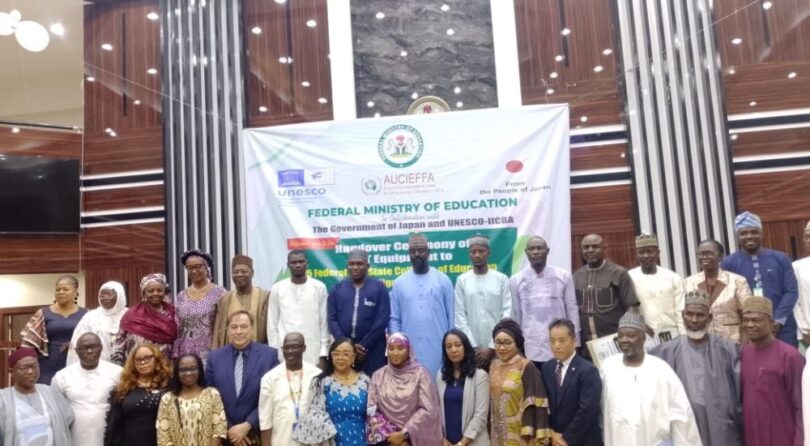
The Federal Government on Tuesday commenced a national consultation on school safety guidelines in Abuja.
The consultation which took place after a ceremony to hand over ICT equipment to 15 federal and state colleges of education, was attended by provost if the beneficiary institutions and other stakeholders .
Speaking during the event, the Minister of State for Education, Prof. Suwaiba Ahmad, said the gathering was both a distribution exercise and a policy forum.
“This ceremony serves not only as a handover event but also as a national consultation platform to introduce and discuss school safety guidelines aimed at strengthening safe and inclusive learning environments,” she stated.
On school security, Ahmad stressed that “safe schools are essential to achieving quality education, especially for girls and vulnerable learners” and called for continued efforts to keep institutions “secure, supportive, and conducive spaces for teaching and learning.”
The equipment, donated with support from the Government of Japan and UNESCO’s International Institute for Capacity Building in Africa, is part of a regional project titled ‘Capacity-building of Teachers to Promote Continuous and Inclusive Access to Safe and Quality Education for Girls in West Africa.’
The minister noted that the project involves six countries, including Nigeria, and was launched in March 2024.
She added that the resources will improve pre-service and in-service training through better access to digital content and learner-centred methods.
The Minister also outlined two new ministry interventions for female teachers and school leaders through mobile-based learning, and for integrating out-of-school children into formal education.
She listed the ministry’s Renewed Hope Agenda priorities as TVET, STEM, Out-of-School Children Education, Girl-Child Education, Quality Assurance, and Data and Digitisation, stressing a focus on “equity, quality, digital transformation, and inclusive education.”
Also at the event, Chargé d’Affaires at the Embassy of Japan, Hitoshi Kozaki, reiterated Japan’s long-standing support for Nigeria’s education sector.
He said the partnership with African countries is based on mutual respect and local ownership, and that the impact of the equipment will depend on how institutions use it to advance teacher training and learning opportunities for girls.
“I want to thank Nigeria for the collaboration that we have had with you for many years. And I really hope that this project makes a difference for the future and the institutions that we have here,” he said.
Similarly, the Director of UNESCO-IICBA, Dr. Quentin Wodon, praised the intervention, saying it would contribute meaningfully to the transformation of teacher education, particularly in advancing girl-child education.
The ICT Items distributed to the institutions include 65 laptop computers with carrying cases, 71 tablets, four desktop computers, five interactive smart boards, 19 all-in-one desktop computers, 14 projectors, 15 printers and 15 backup hard drives.
The beneficiary institutions are Federal College of Education, Kontagora; Federal College of Education, Zaria; Federal College of Education (Technical), Gombe; Federal College of Education, Yola and Federal College of Education (Technical), Asaba.
Others are Federal College of Education (Special), Oyo; Federal College of Education (Technical), Umunze; College of Education, Zuba; Isaac Jasper Boro College of Education; Enugu State College of Education (Technical).
The list also includes Sa’adatu Rimi College of Education, Kano; Adamu Augie College of Education, Argungu; Shehu Shagari College of Education, Sokoto; Adamawa State College of Education, Hong; and Taraba State College of Education, Zing.