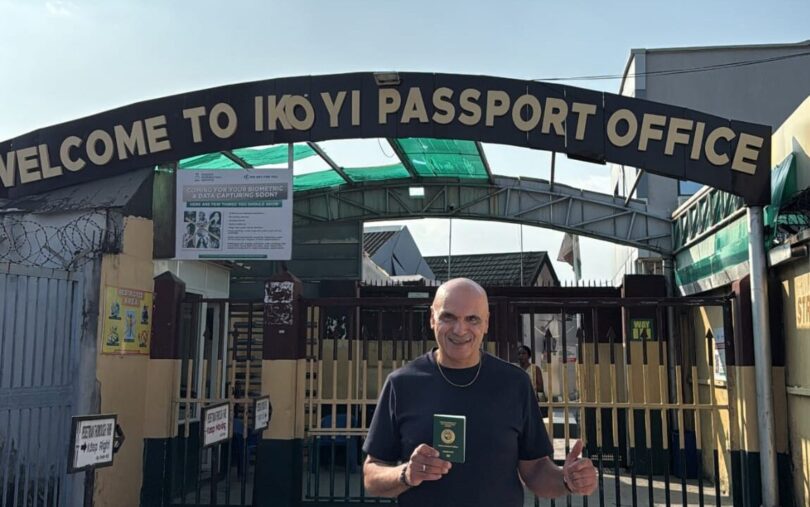
Today, the former president of the Jersey Football Association can finally call himself a Nigerian citizen
For more than two decades, Ricky Weir’s quest to reconnect with his Nigerian heritage remained a deeply personal journey marked by unanswered questions, painstaking research and emotional discoveries.
The Scottish-born football administrator, philanthropist and author recently received his Nigerian passport, bringing to fruition a 26-year search to trace the roots of his late father, who was born in Nigeria.
Mr Weir, founder of the Jersey to Africa Football Foundation, arrived in Lagos last week to receive an award and continue his grassroots football development activities. But beyond football, the trip carried profound personal significance.
“I’m almost more thrilled to get my Nigerian passport than my British passport, which was a right by birth,” Weir said in an exclusive interview with PREMIUM TIMES.
“To think that a journey that started over 26 years ago would end with me holding a Nigerian passport based on my father’s birthplace, it’s something nobody, including myself, could have imagined.”
His story stands in stark contrast to the experiences of many Africans who seek opportunities and citizenship abroad. For Weir, the attraction was not economic but emotional—a desire to reconnect with a part of his identity that had remained elusive for much of his life.
Born in Glasgow to a Scottish mother and a Nigerian father, Weir never met his father, who died before he was born. His mother, facing intense social pressure as an unmarried woman in the 1960s, placed him for adoption shortly after birth.
Raised by adoptive parents in Scotland, Weir said he delayed searching for his biological roots out of respect for the family that brought him up.
“I never wanted my adopted parents to feel they were somehow not enough,” he explained. “My real parents were the people who raised me.”
The search eventually led him to uncover his father’s Nigerian heritage and establish connections with relatives and communities linked to his family history.
Football became the vehicle through which much of that journey unfolded.
A prolific striker in his playing days, Weir scored more than 50 goals in a season and played over 1,000 career matches before moving into football administration. He later served as president of the Jersey Football Association and established charitable initiatives aimed at using football as a tool for social development across Africa.
His relationship with Nigeria has grown steadily in recent years. This was his fifth visit to the country, where he has worked with Walking Football programmes and grassroots initiatives, including the Five Stars League in Abuja.
Weir was instrumental in introducing Walking Football to Nigeria in 2020 and said he was encouraged by the progress made since then, including the establishment of league competitions and the emergence of women’s teams.
Now armed with a Nigerian passport, he hopes to spend even more time in the country.
“The biggest thing is that I can come back whenever I want,” he said. “I don’t have to think about visas or costs anymore. It allows me to embrace the country more, spend time with family, and potentially shift more of my football development work to Nigeria.”
After 14 years of philanthropic work centred largely in Kenya, Weir believes the next chapter of his African journey may increasingly be written in the land of his father.