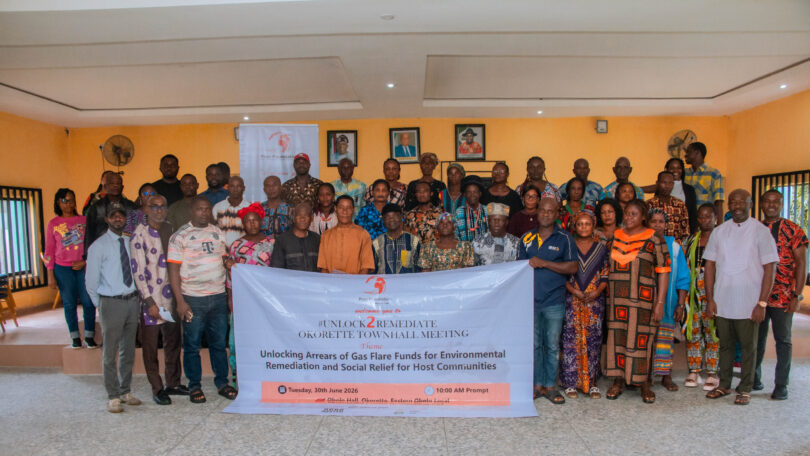
The foundation says many host communities remain unaware of their legal rights to gas flare funds earmarked for environmental restoration despite years of environmental degradation.
Residents of Eastern Obolo Local Government Area, an oil-producing local government area of Akwa Ibom State, have been urged to demand accountability in the management of gas flare funds earmarked for environmental remediation, as concerns grow over the ecological impact of decades of oil and gas production in the area.
Eastern Obolo hosts nine oil assets operated by five oil companies. They include Seplat Energy operator of OML 67, 68, 70 and 104 assets, Total Energies operating OMLs 99 and 100 assets, Sterling Oil operating OML 13, Amni International operating OML 112 and Esso Exploration and Production Nigeria, an affiliate of ExxonMobil operating deepwater oil block OML 139.
The initiative seeks to educate oil and gas host communities on the legal frameworks governing gas flare payments and their rights to advocate for the use of the funds to restore degraded ecosystems and support affected livelihoods.
Speaking at the event, the Executive Director of PEER Foundation, Mfon Gabriel, said many host communities have remained excluded from conversations on gas flare revenues despite bearing the environmental consequences of oil and gas operations.
He said the project, themed “Unlocking Arrears of Gas Flare Funds for Environmental Remediation and Social Relief for Host Communities,” was designed to equip residents with the knowledge required to demand transparency and accountability in the management of gas flare funds.
“Our objective is to ensure that host communities understand that these funds are provided for under the law for environmental restoration and social relief. Communities need the knowledge to engage institutions and demand accountability over how the funds are managed,” Mr Gabriel said.
He also presented a paper on Nigeria’s petroleum fiscal regime, explaining how gas flare payments accrued between 2021 and 2025 and their implications for Eastern Obolo and other host communities.
The State Support Officer of Connected Development, Ubong Ekpe, called on residents to play active roles in protecting their environment through community-based monitoring of remediation activities.
Delivering a presentation on “Restorative Ecology and Livelihood Security in Eastern Obolo: Why Mangrove Conservation and Toxic Cleanup Matter for Eastern Obolo Host Communities,” Mr Ekpe said environmental pollution from oil and gas operations continues to threaten fishing, farming and other traditional livelihoods.
He advocated the establishment of community monitoring committees to oversee environmental restoration efforts and encouraged regular engagement between oil companies and host communities to improve transparency and compliance with environmental obligations.
Also speaking, journalist and extractive governance analyst Ekemini Simon examined the legal provisions governing gas flare funds under the Petroleum Industry Act (PIA) 2021.
In a presentation titled “Navigating the PIA 2021: Understanding Your Right to the Environmental Remediation Fund and Guarding Against Executive Order 9,” Mr Simon explained Sections 104(1) to 104(4) of the Act, which provide for the utilisation of gas flare penalties for environmental remediation in affected communities.
He also discussed the implications of Executive Order 9 issued by President Bola Tinubu, which from February 2026 redirected gas flare revenues into the Federation Account, stressing the need for sustained civic engagement to ensure host communities continue to advocate for environmental justice.
Participants, including traditional rulers, women and youth leaders, welcomed the initiative, describing it as an important step towards addressing years of environmental degradation in Eastern Obolo.
They called for greater public awareness of existing legal protections and stronger collaboration among host communities in the Niger Delta to ensure gas flare revenues are deployed for environmental restoration.
PEER Foundation said the engagement forms part of a campaign that will be extended to other oil-producing communities in Akwa Ibom State, including Effiat in Mbo Local Government Area.
PREMIUM TIMES recently reported how an oil-producing community in Akwa Ibom State hosting nine oil assets drinks water from a corked oil well.