The lawmakers also defended the growing number of establishment bills, denied allegations of inducement in the legislative process and reaffirmed plans to advance state police and other constitutional reforms.
The House of Representatives has revealed that its members introduced 2,747 bills and passed 363 within the first three years of the 10th National Assembly, describing it as one of the most active legislative periods in recent history.
The presentation comes barely weeks after the 10th National Assembly marked its third anniversary on 13 June, a milestone the House leadership used to assess its achievements since members were inaugurated in June 2023.
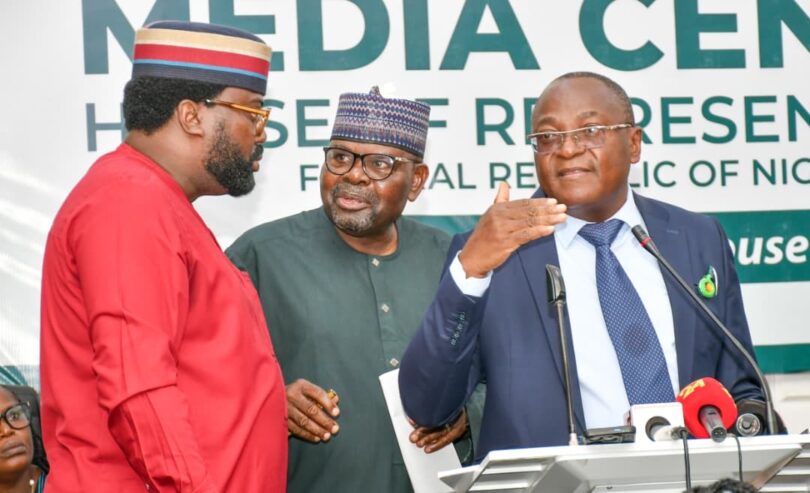
Addressing journalists in Abuja, the Chairman of the House Committee on Rules and Business, Francis Waive, said the volume of bills introduced and considered reflected the House’s determination to strengthen Nigeria’s legal framework and respond to emerging national challenges through legislation.
According to him, the 2,747 bills introduced since the inauguration of the Assembly comprise 57 Executive bills, 95 concurrence bills received from the Senate and 2,595 private members’ bills sponsored by lawmakers.
He said the House had passed 363 bills over the three legislative sessions, recording 89 in the first session, 148 in the second and another 126 during the just-concluded third session.
Mr Waive also provided a breakdown of activities during the third legislative year, stating that lawmakers introduced 484 bills, comprising 31 Executive bills, 391 private members’ bills, and 62 concurrence bills from the Senate.
Beyond lawmaking, he said the House deliberated on 220 motions during the session. Of these, 192 were referred to standing committees for further legislative work, while 28 were assigned to ad hoc committees. He added that 121 motions were admitted as matters of urgent public importance, while the lawmakers also considered 48 public petitions submitted by citizens and organisations.
According to Mr Waive, some of the major legislative measures passed by the House during the period include the 2026 Appropriation Bill, the Electoral Act 2026, constitutional amendment proposals that provide the legal framework for state police, tax reform legislation, and the Minimum Wage Act.
He said the various pieces of legislation were designed to improve governance, strengthen public institutions and promote the welfare of Nigerians.
“We are sharing this data with Nigerians because the House of Representatives is working. This is the scorecard for the session,” he said.
The House leadership also rejected allegations that lawmakers pay money to have bills listed for legislative consideration.
Mr Waive said comments by a member of the House, which gave rise to the allegation, had been misconstrued, explaining that the lawmaker was referring to the extensive consultations, lobbying and procedural work involved in building support for legislation rather than any financial payment.
Supporting the clarification, the House spokesperson, Akin Rotimi, who said he had personally sponsored more than 40 bills, maintained that the legislative process remains transparent and guided strictly by constitutional provisions and the Standing Orders of the House.
Mr Rotimi said every bill undergoes procedural scrutiny before it is admitted for first reading and subsequent legislative stages.
He said the Assembly’s legislative work should not be measured solely by the number of bills introduced compared to those passed.
He explained that many bills with similar objectives are harmonised into a single piece of legislation during the legislative process, resulting in fewer final bills than were originally introduced.
Mr Rotimi further disclosed that lawmakers have introduced more than 300 proposals seeking amendments to the Constitution, with many currently progressing through different stages of legislative consideration.
He said the House leadership was already reviewing its legislative agenda ahead of the fourth session to ensure that priority reforms are concluded before the end of the Assembly’s tenure.
“We’ve covered a lot of ground, but there is still a lot more to do. We are reviewing our legislative agenda internally to ensure that key promises made to Nigerians are delivered before the end of this Assembly,” he said.
Responding to questions from journalists, Mr Waive clarified that the Committee on Rules and Business does not maintain records of bills signed into law by the President.
He explained that once both chambers have passed a bill, documentation relating to presidential assent is handled by the Clerk of the National Assembly in conjunction with the Presidency.
Similarly, he noted that concurrence bills transmitted by the House to the Senate or received from the upper chamber are processed through the Clerk to the National Assembly after passage, while subsequent legislative procedures fall outside the committee’s responsibilities.
Mr Waive also defended the increasing number of establishment bills seeking to create new federal institutions, saying such legislation had produced tangible benefits in several parts of the country.
According to him, many of the approved establishment bills have led to the creation of public institutions, including Federal Medical Centres and other federal facilities, thereby expanding access to government services.
He dismissed suggestions that lawmakers were introducing such bills merely to increase the number of bills processed by the House.
Speaking on the proposed establishment of state police, Mr Waive explained that the constitutional amendment already approved by the House only creates the legal foundation for state-controlled police services.
He said a separate amendment to the Police Act would be required to spell out operational details, including command structure, oversight responsibilities and the relationship between state police formations and the Nigeria Police Force.
Looking ahead to the fourth legislative session, Mr Rotimi said lawmakers are expected to vote on about 40 constitutional amendment bills.
He said the proposals include measures to create reserved legislative seats for women, strengthen democratic institutions and introduce additional governance reforms aimed at improving Nigeria’s constitutional and political framework.