…Kaduna Textiles, Arewa Breweries, NISUCO Among Casualties
…Communities Left With Job Losses, Poverty, Abandoned Plants
At least 51 industries across northern Nigeria have shut down over the past three decades, with labour activists, former workers and industry stakeholders attributing the collapse largely to corruption, policy failures, poor infrastructure, smuggling and weak industrial governance.
The list of affected companies, now circulating among unionists and retired factory workers from Kano to Kaduna and Kwara, includes textile mills, sugar companies, breweries, fertiliser plants, paper mills, automobile manufacturers and food processing companies that once formed the backbone of the region’s economy.
NEWSNGR investigation, based on interviews with former workers, labour leaders, manufacturers, academic studies, archived reports and Bureau of Public Enterprises records, found that while some of the companies collapsed because of sector-specific challenges, many were brought down by recurring problems, including poor management, inconsistent government policies, inadequate power supply, smuggling and failed privatisation.
Where individual claims on the circulating list could not be independently verified, they are identified as unverified rather than presented as fact.
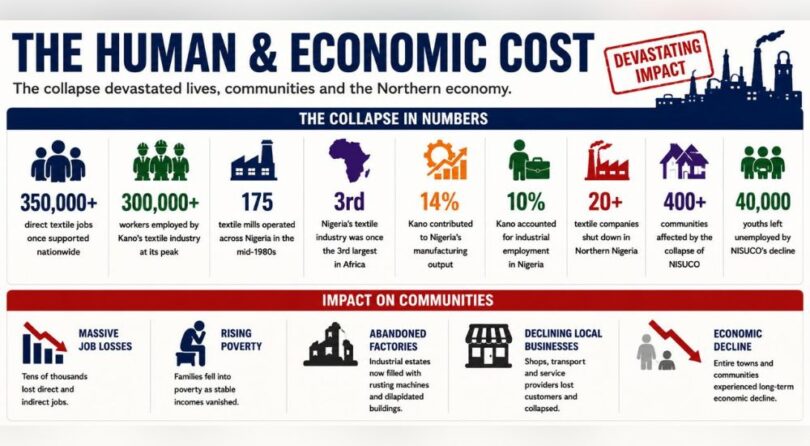
Among the hardest-hit sectors is the textile industry, which accounted for more than 20 of the companies on the list.
Nowhere was the decline more evident than in Kano, once regarded as the textile capital of West Africa.
The old Challawa Industrial Estate, once home to factories operating three shifts daily, now consists largely of abandoned buildings, rusting machinery and collapsed rooftops.
Former workers who still live around the industrial estate say the factories that once sustained thousands of families have remained silent for years.
The story of Kano’s textile mills reflects the wider decline of northern Nigeria’s industrial base.
It is a story shaped by colonial economic policies, post-independence industrial expansion, structural adjustment reforms, rising production costs, smuggling and insecurity that gradually weakened local manufacturing.
Kano’s textile tradition predates colonial rule.
The city was already a major centre for cotton weaving and indigo-dyed fabrics traded across West Africa.
That heritage remains visible at Kofar Mata, where dye pits established in 1498 are still used by families engaged in the traditional textile business.
Following colonial rule, British authorities established spinning and weaving mills to process locally produced cotton.
After independence, successive governments expanded the industry as part of efforts to industrialise northern Nigeria.
In 1949, the late Premier of Northern Nigeria, Sir Ahmadu Bello, established the Kano Textile Factory in Gwammaja and Kaduna Textile Mill to utilise cotton produced across the region.
The investments transformed Kano into one of Nigeria’s foremost manufacturing centres.
Industrial estates in Challawa, Sharada, Bompai, Independence Road and Club Road expanded rapidly as textile companies established production facilities.
By the mid-1980s, Nigeria had 175 textile mills located in Aba, Asaba, Funtua, Gusau, Kaduna, Kano, Port Harcourt and Lagos.
The industry had become the third largest in Africa after Egypt and South Africa, with factories operating above 50 per cent capacity.
According to the Textile Association of Nigeria, the industry employed more than 350,000 workers directly, making it the country’s second-largest employer after the Federal Government.
In Kano alone, textile factories employed over 300,000 workers and contributed significantly to Nigeria’s manufacturing output.
The city accounted for about 14 per cent of national manufacturing production and 10 per cent of employment in the country’s industrial sector.
Former workers interviewed by NEWSNGR recalled a period when factory employment provided stable incomes and supported thousands of households across northern Nigeria.
Among the companies that dominated the industry were Gaskiya Textile Mills, Kano Textile Limited, African Textile Manufacturers Plc and Tofa Textile Mills.
Each became a major employer in Kano and ultimately shut down.
The investigation found that while the circumstances differed from one company to another, the underlying challenges were largely the same.
Economic reforms introduced by government increased production costs through currency devaluation, rising interest rates and inflation.
At the same time, unreliable electricity forced manufacturers to depend heavily on diesel generators, significantly increasing operating costs.
Manufacturers also faced increasing competition from imported textiles, particularly products smuggled into Nigeria through neighbouring countries.
Industry stakeholders said these combined pressures steadily reduced production, weakened profitability and forced many companies to shut down.
Among the companies that survived longer than many of their competitors was Tofa Textile Mills Limited.
Located at Plots 104/105, Sharada Industrial Estate Phase II, Kano, the company specialised in cotton-based household textiles, particularly blankets, giving it a niche in the domestic market.
For decades, the company was led by its Managing Director, Salisu Usman Tofa, who also served as Chairman of the Manufacturers Association of Nigeria (MAN), Kano Chapter. In that role, he became one of the industry’s most vocal advocates, repeatedly highlighting the challenges confronting textile manufacturers in Kano.
By the outbreak of the COVID-19 pandemic, Tofa Textile was among the few textile mills still operating on a meaningful scale.