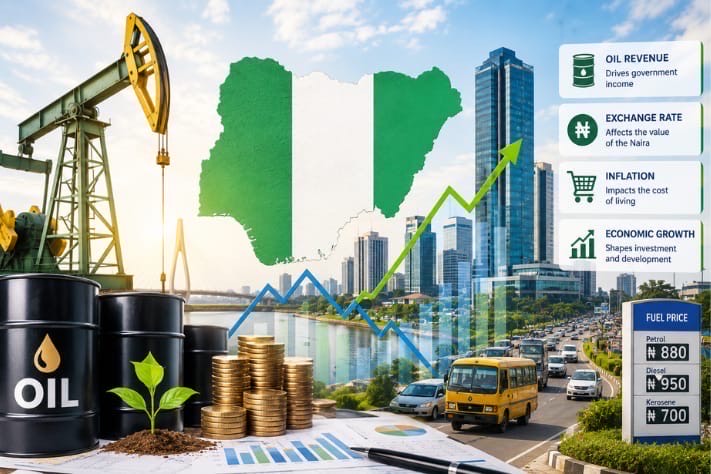
One of the clearest ways oil prices influence Nigeria’s economy is through the exchange rate. Higher oil revenues generally increase the flow of foreign currency into the country, helping to support the naira and improve liquidity in foreign exchange markets
Nigeria’s economic fortunes have for decades been closely tied to the global oil market. While the country has made efforts to diversify its economy, crude oil remains a critical source of government revenue and foreign exchange earnings.
This relationship is neither simple nor entirely predictable. Higher oil prices do not automatically guarantee prosperity, just as lower prices do not inevitably lead to crisis. The continued volatility in energy markets nonetheless means that oil continues to be one of the most important forces influencing Nigeria’s economic outlook.
Oil exports provide a major share of Nigeria’s foreign earnings. When global crude prices rise, government revenues tend to strengthen, creating greater room for public spending.
The challenge is that oil markets are notoriously unstable. Geopolitical tensions and shifts in global demand and broader economic uncertainty can all trigger rapid price swings.
This creates a difficult environment for long-term planning. Budget forecasts that appear comfortable during periods of strong prices can quickly come under pressure when markets weaken.
As a result, policymakers often find themselves balancing immediate opportunities against the risk of future volatility.
One of the clearest ways oil prices influence Nigeria’s economy is through the exchange rate. Higher oil revenues generally increase the flow of foreign currency into the country, helping to support the naira and improve liquidity in foreign exchange markets.
When prices decline, however, the opposite effect can emerge. Reduced export earnings place pressure on foreign currency reserves while increasing concerns about the availability of dollars.
This relationship has become especially important as importers and consumers deal with an increasingly globalized economy. Exchange rate movements affect the cost of imported goods and even everyday consumer products. In this way, changes in oil prices often move far beyond the energy sector itself.
Oil price volatility can also influence inflation, both directly and indirectly. Nigeria’s economy is still highly connected to energy costs. Transport expenses and manufacturing costs all respond to fluctuations in fuel prices. When energy-related costs increase, businesses frequently pass at least part of the burden on to consumers.
The result can be higher prices for a wide range of goods and services. For households already managing rising living costs, this creates additional pressure on budgets and spending decisions.
Periods of stronger oil revenues might provide government with greater flexibility to support economic programmes or infrastructure projects that stimulate growth. The benefits, however, are often uneven and can take time to filter through the broader economy.
One of the recurring themes in discussions about Nigeria’s future is the need to reduce dependence on oil.
The country has made notable progress in sectors such as technology, telecommunications, agriculture and financial services. These industries are increasingly contributing to economic activity while creating opportunities that extend beyond the energy sector.
Diversification is a long-term process rather than a quick solution. Oil is deeply embedded in Nigeria’s fiscal structure, meaning global price movements continue to exert a powerful influence on national economic performance.
For many analysts, the real question is how quickly other sectors can grow large enough to reduce the economy’s exposure to external energy shocks.
Oil price volatility is likely to remain a defining feature of Nigeria’s economy for years to come. Global energy markets are evolving and the transition toward alternative energy sources is creating new questions about long-term demand.
Nigeria faces a delicate balancing act against this backdrop. The country must continue to benefit from its energy resources while building a broader and more durable economic foundation.
The country’s future will not be determined by oil prices alone. That said, as long as crude exports remain a major source of revenue and foreign exchange, every rise and fall in the market will continue to influence the direction of Africa’s largest economy.