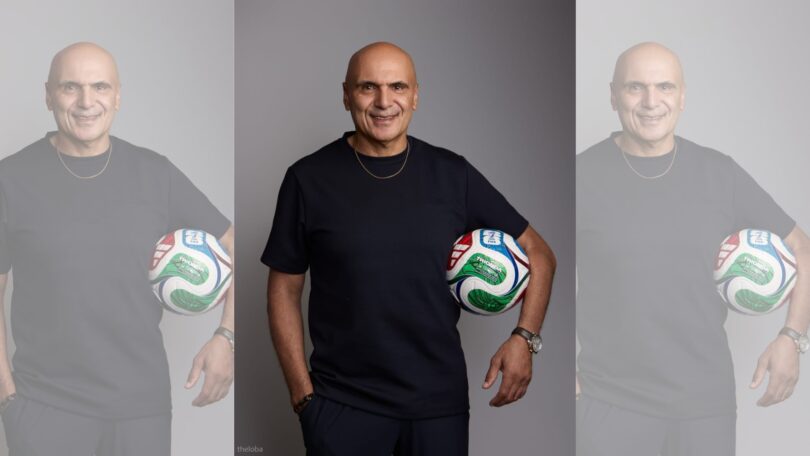
In this exclusive interview with PREMIUM TIMES, Mr Weir speaks about tracing his Nigerian roots, obtaining Nigerian citizenship, and also about the recent innovations by FIFA
President of Jersey 2 Africa 4 Football Foundation and former Jersey FA President, Ricky Weir, recently visited Nigeria to promote his award-winning memoir, Illegitimately Blessed, support grassroots football initiatives and strengthen the country’s growing Walking Football movement.
PT: Why are you in Nigeria? Is this your first visit?
Ricky Weir: No, this is actually my fifth visit to Nigeria. I came primarily to receive an award, which was a wonderful honour. But while here, I’ve also been working with Walking Football groups in Lagos and Abuja, and supporting grassroots football initiatives.
I attended the opening of the Five Stars League in Abuja, which I think is one of the best grassroots football programmes of its kind. I was very impressed by what I saw. I also used the opportunity to complete some personal matters connected to my Nigerian heritage.
PT: You have spoken extensively about your Nigerian roots. Why was it important for you to obtain Nigerian citizenship?
Ricky Weir: The simple reason is that I wanted to be able to come back to Nigeria whenever I choose without the restrictions and costs associated with visas.
But beyond that, it represents something much deeper. The journey started more than 26 years ago when I began tracing my father’s roots. Finally holding a Nigerian passport because my father was born here is something I never imagined would happen.
Many people seek European or American passports. In my case, I was pursuing a Nigerian passport. For me, it is about identity and connection.
PT: Tell us about your father and your journey to discovering your roots.
Ricky Weir: My father was Nigerian, and my mother was Scottish. Unfortunately, my father died before I was born, so I never met him.
My mother was pregnant and unmarried in the 1960s. She faced enormous pressure and was eventually placed for adoption shortly after birth.
Wonderful adoptive parents in Scotland raised me. For many years, I resisted searching for my biological family because I never wanted my adoptive parents to feel they were somehow inadequate. They were my parents because they raised me.
Eventually, I felt it was time to understand where I came from. That began a long search that ultimately led me to Nigeria.
PT: What aspects of Nigerian culture stand out to you?
Ricky Weir: Nigerians are straightforward. Sometimes that can appear a little harsh at first, but once people get to know you, there is tremendous warmth and kindness.
I’ve always been made to feel welcome here. I feel an emotional connection to Nigeria because of my father, and that connection continues to grow with every visit.
PT: Tell us about your football journey.
Ricky Weir: Like many children in Scotland, football was simply part of everyday life. We didn’t have computers or mobile phones. We had football.
You would grab a ball and go outside to play. It was the easiest and most accessible sport. That’s why football became the world’s game.
I started playing from a very young age and eventually developed into a striker. During the best years of my career, I was an out-and-out goalscorer.
PT: Did football help you navigate some of the challenges you faced growing up?
Ricky Weir: Absolutely.
Growing up as a mixed-race child in Scotland during the 1960s and 1970s wasn’t always easy. At that time, there wasn’t even a common term like “mixed race.” You were generally labelled as either white or black.
I experienced discrimination and name-calling. Football became my sanctuary. It was the one place where I felt accepted. People might not have welcomed me everywhere, but they rarely turned me away from a football game.
Football gave me confidence and helped shape who I became.
PT: You often mention Pelé when discussing your childhood. Why?
Ricky Weir: The 1970 World Cup was a huge moment. Colour television was becoming widespread, and people were watching Pelé and Brazil.
Because of my skin colour, people would jokingly call me “Pelé.” I was very happy to accept that comparison. It made me feel proud.
In fact, one of the chapters in my book is titled Glasgow Pelé.