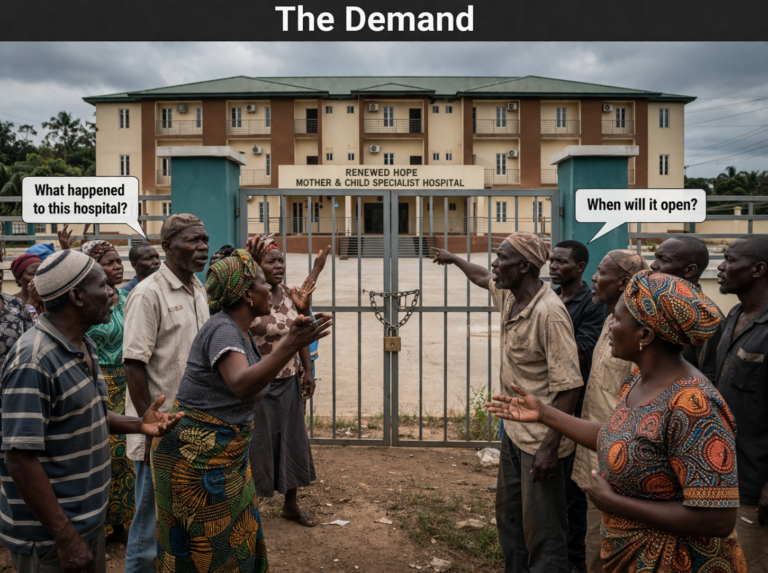
Almost a year after the Mother and Child Hospital was commissioned in Akwa Ibom, it remains closed.
One midnight in September 2025, as labour pains intensified, Blessing Okon was rushed through the dark roads of Oko-Ita in Ibiono Ibom Local Government Area of Akwa Ibom State in search of help.
She and her husband went to a primary healthcare centre (PHC) in Ikot Usen, about 30 minutes away. When they arrived, no health worker was on duty.
They waited nearly an hour as her condition worsened. No help came.
“I had felt the signs earlier but thought it was not serious and could wait till morning,” Mrs Okon recalled.
With no alternative, her husband drove her back home, where a traditional birth attendant (TBA) was called in to assist with the delivery.
The outcome was severe.
Mrs Okon said she suffered complications and heavy bleeding that left her unable to walk properly or carry heavy objects for months.
“The TBA tried her best. At the time, I had already become weak and lost a lot of blood,” she said. “If not for the intervention of the TBA, I would have died.”
The irony is that the facility meant to tend to such emergencies was within reach but remained closed.
The Renewed Hope Mother and Child Hospital in Oko-Ita, a 100-bed specialist facility built to serve Ibiono Ibom and surrounding communities, had been commissioned months earlier but had never opened its doors.
A paved access road leads into the compound. Streetlights line the entrance. Air-conditioning units are fixed along its walls. But behind the gates sit empty wards and silent corridors.
There are no patients. No staff. No activity.
“We live close to the facility; it is even within walking distance,” Mrs Okon said. “But I couldn’t go there because it was locked.”
Nigeria continues to record some of the highest maternal and child mortality rates in the world, with tens of thousands of women dying each year from pregnancy and childbirth-related complications.
The major drivers include delayed access to skilled care, weak health infrastructure, and shortages of trained health workers.
According to the 2024 Nigeria Demographic and Health Survey, Akwa Ibom has one of the lowest percentages (38.6 per cent) of live births delivered in a health facility in the country. It ranks lowest among Nigeria’s 17 southern states. It also ranks lower than five of the six north-central states and three out of six north-east states.
The report further shows that Akwa Ibom has one of the lowest percentages of births delivered by a skilled provider (51.5 per cent) in Nigeria, the lowest across the southern and North-central states except Niger.
Akwa Ibom State has a maternal mortality rate of 774 per 100,000 live births, according to District Health Information Software 2, a free and open-source software platform primarily used for managing and analysing health information in Nigeria.
It was against this backdrop that the federal government, through the Office of the Senior Special Assistant to the President on Sustainable Development Goals, launched the Renewed Hope Mother and Child Hospitals initiative to expand access to maternal, neonatal, and child healthcare in underserved communities.
The initiative delivered purpose-built specialist hospitals across several states, designed to provide antenatal and postnatal care, safe delivery services, emergency obstetric care, neonatal care, and diagnostic support.
The Senior Special Assistant to the President on Sustainable Development Goals, Adejoke Orelope-Adefulire, described the hospitals as symbols of renewed hope for women, newborns, and families nationwide.
In Akwa Ibom, a 100-bed Mother and Child Hospital was commissioned in Oko Ita, Ibiono Ibom LGA, on 6 August 2025. The facility was expected to serve more than 24 communities and about 30,000 residents.
Community leaders said the commissioning raised expectations. David Udofia, the head of Oko-Ita, recalled that residents trooped out in large numbers for the event, hopeful that access to quality maternal care had finally arrived.
“We were thankful to the government and believed that in no distant time, the hospital would become operational and our women and children would begin to access care close to home,” he said.
Similarly, the village head of Ikot Obong, Okon Robert, said the facility quickly became a symbol of hope for women who had long endured difficult, sometimes fatal, childbirth experiences.
At the commissioning, Governor Umo Eno, represented by his deputy, Akon Eyakenyi, said the hospital would strengthen healthcare delivery in the state and expand access to affordable services, particularly in rural communities.
Months after its commissioning, the Renewed Hope Mother and Child Hospital in Oko-Ita remains closed and unused.
Visits to the facility in May and June show a completed structure standing idle. The compound is quiet. There is no movement of patients or staff.
The gates remain locked. Inside, wards and consultation rooms are empty. Equipment installed in the facility has never been used.