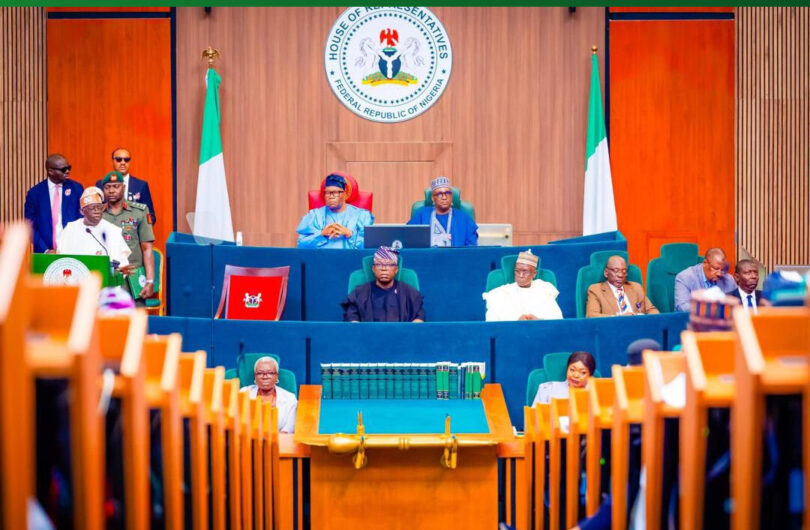
Mr Tinubu said his administration is committed to reorganising Nigeria’s security architecture to adequately protect the lives and property of citizens.
President Bola Tinubu has transmitted a constitutional amendment bill seeking the establishment of state police to the Senate.
The Senate President, Godswill Akpabio, disclosed this in a letter read during an emergency plenary session on Tuesday.
Although the bill was transmitted with its various clauses, Mr Akpabio did not disclose their details. He only stated that the relevant provisions were attached to the proposed legislation.
In the letter, Mr Tinubu said his administration was committed to reorganising Nigeria’s security architecture to adequately protect the lives and property of citizens.
He said the proposed legislation would complement the version of the state police bill earlier passed by the House of Representatives in order to address the country’s growing security challenges.
“The bill builds on the significant work already done in this regard by the House of Representatives and the Senate, and incorporates additional safeguards to ensure that the creation of a dual policing structure to address our nation’s evolving national security challenges will be achieved quickly and effectively to the benefit of all Nigerians.
“The proposed legislation is a critical component of our administration’s strategy to reorganise Nigeria’s security architecture to better protect our citizens. And I’m confident that the Senate will act quickly to consider and pass this bill,” he said.
After reading the letter, Mr Akpabio referred the bill to the Senate Committee on Constitution Review for further legislative deliberation. He directed the committee to report back to the Senate on Wednesday for possible final consideration.
The Senate had on 11 June passed for second reading a separate bill seeking to establish state police after most senators supported it during plenary. The bill was expected to proceed to a public hearing where stakeholders would present their views and concerns.
However, with the president’s transmission of the constitutional amendment bill, it remains unclear whether lawmakers will still conduct a public hearing in line with parliamentary practice before the final passage of the legislation.
Over the years, there have been calls from some state governments and civil society organisations for localised policing as incidents of armed robbery, communal clashes and other security challenges increased.
A National Conference was convened during the administration of former President Goodluck Jonathan where the participants recommended the creation of state police as a strategy to reduce insecurity.
The insurgence of banditry, kidnapping, and other terrorism activities have increased pressure from governors and political leaders for the creation of state police.
In the absence of a formal state policing structure, some regions have established informal security outfits such as Amotekun in the South-west, Ebube Agu in the South-east, and Hisbah in the North-west.
Despite the security challenges, the call for a state police is still a contentious issue among political figures. Some argued that without proper arrangements, state police could be exploited by governors to harass political opponents, suppress dissent, and stifle press freedom. Others said the best way to reduce insecurity is through state policing.
Recently, the Senate President, Godswill Akpabio, said the proposed state police framework would provide for the establishment of a National State Police Commission to regulate the operations of state police formations, including the recruitment, training, promotion, discipline, and conduct of officers.