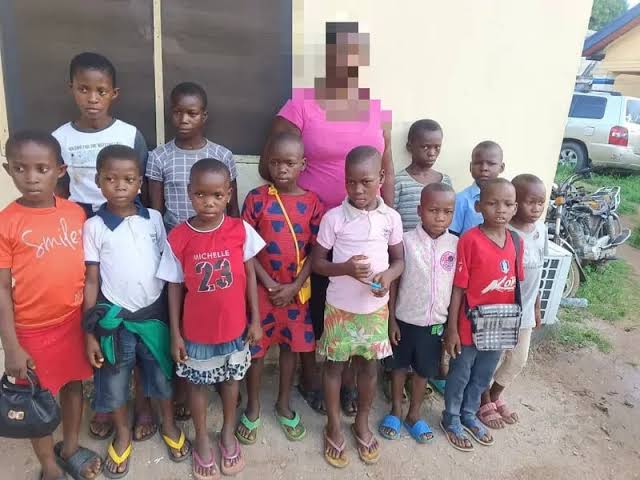
Conflict, displacement and economic hardship in Benue State have created conditions that traffickers exploit to traffic children and women.
From where she sat under a mango tree beside two huts and an old three-bedroom bungalow, Hembadoon Tervershima watched a motorcycle turn onto the narrow footpath that ended in the compound.
“I still wait for her every day,” she said quietly. “Sometimes I thought I heard her voice.”
Joy Tervershima was 15 when she left for school one morning in Zaki Biam, headquarters of Ukum Local Government Area in Benue State. That was the last time a family member saw her. Her disappearance came years after armed attackers displaced her family and thousands of other residents from their ancestral home in Guma Local Government Area. The family settled in Zaki Biam with their two daughters, hoping to rebuild their lives away from the conflict. That hope was short-lived.
Months passed before the family heard from police investigators that Joy had been trafficked through Lagos to Libya. Then, one day, nearly a year after she vanished, she called from an international code.
According to Mrs Tervershima, Joy said a man she knew in Zaki Biam had lured her and several other girls with a promise of jobs abroad.
“When they got to Libya, they realised they had been taken there for prostitution,” her mother said.
Joy told her family that many of the girls she travelled with from Benue died during the journey. She has spoken to her mother only twice since that call. The number has been unreachable.
“I don’t know if she is alive or dead,” her mother said.
Joy’s father died in December 2024 after suffering a stroke. Mrs Tervershima later heard that the suspected trafficker was well-known around the Zaki Biam International Yam Market. His whereabouts are now unknown.
Hundreds of kilometres away in another rural part of Benue, another trafficking network was targeting vulnerable teenagers with the same promises of jobs.
Among those drawn in were two 17-year-olds, Chivirter and Kashimana, from Logo Local Government Area. The two friends had grown up in rural communities where incessant violent attacks had disrupted farming and other means of livelihood.
According to the girls, a relative of one of them had offered them jobs in Benin City, Edo State. Neither teenager told her parents before leaving with the man.
At the time, Chivirter’s mother, Nancy, was in Taraba State. “I was shocked,” she said. “Nobody knew where she had gone.”
The girls said their journey to Benin City lasted nearly two days, during which they passed several security checkpoints.
“The security people only asked for money,” Kashimana said. “Nobody asked us where we were going.”
In Benin City, the girls were handed over to different women.
Kashimana’s “Madam” was one Mama Osas in the Akiwa area of the Edo State capital.
Chivirter had access to a mobile phone, which she used to organise her escape. Within a week, she fled back to Benue.
“I called my parents and told them I had been trafficked,” she said. “I told them I wanted to return home.”
Kashimana remained in Benin City for more than a year and told her parents that she had married.
“I knew they were worried,” she said. “I wanted them to move on.”
Kashimana said she was not forced into prostitution. “I heard about it because other girls were doing it,” she said.
She also alleged that Atsuku pressured her to invite other girls from Benue, offering between ₦90,000 and ₦120,000 for each person she brought into the network.
Both girls have since returned to Benue, but their families said the experience continues to affect them. Chivirter’s father said she became withdrawn after returning home.
“She is no longer the same person,” he said. “The experience changed her.”
Kashimana’s relatives described a similar change. Before leaving Benue, the two friends were active in church activities, including attending Sunday school. However, since their return, Kashimana has rarely participated.
“We feel ashamed,” Chivirter said. “We are always scared.”
PREMIUM TIMES found that traffickers targeted a different type of victims in the Guma Local Government Area of Benue State. Instead of individual teenagers, they target conflict-displaced families, offering education, food, and accommodation for their children.
Posing as aid workers, they tell parents their children would attend school and return home during Christmas and Easter holidays.