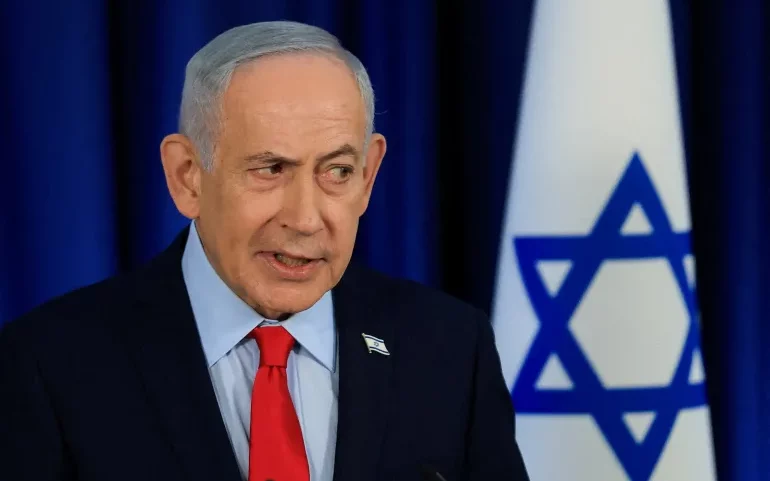
Mr Netanyahu’s office said Israel supported Washington’s decision to suspend strikes on Iran, on the condition that Tehran immediately reopened the Strait of Hormuz and halted all attacks on the United States, Israel, and other countries in the region.
Israeli Prime Minister Benjamin Netanyahu has thrown his support behind United States President Donald Trump’s two-week ceasefire agreement with Iran, but has made clear that the truce does not extend to Israel’s military operations in Lebanon.
“Israel also supports the US effort to ensure that Iran no longer poses a nuclear, missile and terror threat to America, Israel, Iran’s Arab neighbours and the world,” the statement read.
“The United States has told Israel that it is committed to achieving these goals, shared by the US, Israel and Israel’s regional allies, in the upcoming negotiations. The two-week ceasefire does not include Lebanon,” Mr Netanyahu added.
PREMIUM TIMES reported that the United States and Iran agreed to a two-week ceasefire on Tuesday, barely an hour before a deadline set by President Donald Trump for devastating strikes on Iranian infrastructure was set to expire.
The ceasefire has brought to an end, at least temporarily, a war that has killed thousands of people across the Middle East since it began on 28 February. The war started after the United States and Israel launched coordinated strikes that triggered a sweeping Iranian retaliation.
The ceasefire, brokered through Pakistani mediation, includes a temporary reopening of the Strait of Hormuz, one of the world’s most critical oil and gas transit routes, which Iran had blockaded since the start of hostilities.
Pakistan’s Prime Minister, Shehbaz Sharif, played a central role in securing the ceasefire. Late on Tuesday, he urged Mr Trump to extend his deadline by two weeks to allow diplomacy to proceed, and separately appealed to Iran to reopen the strait for the same period.
In a post on X (formerly Twitter), Mr Sharif announced that the parties “have agreed to an immediate ceasefire everywhere, including Lebanon and elsewhere, EFFECTIVE IMMEDIATELY.” He also said he had invited Iranian and American delegations to meet in Islamabad on Friday for in-person talks. The warring parties have agreed to be at the talks.
Mr Netanyahu’s statement was a direct response to Mr Sharif’s announcement. The Israeli leader’s statement effectively contradicted Mr Sharif’s characterisation of the ceasefire’s scope.
On Wednesday, Lebanon’s National News Agency reported that Israeli forces continued to carry out attacks on the southern parts of the country.
Israeli forces bombed the southern town of Srifa in the Tyre region and issued an evacuation warning for a building near the town.
In a statement on Wednesday, the Lebanese army urged residents to hold off on returning to areas in the south.
“In light of regional developments and reports circulating about a ceasefire, [the army] urges citizens to wait before returning to southern villages and towns and to avoid approaching areas where Israeli occupation forces have advanced… since they may be exposing themselves to the ongoing Israeli attacks,” the army said.
There was no immediate response from Hezbollah or the Lebanese government to Mr Netanyahu’s announcement.
Lebanon was pulled into the US-Israel conflict against Iran on 2 March, after Tehran-aligned Hezbollah launched a series of attacks on Israel.
Hezbollah said the strikes were in retaliation for Israel’s killing of Iranian Supreme Leader Ayatollah Ali Khamenei on 28 February, the first day of the war, and for Israel’s near-daily violations of a ceasefire it had agreed to in Lebanon in November 2024.
That earlier truce had been brokered after more than a year of cross-border exchanges between Israeli forces and Hezbollah fighters, following Israel’s launch of its military campaign in Gaza in October 2023.
Lebanese authorities say Israeli attacks have killed more than 1,500 people and displaced over 1.2 million since 2 March. Israel has also launched a ground invasion of southern Lebanon, declaring its intention to seize additional territory as a buffer zone.