“The IVLP journey ultimately became more than a tour of American cities. It was an immersion into the forces shaping the modern global economy.”
When I was selected for the 2025 International Visitor Leadership Programme (IVLP), sponsored by the United States Department of State and the U.S government, I knew the experience would extend beyond a professional exchange. What I did not anticipate was how profoundly it would reshape my thoughts around trade, finance, development, culture, America, and the place of Africa in an increasingly interconnected world.
As a business and financial journalist, I occupied a fascinating position within the group. While many approached issues from the perspectives of policymaking, regulation, or investment, my role often involved placing those discussions within broader societal and continental (African) contexts. It was a position that required me to ask many questions—and yielded invaluable insights.
Our travels took us across several American cities, each offering a distinct lesson about economics, governance, culture, trade, technology, arts, and development.
In Washington, D.C., Philadelphia, and surrounding cities, discussions frequently revolved around global trade, tariffs, economic competitiveness, and development financing. One issue lingered in my mind throughout those conversations: Africa’s place in the global economy. The expiration of the African Growth and Opportunity Act (AGOA), which had provided duty-free access to U.S. markets for qualifying sub-Saharan African countries for twenty-five years, underscored a broader reality. Too often, Africa appears in global trade conversations as a footnote rather than a central participant.
But the numbers explain part of the dynamics. Africa’s share of U.S. trade remains relatively modest despite the continent’s enormous potential. Yet what fascinated me was the contradiction embedded in many policy discussions. Africa was frequently described as the future—a continent of demographic growth, expanding markets, and abundant opportunities—while simultaneously occupying only a peripheral position in practical trade calculations in today’s contexts. That contradiction often brought out my Pan-African instincts during discussions, earning me the affectionate nickname “Papa Africa” from a colleague.
Philadelphia added historical depth to those reflections. Unlike the intensity of Washington D.C, the city possessed a communal warmth that immediately resonated with me. At the National Constitution Centre, I encountered the story of America’s democratic evolution through engaging performances and historical exhibits. Standing beneath the symbols of American nationhood while spotting the Nigerian flag along Benjamin Franklin Parkway was a quietly moving experience. It served as a reminder that no matter how far one travels, identity remains a permanent companion.
From Philadelphia, the journey moved westward to Albuquerque, New Mexico, a city that felt unexpectedly familiar. Its landscapes, mountains, open countryside, and agrarian character reminded me of parts of northern Nigeria. Albuquerque offered a unique lens through which to examine the intersection of migration, trade, and economic opportunity. Located near the U.S.-Mexico border, it sits at the heart of conversations about migration and commerce that increasingly define contemporary American politics.
The city also revealed a paradox that resonated strongly with Nigerian realities. Despite being one of America’s leading oil and gas-producing states, New Mexico remains among its less affluent regions. The contrast immediately recalled Nigeria’s own long-standing resource paradox. Even though the contexts and peculiarities differ, It reinforced a lesson familiar to many developing countries: natural resources alone do not guarantee prosperity.
Yet Albuquerque was also a place of wonder. The Sandia Peak Tramway carried us above mountains; the city threw us into the inviting arms of indigenous Americans as volunteers (I love volunteering and enjoyed this part!), and the deserts offered an experience that was both exhilarating and fascinating. Driving through Los Alamos, Santa Fe, and stretches of desert landscape made me feel as though I had wandered into an episode of Breaking Bad, the iconic movie set in New Mexico.
More importantly, Albuquerque inspired reflections on how communities transform culture and storytelling into economic assets, most notably by hosting the biggest balloon festival in the world. As I encountered sites associated with popular television productions, I found myself wondering why Nigeria has done so little to preserve locations associated with its own iconic films and cultural heritage. Do we have any conscious creation of memories for iconic film locations for movies like Saworo-Ide, Isakaba, Arelu, Oleku, Ogbori-Elemoso, to mention but a few? Do we even recognise the place of seemingly inconsequential things like this in terms of memory, culture, tourism, and ultimately, commerce?
Dallas, Texas, offered perhaps the most significant professional lesson of the IVLP journey. During a meeting with a senior executive at FedEx, I posed a question about what I perceived to be an obvious gap in African logistics networks. His response was both simple and profound: a gap in a market does not necessarily mean there is a market in that gap. It was a familiar line that brought along a new, eye-opening meaning within the context of that conversation.
The observation challenged many assumptions. Moving goods between African cities can sometimes be easier through Europe or the Middle East than directly within the continent itself. While the logistical gap is obvious, sustainable commercial demand depends on infrastructure, connectivity, regulation, and economic viability. The lesson was clear: identifying opportunities is only the beginning; creating functioning markets requires far more across the continent.
Dallas also exposed us to discussions on trade policy, presidential history, and economic governance at institutions such as the George W. Bush Presidential Center. Beyond the policy conversations, however, the city revealed another side of economic development. Deep Ellum’s vibrant nightlife, cultural scene, and entertainment economy demonstrated how creativity and culture generate employment, attract investment, and contribute to urban prosperity. It was a friend’s birthday and Deep Elum provided perhaps the most entertaining ambience for us to celebrate him.
Meanwhile, the State Fair of Texas illustrated the sheer scale of a regional economy whose output rivals that of many countries.
If Dallas was about the vastness of its economy and commerce, Orlando was about imagination.
Long before I arrived in Florida, Orlando had existed in my consciousness through the music of Fuji legend Sikiru Ayinde Barrister. Decades ago, his lyrics transported listeners across America, naming cities that seemed distant and mythical. Orlando was one of them.
Upon moving away from Dallas, arriving Orlando felt like stepping into a memory.
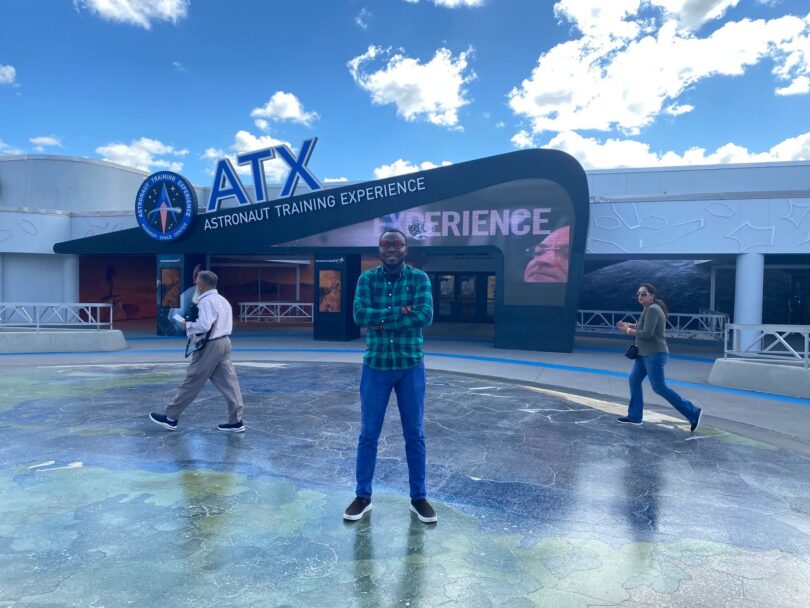
The city demonstrated how storytelling, creativity, and entertainment can become engines of economic growth. At the Kennedy Space Center, we became temporary astronauts, exploring humanity’s quest beyond Earth. At Universal Studios and Disney World, fiction came alive with astonishing realism. Yet beneath the attractions lay an important economic lesson: Orlando’s prosperity is not built solely on tourism. The city has developed a diversified economy that includes aerospace, education, healthcare, technology, and logistics.
What impressed me most throughout the IVLP journey was America’s ability to extract economic value from almost every opportunity—history, culture, sports, technology, entertainment, and even mythology. Whether at the Rocky Steps in Philadelphia, the deserts of New Mexico, the trade institutions of Texas, or the theme parks of Florida, there was a consistent effort to transform stories into industries and experiences into economic ecosystems that create value.
As the programme progressed, I found myself reflecting less on differences between Nigeria and the United States and more on the lessons that could travel across borders. The most enduring insights were not necessarily about trade balances, investment flows, or economic statistics. Rather, they concerned institutions, infrastructure, innovation, and the ability of societies to convert potential into reality.
The IVLP journey ultimately became more than a tour of American cities. It was an immersion into the forces shaping the modern global economy. It revealed the opportunities and limitations confronting Africa, the importance of regional integration, the value of private capital, and the power of ideas in driving development.
Most importantly, it reinforced my belief that Africa’s future will not be determined by projections alone or the sheer size of its youth population. It will depend on how effectively the continent transforms its immense possibilities into tangible outcomes.
As I travelled from Washington to Philadelphia, from Albuquerque to Dallas, and finally to Orlando, I carried with me a singular objective: to understand the world more clearly and to situate those lessons within the context of Nigeria and Africa.
The IVLP experience didn’t only sharpen my insight on trade, finance and development, it brought with it a new set of friends and felt like family in less than a month from the wonderful team of co-ordinators (Meghan, James, Teresita and the amazing, deeply understanding Ruth) through Sasa, the ever-friendly humour merchant; the super-articulate Haleem Anila; Bondarenko; Alvaro; Chavez; Domini; Viorel; Fabio; Narine; Abdul; Jelena; Antoine; the cool Bruno; and Haleemah, a worthy companion.
My amazing Albuquerque teammates— Fryad, Damir, GHOUBONTNI Soufiene, the ever-graceful Daniele, and the ever-smiling duo of Liisa and Aditi Sharma – made life in New Mexico quite unforgettable.
I returned to Lagos with many answers, even more questions, and a deeper appreciation of the complex relationship between trade, development, culture, and human aspiration.
For God and Country.
Oladeinde, an IVLP Fellow and muti-award-winning journalist, is the Business & Economy Editor of PREMIUM TIMES