Top Stories
“Judicial Prestige Must Be Earned Through Impartiality, Courage And Transparency” — PUNCH Says US Visa Ban Should Be Wake-Up Call For Judiciary

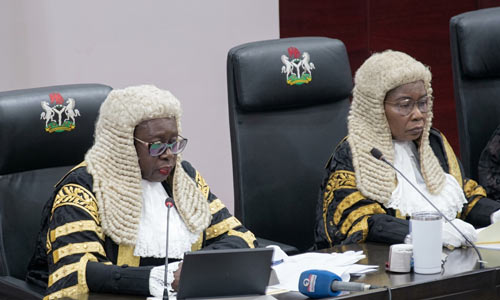
The PUNCH Editorial Board has called for deeper accountability and structural reforms in Nigeria’s judiciary following the revelation by retired Supreme Court Justice Uwani Abba-Aji that members of a Supreme Court panel were subjected to United States visa restrictions over a controversial judgment.
In an editorial published on November 26, PUNCH said the disclosure had again placed the Supreme Court under intense scrutiny and raised questions about the reputation of the judiciary and public confidence in its decisions.
Abba-Aji had said during her valedictory session that one of the judgments delivered while she served on the Supreme Court was “widely misinterpreted” and resulted in a travel ban being imposed on members of the panel.
PUNCH, however, argued that describing the judgment as merely misunderstood was not enough to address the wider concerns surrounding the development.
The newspaper said judicial decisions are increasingly subjected to domestic and international scrutiny and maintained that judicial authority does not shield court decisions from legitimate criticism.
The editorial cited several controversial judgments, including disputes arising from the 2023 senatorial elections involving Godswill Akpabio and Ahmad Lawan, as examples of cases that had fuelled public suspicion about the consistency of judicial outcomes.
It also revisited the January 14, 2020, Imo State governorship judgment in which the Supreme Court overturned the election of Emeka Ihedioha and declared Hope Uzodimma governor after adding votes from 388 polling units.
PUNCH said the controversies surrounding such judgments had contributed to the perception that electoral contests increasingly end in court rather than at the ballot box.
It recalled the warning of the late Justice Centus Nweze, who dissented when the court rejected Ihedioha’s application for a review of the judgment, that the decision would continue to affect Nigeria’s electoral jurisprudence.
The editorial also referred to the Orji Uzor Kalu case, where the Supreme Court set aside his 12-year conviction on jurisdictional grounds and ordered a retrial after holding that the trial judge lacked jurisdiction following his elevation to the Court of Appeal.
Beyond judicial decisions, PUNCH expressed concern about what it described as the growing proximity between some judicial officers and political authorities.
The newspaper recalled criticism that followed the attendance of then Acting Chief Justice of Nigeria, Tanko Muhammad, and other judicial officers at an Iftar dinner hosted by then President Muhammadu Buhari while presidential election petitions were pending.
“Justice must not only be done; it must be seen to be done,” the editorial stated.
PUNCH also cited disciplinary actions taken by the National Judicial Council against some lower court judges, arguing that such sanctions, while necessary, also showed the scale of the institutional challenges facing the judiciary.
It therefore urged the NJC to strengthen its investigative capacity, impose firm and transparent sanctions where misconduct is established, and ensure that accountability extends to all levels of the judiciary.
“No judge should be considered too senior, influential or politically connected to face scrutiny,” the editorial said.
The newspaper also called for structural reforms in judicial appointments, arguing that the selection of the Chief Justice of Nigeria, President of the Court of Appeal and chief judges should be better insulated from political influence.
It proposed an independent and broadly representative appointments commission to play a major role in identifying, screening and recommending judicial candidates based on competence, integrity and professional merit.
PUNCH said such reforms should also allow meaningful public participation while preserving judicial independence.
As Nigeria approaches the 2027 general elections, the newspaper urged the Supreme Court and the wider judiciary to undertake what it described as serious institutional soul-searching, warning that the credibility of elections would depend not only on INEC but also on the integrity of courts that adjudicate electoral disputes.
It warned that doubts about judicial integrity could weaken democracy, erode confidence in the rule of law and discourage investment.
Concluding, the editorial said the lesson from the reported US visa restrictions should be clear.
“Judicial prestige cannot be sustained by constitutional status or the grand trappings of office,” PUNCH said, adding that it must instead be earned through “impartiality, courage, transparency and fidelity to the law.”
.. “Judicial Prestige Must Be Earned Through Impartiality, Courage And Transparency” — PUNCH Says US Visa Ban Should Be Wake-Up Call For Judiciary … NewsNGR.


Kano govt dismisses Kwankwaso’s EFCC allegations against Governor Yusuf

Widow demands prosecution of police officers linked to dead husband’s disappearance

FG Boosts Safe Blood Services With New Centre In Kebbi

Eguavoen names Nnadozie, Oshoala, 22 others for Algeria friendlies

FIFA confirms cyberattack as hackers steal personal, business data

Fountain Of Life Church Challenges Bench Warrant Against Jimmy Odukoya

Lagos cancels November environmental sanitation exercise over INEC mock accreditation

Kebbi doctors hail Gov. Idris over welfare, retirement age extension
Jumia Nigeria Unveils ‘No Manage Am’ Black Friday 2026 Campaign With Up To 60% Off
“User Funds Are Completely Safe” — Binance Investigates Suspected $6.3 Billion Hack, Suspends Deposits And Withdrawals
ADC Postpones Presidential Campaign Flagoff, Fixes New Date
Abuja court to rule on joinder application in Pantami-PDP suit
Davido features Chioma in ‘Already Falling’ video, recreates proposal scene

“Airlines Increase Seat Availability But Do Not Necessarily Reduce Airfare” — Christmas Return Tickets Hit ₦822,000 As Carriers Expand Flights Across Nigeria
IAEA can’t verify location of Iran’s nuclear material – Rafael Grossi
Troops Neutralise 44 Terrorists In Borno, Disrupt IED Attack

 Business3 days ago
“Airlines Increase Seat Availability But Do Not Necessarily Reduce Airfare” — Christmas Return Tickets Hit ₦822,000 As Carriers Expand Flights Across Nigeria
- Special Reports3 days ago
Zamfara Govt Suspends Campaign In Maru LGA Following Fatal Accident In Gummi
- Top Stories5 days ago
“1,571 Tractors Deployed To 23 States” — APC PCC Lists Agriculture Interventions As Tinubu Approves ₦1.5tn BOA Recapitalisation
- News3 days ago
NAFDAC Threatens Prosecution Over Illegal Pharmacy Raids In Edo
- Business7 days ago
“₦1,472/$ In Parallel Market, ₦1,394/$ At Official Window” — Naira Weakens Further Against Dollar
- Top Stories5 days ago
“We Are Examining The Video” — Daura Emirate Launches Probe Into Tourist’s Sexual Assault Allegations Against Emir Faruk Umar Faruk
- News5 days ago
One Dead As Fire Guts Lagos Filling Station
 Politics3 days ago
ADC Demands Tinubu’s Impeachment Over Gov Yusuf’s S’Court Revelation