The lawmakers say Nigeria’s democracy is in serious decline, citing alleged constitutional violations, persistent budget underperformance, opaque public spending, and worsening insecurity.
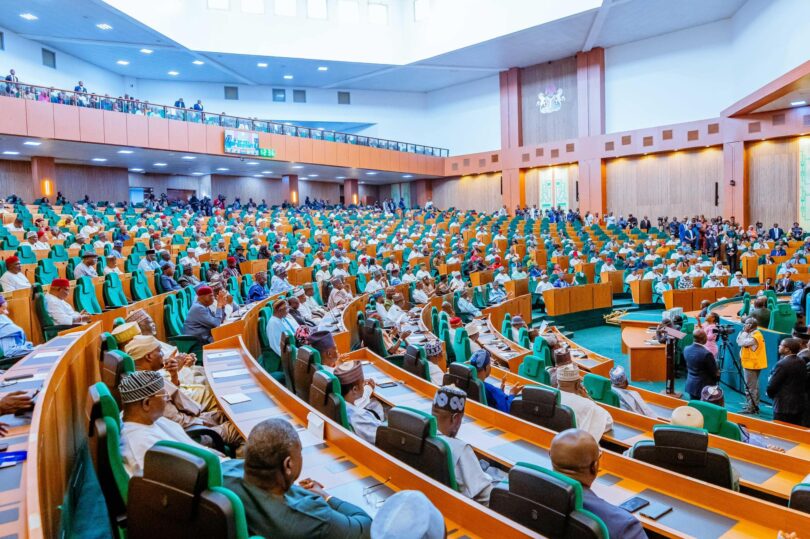
Some serving members of the House of Representatives, operating under the banner of the Save Democracy Group (SDG), have warned that Nigeria’s democracy is facing a dangerous decline, citing alleged constitutional violations, chronic budget under-implementation, opaque public spending, worsening insecurity and growing economic hardship.
SDG described itself as a non-partisan platform of members of the 10th National Assembly committed to defending democracy, constitutional governance, legislative independence, accountability and the rule of law.
It stressed that its members cut across political parties and regions and insisted that it was neither an opposition platform nor a political pressure group.
“Our membership cuts across political parties, regions and ideological differences. We are neither an opposition platform nor an instrument of any political interest. We are legislators increasingly alarmed by the direction of Nigeria’s democracy,” the statement said.
The lawmakers accused public institutions of increasingly treating constitutional provisions as optional and warned that such practices threaten democratic governance.
They revisited the National Assembly’s approval of the declaration of a state of emergency in Rivers State in March 2025, arguing that the reliance on a voice vote was inconsistent with Section 305(6) of the Constitution, which requires approval by a two-thirds majority of all members of each chamber.
The group also questioned the House’s passage of the Executive State Police Constitutional Alteration Bill on 23 July 2026.
According to the statement, although Speaker Abbas Tajudeen announced that 311 lawmakers voted in favour of the bill, some members present throughout the proceedings maintained that fewer than the constitutionally required 240 members were physically present in the chamber.
The group alleged that the announced figure could only have been achieved by counting votes transmitted through WhatsApp by members who were not physically present during the proceedings.
It argued that Section 9(2) of the Constitution requires the affirmative votes of not less than two-thirds of all members before any constitutional amendment can be validly passed.
“The Constitution cannot be altered by presumption, improvisation or undisclosed voting arrangements,” the lawmakers said.
While acknowledging that state police may be a desirable reform, they insisted that constitutional amendments establishing it must strictly comply with constitutional procedures.
The lawmakers also expressed concern over what they described as persistent failures by the federal government to fully implement annual budgets.
They argued that the repeated extensions of budget implementation periods and the rollover of capital projects from one fiscal year to the next had weakened fiscal discipline and legislative oversight.
According to the statement, only about 30 per cent of the 2025 capital budget was reportedly funded, with approximately 70 per cent carried over into 2026.
The group cited remarks previously made by Senate Chief Whip Tahir Monguno, who reportedly described the failure to implement an Appropriation Act as a breach of the law that could amount to an impeachable offence.
The lawmakers endorsed that position, arguing that deliberate or persistent refusal to implement duly enacted Appropriation Acts raises serious constitutional issues.
They demanded comprehensive implementation reports for the 2024, 2025 and 2026 budgets; full disclosure of capital releases to ministries, departments and agencies; reconciliation of revenues with authorised expenditure; explanations for delayed capital releases; a joint parliamentary investigation into budget implementation failures; and constitutional action where deliberate non-implementation is established.
“An Appropriation Act is law, and the government cannot choose which laws to obey,” they stated.
The group further called for an independent forensic audit into reports of alleged off-budget public expenditure.
It referred to reports that the International Monetary Fund (IMF) estimated that public expenditure equivalent to about two per cent of Nigeria’s Gross Domestic Product, approximately ₦8.83 trillion, was not reflected in recent official budgets.
According to the lawmakers, if confirmed, such expenditure would represent a significant discrepancy between Nigeria’s declared fiscal deficit and its actual financing requirements.
They argued that allegations of unrecorded public spending warrant immediate legislative scrutiny and insisted that public funds must not be spent outside duly approved Appropriation Acts.
“This administration cannot demand sacrifice from Nigerians while public expenditure remains opaque,” the statement said.
The lawmakers maintained that every naira spent by the government belongs to Nigerians and must be fully accounted for through transparent appropriation and expenditure processes.
On insecurity, the group said the continued killings, kidnappings and displacement of citizens by terrorists, bandits and other criminal groups remained unacceptable.
The lawmakers also cited reports indicating that some security agencies had yet to receive capital releases despite the country’s worsening security situation.
They questioned what they described as disparities in government spending priorities, claiming that almost the entire allocation for the Presidential Air Fleet had reportedly been released, while only a small portion of funds appropriated for the Nigerian Army’s security equipment had been made available.
The lawmakers clarified that they were not opposed to maintaining the Presidential Air Fleet but argued that operational funding for security agencies should receive greater priority.