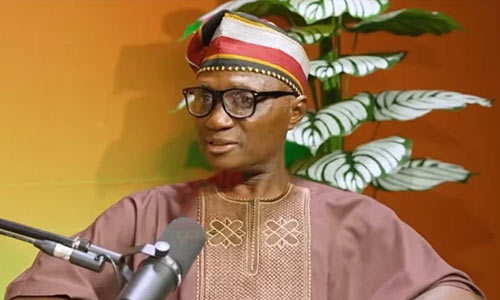
A professor at Obafemi Awolowo University, Tunji Ogunyemi, has warned that a return to petrol subsidy could severely weaken the finances of many Nigerian states, claiming that more than 15 states in the North could become unable to sustain government operations within three months.
Ogunyemi made the assertion during an interview on Open Forum 360, a podcast hosted by Dare Adekanmbi, while reacting to a proposal associated with African Democratic Congress presidential candidate and former Vice-President Atiku Abubakar on petroleum subsidy.
The professor described a return to the previous subsidy regime as potentially “calamitous,” arguing that it would significantly reduce the amount of money accruing to the Federation Account from which federal, state and local governments receive allocations.
According to him, the Federation Account remains the financial lifeline of the majority of Nigeria’s states.
“The Federation Account is the jugular of more than 30 states in the federation. Only about four states in Nigeria can survive without the Federation Account,” Ogunyemi said.
He identified Lagos, Delta and Rivers among states he believes have stronger capacity to withstand a significant reduction in federal allocations, while citing Taraba as an example of a state heavily dependent on Federation Account receipts.
Ogunyemi argued that any subsidy arrangement that substantially reduces the pool of revenue available for distribution could quickly place many northern states under severe financial pressure.
“So if you now say reduce the accrual from the account, I tell you more than about 15 states in the north will collapse. They will collapse within three months,” he said.
He said the immediate consequence would likely be a return to difficulties in meeting basic obligations, particularly the payment of workers and pensioners.
“The second is that states will return to a regime of incapacity to pay salaries, let alone pensions,” he said.
The university professor warned that the financial impact would not be limited to state governments, arguing that the Federal Government could also struggle to meet recurrent expenditure and finance capital projects if its share of revenues declined significantly.
He estimated that between 60 and 70 per cent of Federal Government spending goes to recurrent expenditure, which he described as “consumption expenditure.”
“That is consumption expenditure. You reduce the revenue in that respect, you will see a situation in which government will not be able to support its minimum expenditure, let alone go for capital expenditure,” he said.
Ogunyemi further warned that declining government revenues could affect Nigeria’s capacity to service its debts, with possible consequences for the country’s financial standing and creditworthiness.
He also questioned the political and economic basis of Atiku’s subsidy proposal, arguing that a former Vice-President should clearly explain the fiscal consequences of any attempt to restore such an intervention.
Atiku had argued that Nigerians had not sufficiently felt the benefits of subsidy removal and had questioned how the savings generated from the policy were being utilised.
He subsequently clarified that his proposal was not a return to the former import-based subsidy arrangement, but rather a targeted and capped intervention aimed at supporting domestic refining and production, with transparency and auditing mechanisms.
Petrol subsidy was removed by President Bola Tinubu on May 29, 2023. The policy resulted in sharp increases in petrol prices and transportation costs, while the Federal Government has maintained that subsidy removal was necessary to reduce fiscal pressure and free additional resources for the three tiers of government.
Ogunyemi’s projection that states could “collapse” within three months remains his assessment of the possible fiscal consequences of a subsidy return and is not an official government forecast.