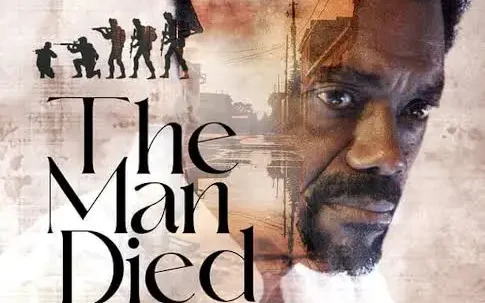
Bringing Wole Soyinka’s prison memoir to screen is an ambitious undertaking, and The Man Died is at its best when history gives way to the human story.
There are stories we tell because they are entertaining, and there are stories we tell because forgetting them carries a cost. The Man Died belongs firmly to the latter category.
The film stars Wale Ojo as Wole Soyinka, alongside Sam Dede, Norbert Young, Segilola Ogidan, Christinah Oshunniyi, Abraham Amkpa, Tmilolu Fosudo, Similoluwa Hassan and Ropo Ewenla.
Inspired by Soyinka’s prison memoir, The Man Died: Prison Notes of Wole Soyinka, the film revisits one of the defining periods of the writer’s life: his arrest and imprisonment during the Nigerian Civil War.
It had a special screening in Lagos on 12 July 2024 as part of activities marking Soyinka’s 90th birthday the following day, and subsequently travelled to international film festivals. The film was among the selections at the 2025 New York African Film Festival.
Published in 1972, The Man Died: Prison Notes of Wole Soyinka chronicles Soyinka’s experiences in detention during the Nigerian Civil War and has become an important part of his writings on political repression, freedom and resistance.
Soyinka had attempted to intervene in the conflict and secretly met Biafran leader Chukwuemeka Odumegwu Ojukwu as part of efforts to avert or end the war.
Federal authorities subsequently arrested him in 1967. He was imprisoned for about 22 months without trial, much of that period in solitary confinement, before his release in 1969.
The imprisonment occurred nearly two decades before Soyinka became the first African recipient of the Nobel Prize in Literature in 1986.
It is this younger Soyinka, the writer and activist confronting military power, imprisonment and isolation, whom Wale Ojo is tasked with bringing to the screen.
The Man Died follows Soyinka (Wale Ojo), a writer and public intellectual whose attempt to mediate during the Nigerian Civil War eventually contributes to his detention by the military government.
The film is set against the backdrop of the war between the Federal Government and the secessionist Republic of Biafra from 1967 to 1970.
The conflict was preceded by political instability, two military coups, ethnic killings and the displacement and massacre of thousands of people, particularly during the pogroms against Igbo people in parts of Northern Nigeria.
Soyinka’s intervention places him in an increasingly dangerous position. His meeting with Ojukwu and efforts to encourage a negotiated settlement are viewed with suspicion by the federal military authorities.
He is eventually detained without trial and spends about 22 months in confinement, much of it in solitary conditions.
From there, the film explores not only Soyinka’s imprisonment but also the political turmoil, relationships and convictions surrounding his decision to intervene.
Every adaptation comes with its own burden of expectation, particularly when it is based on a story familiar to its audience.
Such familiarity raises the stakes for filmmakers, who must balance fidelity to the source material with the demands of filmmaking.
Adapting The Man Died was never going to be easy.
The film begins with a powerful maxim attributed to Soyinka’s grandfather: “Death is never the end of a man, fear is.”
It is a fitting opening for a film centred on courage, resistance and survival.
From there, Mr Amkpa builds the narrative through party scenes from the 1960s, prison sequences, flashbacks, radio broadcasts, voiceovers and Soyinka’s clandestine writings.
Wale Ojo carries much of the film as Soyinka, portraying the writer during a period far removed from the Nobel laureate and global literary figure audiences know today.
Rather than presenting a conventional cradle-to-career biopic, The Man Died focuses on the man behind the literary icon, exploring the experiences, convictions, and choices that made Soyinka’s story worth telling.
The narrative moves between his imprisonment and earlier encounters with some of Nigeria’s notable political and literary figures, including writer Christopher Okigbo, politician Bola Ige and Biafran leader Emeka Ojukwu.
These encounters provide context for the political tensions that preceded and eventually erupted into the Nigerian Civil War.
The film also revisits the atmosphere of military coups, ethnic violence, political suspicion and the struggle for national unity that defined one of the most turbulent periods in Nigeria’s history.
The film’s biggest weakness is also a consequence of its biggest ambition.
The Man Died wants to educate. Sometimes, it wants to educate too much.
At its strongest, the film allows the audience to feel history through Soyinka’s fear, isolation and uncertainty. At weaker moments, it simply tells the audience what happened.